Winston Churchill
The Man Who Refused to Surrender
Born on 30 November 1874 at Blenheim Palace in Oxfordshire, Winston Churchill was Britain's Prime Minister through the Second World War, rallying the country to fight on alone in 1940. A soldier, journalist and historian, he won the Nobel Prize in Literature in 1953, while his imperial views and record in India remain fiercely debated.
- 17 min listen
- Prime Minister
- War leader
- Nobel laureate
Winston Churchill’s full 17 min audio biography, The Man Who Refused to Surrender, is available on Lyfestori for iOS. Listen to a free preview below.
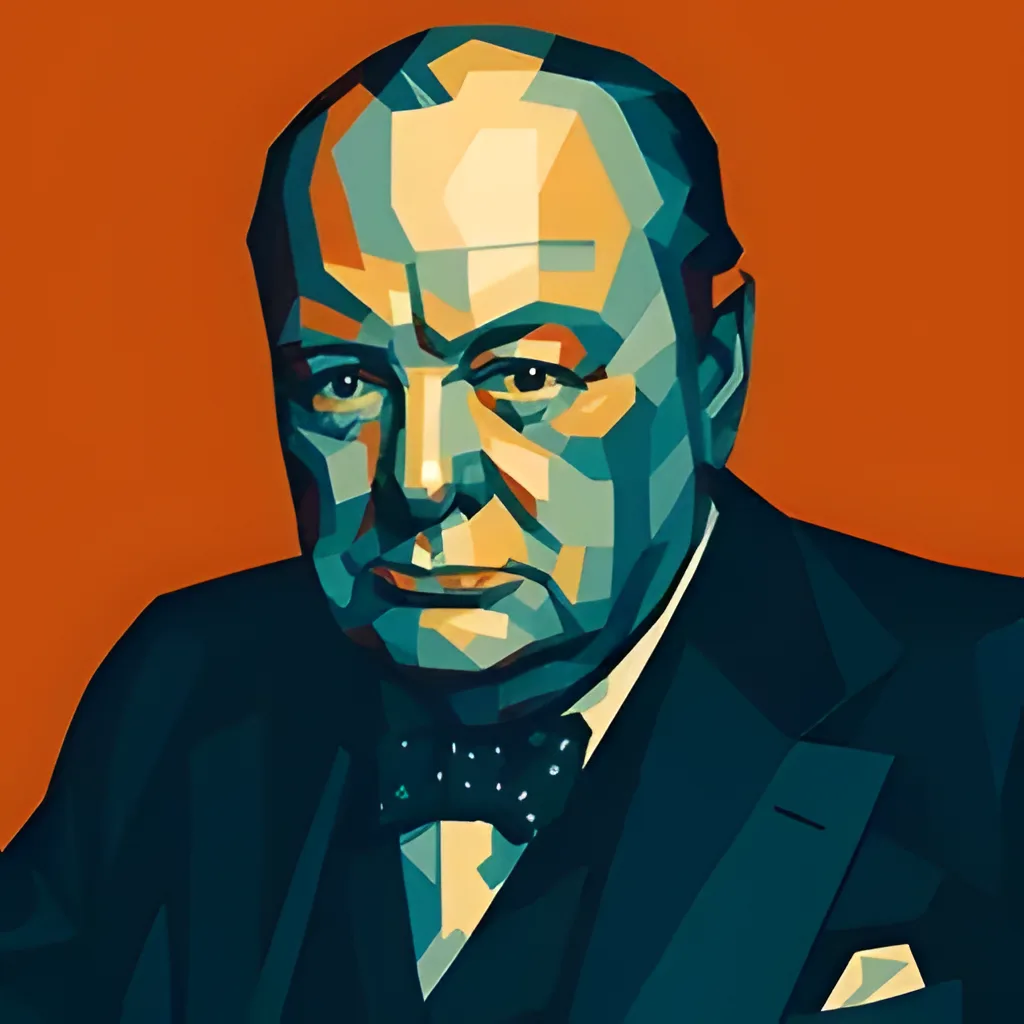
A life in brief
Winston Churchill: life and timeline.
He was neglected by his parents and loved by his nanny, failed the Sandhurst entrance exam twice, then went looking for wars: Cuba, India's North-West Frontier, the cavalry charge at Omdurman and an escape from a Boer prison in Pretoria. Winston Churchill was in Parliament at twenty-five, blamed for Gallipoli at forty, and out of office through the 1930s, warning about Hitler to colleagues who no longer trusted his judgement. In May 1940, at sixty-five, he became Prime Minister and refused to discuss peace terms.
- 1874
Born at Blenheim Palace
Born 30 November to Lord Randolph Churchill, a rising Conservative politician, and the American heiress Jennie Jerome. His closest bond in childhood is with his nanny, Elizabeth Everest.
- 1894
Sandhurst
After struggling at Harrow and failing the Royal Military College entrance exam twice, he graduates eighth in his class. His father dies the following January, aged forty-five.
- 1898
Omdurman
Having watched fighting in Cuba and served on India's North-West Frontier, he rides with the 21st Lancers in one of the British Army's last cavalry charges, at Omdurman in Sudan, and turns the campaign into a book.
- 1899
Escape from Pretoria
Reporting on the Boer War, he is captured after an armoured train is ambushed and spends his twenty-fifth birthday as a prisoner. His escape over the prison wall makes him famous across the Empire.
- 1900
Into Parliament
Elected Conservative MP for Oldham at twenty-five. In 1904 he crosses the floor to the Liberals over free trade; he rejoins the Conservatives two decades later.
- 1908
Marriage to Clementine
Marries Clementine Hozier. They have five children. In 1911 he becomes First Lord of the Admiralty and drives the Royal Navy's switch from coal to oil.
- 1915
Gallipoli
The Dardanelles campaign he championed collapses into a bloody stalemate. He is removed from the Admiralty and serves for a time as a battalion commander on the Western Front.
- 1938
The wilderness years
Out of office since 1929 and distrusted over India and the abdication crisis, he warns about German rearmament. After Munich he tells the Commons Britain has sustained "a total and unmitigated defeat".
- 1940
Prime Minister
Becomes Prime Minister on 10 May as Germany attacks in the west. Between 26 and 28 May he overrules Lord Halifax's push to explore peace terms through Mussolini; the Dunkirk evacuation brings home about 338,000 troops.
- 1945
Victory and defeat
Germany surrenders in May. On 26 July the general election results give Labour a landslide, and he leaves office.
- 1946
The Iron Curtain
In Fulton, Missouri, with President Truman beside him, he warns that an iron curtain has descended across Europe — a defining image of the Cold War.
- 1953
Second premiership and the Nobel
Back as Prime Minister since 1951, he suffers a serious stroke in June that is hidden from the public, and is awarded the Nobel Prize in Literature. He resigns in April 1955 at eighty and dies on 24 January 1965, aged ninety.
Major achievements
Winston Churchill: major achievements.
- 01
Leading Britain in 1940
With France falling and his own War Cabinet divided, he refused to open peace talks with Hitler and kept Britain in the war alone until the Soviet Union and the United States joined it in 1941.
- 02
The speeches
"Blood, toil, tears and sweat", "We shall fight on the beaches" and "Their finest hour" turned a military crisis into a story the country could believe in.
- 03
Nobel Prize in Literature
Awarded in 1953 for a lifetime of history, memoir and oratory, including his multi-volume history of the Second World War and his biography of his father.
- 04
The Grand Alliance
His partnership with Franklin D. Roosevelt and his uneasy dealings with Stalin held together the coalition that defeated Nazi Germany.
- 05
Modernising the Navy
As First Lord of the Admiralty from 1911 he converted the fleet from coal to oil and backed the early development of the tank through the Landships Committee.
Turning points
Winston Churchill: defining moments.
- 1899
Captured and escaped
Taken prisoner by the Boers after helping clear an ambushed armoured train, he climbed the wall of his Pretoria prison, hid with an English mine manager and escaped on a freight train. He came home a celebrity, and won a seat in Parliament the next year.
- 1915
The Dardanelles
He was the most visible sponsor of the attempt to force the Dardanelles and knock the Ottoman Empire out of the war. It ended in disaster, with hundreds of thousands of casualties. He was forced from the Admiralty, and Gallipoli followed him for two decades.
- 26–28 May 1940
The War Cabinet crisis
Halifax argued that Britain should explore terms through Mussolini while it still had bargaining power. Churchill refused, then took his case to the wider cabinet, whose fierce support isolated Halifax. Britain fought on.
- 1943
The Bengal famine
Roughly two to three million people died in the famine in British-ruled Bengal. Historians debate the balance of causes — war, inflation, shipping and colonial failures — but Churchill's own remarks about Indians have left a lasting stain on his reputation.
I have nothing to offer but blood, toil, tears and sweat.
House of Commons, 13 May 1940
What you’ll take away
Lessons from Winston Churchill’s life.
- 01
A record of failure is not a verdict
He failed exams, crossed the floor twice, owned Gallipoli and spent a decade out of office. None of it prevented him from being right about the decisive question of his life.
- 02
Unpopular warnings can be true
Through the 1930s he warned about Hitler to a Parliament that had stopped listening to him. The people who dismissed him were judging his past, not his argument.
- 03
Great leaders still need judging whole
The man who would not yield in 1940 also opposed Indian self-government and held harsh racial views. Both belong in the same biography.
If you liked Winston Churchill…
Browse all → Soviet Leader16 min
Joseph Stalin
The Dictator Who Ruled with an Iron Fist
 Independence Leader19 min
Mahatma Gandhi
The Father of a Nation
 President of Ukraine16 min
Volodymyr Zelenskyy
The Comedian Who Refused to Run
 European Commission President19 min
Ursula von der Leyen
From Doctor to Europe's Most Powerful Woman
FAQ
Frequently asked questions about Winston Churchill.
What was Winston Churchill's full name?
Sir Winston Leonard Spencer Churchill. He was a descendant of the Dukes of Marlborough, whose family surname is Spencer-Churchill, and was born at Blenheim Palace on 30 November 1874.
How did Winston Churchill die?
After a severe stroke. He died at his London home at Hyde Park Gate on 24 January 1965, aged ninety — seventy years to the day after his father's death — and was given a state funeral on 30 January.
Where did Winston Churchill go to school?
Harrow School, followed by the Royal Military College, Sandhurst. He never went to university; he educated himself through wide reading as a young officer in India.
What did Winston Churchill do in the First World War?
He began it as First Lord of the Admiralty. After the failure of the Gallipoli campaign in 1915 he left the government and commanded a battalion on the Western Front, then returned as Minister of Munitions in 1917.
Why did Winston Churchill lose the 1945 election?
Voters wanted a different government to build the peace. Churchill remained personally admired, but Labour's promises of social reform, housing and a welfare state won it a landslide.
Who was Winston Churchill's wife?
Clementine Hozier, whom he married in 1908. They were married for more than fifty-six years and had five children: Diana, Randolph, Sarah, Marigold and Mary.
Where is Winston Churchill buried?
At St Martin's Church in Bladon, Oxfordshire, close to Blenheim Palace where he was born.
Published by Lyfestori, from Duck Pond Ventures Oy. About us and how to report a correction.
17 min · one sitting