Mahatma Gandhi
The Father of a Nation
Born Mohandas Karamchand Gandhi on 2 October 1869 in Porbandar, India, Mahatma Gandhi trained as a lawyer in London, developed nonviolent resistance in South Africa, and led India's independence movement through campaigns like the Salt March — until he was assassinated in 1948, months after independence.
- 19 min listen
- Satyagraha
- Indian independence
- Non-violent resistance
Mahatma Gandhi’s full 19 min audio biography, The Father of a Nation, is available on Lyfestori for iOS. Listen to a free preview below.
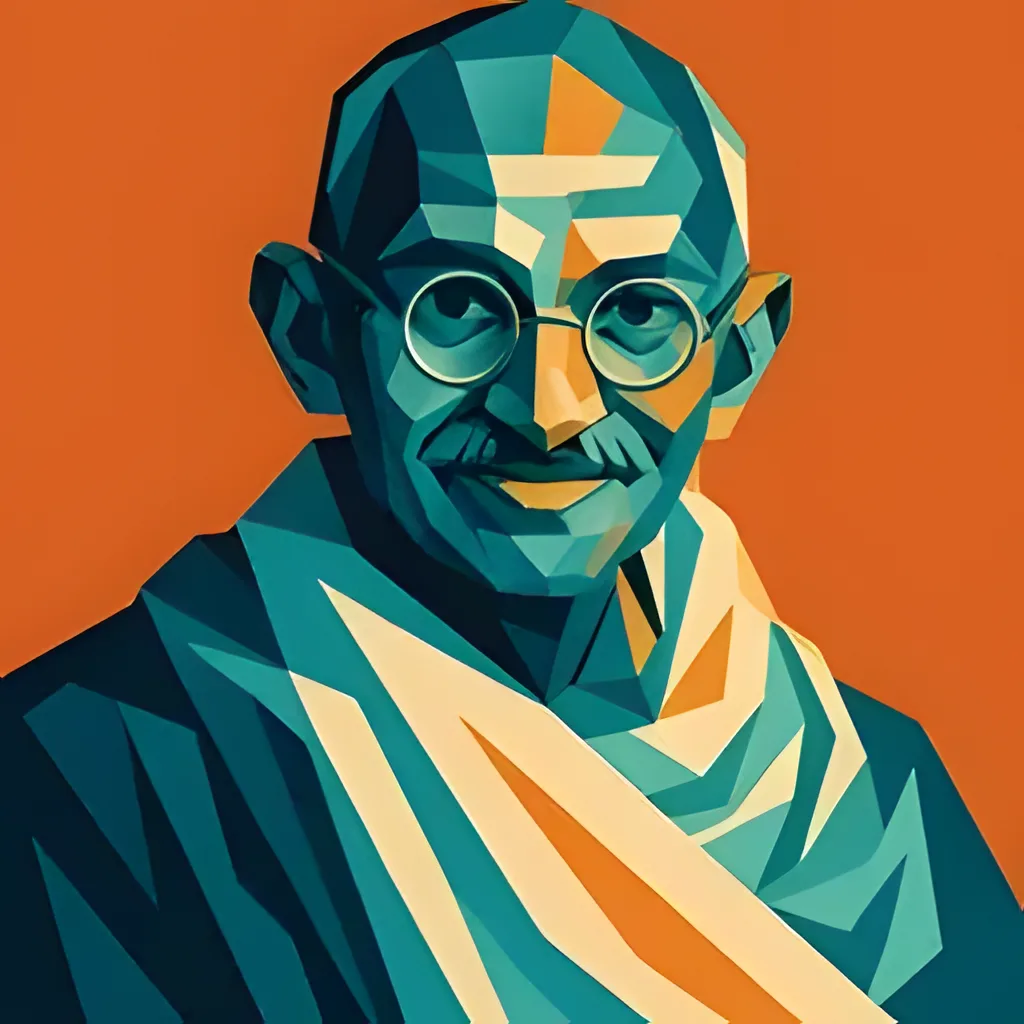
A life in brief
Mahatma Gandhi: life and timeline.
He was too shy to speak in court. Returning from London with a barrister's qualification in 1891, Mohandas Gandhi could not build a practice in India and took a job in South Africa because he needed the work. Being thrown off a train there, first-class ticket in his pocket, started twenty-one years of organising and produced the method: satyagraha, or truth force. He came home in 1915 and used it to make British rule unsustainable — one boycott, one fast, one 240-mile walk at a time.
- 1869
Born in Porbandar
Born 2 October in a coastal town in what is now Gujarat. His father was chief minister of Porbandar; his mother's piety and the Jain ideal of ahimsa — non-violence — shaped him early.
- 1888
London
Sails at nineteen to study law at University College London, having vowed to his mother to avoid meat, alcohol and women. He joins the London Vegetarian Society and reads the Bhagavad Gita, the Bible and works on Buddhism and Islam.
- 1893
South Africa
Qualified as a barrister in 1891, he could not build a practice in India — too shy to speak in court. He takes a job in Durban. On the journey to Pretoria he is thrown off a train despite holding a first-class ticket, because he is Indian.
- 1906
Satyagraha
The Transvaal proposes that all Indians register and carry passes. He organises refusal and coins the word satyagraha. The campaign runs eight years — passes burned, prison accepted — and wins in 1914.
- 1915
Return to India
Comes home after twenty-one years and spends his first year travelling the country, shocked by the poverty, illiteracy and exploitation he finds under British rule.
- 1917
Champaran
Organises indigo farmers in Bihar forced to grow indigo instead of food, investigates their conditions and negotiates with the British. It works — and establishes him as a leader who delivers results.
- 1920
Non-Cooperation
After the Jallianwala Bagh massacre, he calls on Indians to boycott British schools, courts and goods. Millions take part. He promotes the spinning wheel and spins daily himself.
- 1922
Calling it off
Protesters kill twenty-two policemen at Chauri Chaura. Horrified by the violence, he ends the entire movement, disappointing followers who felt they were close to winning.
- 1930
The Salt March
Walks 240 miles from Ahmedabad to Dandi over twenty-four days with seventy-eight followers, thousands joining along the way. On 6 April he picks up a handful of salt and breaks the law.
- 1942
Quit India
Demands immediate British withdrawal and gives the slogan Do or Die. The British arrest him and the Congress leadership and ban the organisation. He is imprisoned for nearly two years.
- 1947
Independence and partition
India is free on 15 August and divided in two. He spends the day in Calcutta trying to stop communal violence rather than celebrating in Delhi.
- 1948
Assassination
Shot three times on 30 January by Nathuram Godse, a Hindu nationalist opposed to his efforts at Hindu-Muslim unity, while walking to a prayer meeting in New Delhi.
Major achievements
Mahatma Gandhi: major achievements.
- 01
Satyagraha
Coined in the Transvaal in 1906 and refined over eight years: refuse the unjust law, accept the punishment, let moral force do what violence would. It worked — in 1914 South Africa recognised Indian marriages and abolished the poll tax on Indians.
- 02
The Salt March
240 miles on foot over twenty-four days in 1930, ending with a handful of salt at Dandi. Simple enough for anyone to understand, it touched every Indian regardless of class or religion and made British rule look absurd.
- 03
Indian independence
Led millions in campaigns that made British rule unsustainable — non-cooperation, civil disobedience, Quit India. India was free on 15 August 1947.
- 04
A method others could use
Martin Luther King Jr. studied his methods and applied them to the American civil rights movement. Nelson Mandela and other anti-apartheid leaders drew on his example. Satyagraha has since been used against war, environmental destruction and economic inequality.
- 05
Against untouchability
Fought the discrimination against Dalits in Hindu society, calling them Harijans — children of God — and working to integrate them into mainstream society. He also promoted women's rights and their participation in the independence movement.
Turning points
Mahatma Gandhi: defining moments.
- 1893
Thrown off the train
He went to South Africa because he could not make a living as a lawyer in India. On the journey from Durban to Pretoria he was removed from a first-class carriage he had paid for, because he was Indian. He decided to fight the treatment of Indians there. He stayed twenty-one years.
- 1906–1914
Inventing the method
The Transvaal wanted every Indian registered and carrying a pass. He organised refusal rather than protest: burn the passes, accept the prison. Eight years and thousands of participants later, the government conceded. He had learned that moral force could overcome physical force, and that personal sacrifice was the price of it.
- 1922
Calling off a movement that was winning
Non-Cooperation had millions participating and the British on the back foot. Then protesters at Chauri Chaura killed twenty-two policemen. He ended the whole thing, disappointing followers who felt independence was within reach. The method mattered more to him than the timetable.
- 1930
A handful of salt
The British monopolised salt and taxed it, which hurt the poor most. He walked 240 miles to the sea with seventy-eight followers, thousands joining and the world's media watching, and picked some up. Millions began making their own. It was political theatre, and it was unanswerable.
- 1947
Independence he could not celebrate
He had worked to prevent partition, meeting leaders from every community and fasting for unity. India was divided anyway, and the violence displaced millions and killed hundreds of thousands. He spent independence day in Calcutta trying to stop the riots. His presence and his fasting helped restore peace there.
Earth provides enough to satisfy every man's needs, but not every man's greed.
Mahatma Gandhi
What you’ll take away
Lessons from Mahatma Gandhi’s life.
- 01
The method is the message
He stopped a movement that was winning because twenty-two policemen had been killed. Non-violence kept only while convenient is a tactic, not a principle — and a tactic can be answered.
- 02
Make it simple enough to join
The Salt March worked because anyone could understand it and anyone could copy it. Millions made their own salt. A protest that needs explaining has already lost most of the people who might have joined.
- 03
Be the argument
He spun his own cloth, fasted, and lived on almost nothing. He believed personal transformation had to come before social change, and that leaders must embody what they ask of others. It is why people believed him.
Did you know
Facts about Mahatma Gandhi.
- 01
Did you know that Mahatma Gandhi, an icon of peaceful resistance, was initially a shy lawyer who struggled to speak in court and failed to attract clients when he first started practicing in India?
- 02
Did you know that Gandhi developed his famous philosophy of non-violent protest, known as satyagraha, during his twenty-one years living in South Africa while fighting against racial discrimination?
- 03
Did you know that during the 1930 Salt March, Gandhi walked 240 miles to the sea to make his own salt, symbolically breaking British law and sparking a nationwide campaign of civil disobedience?
If you liked Mahatma Gandhi…
Browse all → Civil Rights Leader16 min
Martin Luther King Jr.
The Preacher Who Led America's Fight for Civil Rights
 Anti-Apartheid Leader17 min
Nelson Mandela
The Freedom Fighter Who United a Nation
 Civil Rights Leader17 min
Malcolm X
The Revolutionary Who Transformed Black Consciousness in America
 Labor Leader15 min
César Chávez
A Farm-worker Who Became One of America’s Most Influential Labor Leaders
FAQ
Frequently asked questions about Mahatma Gandhi.
What was Mahatma Gandhi's full name?
Mohandas Karamchand Gandhi. “Mahatma,” meaning “great soul” in Sanskrit, is an honorific that came into wide use around 1915; in India he is also affectionately called Bapu, “father.”
What was Gandhi's religion?
He was a Hindu, raised in a devout Vaishnava household influenced by Jain ideas of nonviolence. He drew on many traditions — the Bhagavad Gita, the Sermon on the Mount, Islam — and insisted on respect between India's religions, which made him a target of Hindu nationalists.
What does satyagraha mean?
Truth force, in Sanskrit. Gandhi coined the term in South Africa in 1906 for his method of non-violent protest: refusing to obey unjust laws and accepting imprisonment rather than complying, so that moral force does the work violence would otherwise do.
What was the Salt March?
In 1930 Gandhi walked 240 miles from his ashram in Ahmedabad to the coastal village of Dandi, over twenty-four days, with seventy-eight followers and thousands joining along the way. On 6 April he picked up a handful of salt from the beach, breaking the British salt monopoly. Millions followed, and thousands were arrested.
Why did Gandhi call off the Non-Cooperation Movement?
In 1922 violence broke out at Chauri Chaura, where protesters killed twenty-two policemen. Gandhi, horrified, called off the entire movement — disappointing many followers who felt they were close to achieving their goals.
Who killed Gandhi, and why?
Nathuram Godse, a Hindu nationalist, shot him three times on 30 January 1948 as he walked to a prayer meeting in New Delhi. Godse opposed his efforts to promote Hindu-Muslim unity. Some Hindu extremists had come to see him as too sympathetic to Muslims and Pakistan, and a traitor to Hindu interests.
Did Gandhi support the partition of India?
No. He worked tirelessly to prevent it, meeting leaders from all communities and fasting to promote unity. The British government decided partition was the only solution as communal violence spread. He was heartbroken by the division and the violence that followed.
Published by Lyfestori, from Duck Pond Ventures Oy. About us and how to report a correction.
19 min · one sitting