Joseph Stalin
The Dictator Who Ruled with an Iron Fist
Born Ioseb Jughashvili on 18 December 1878 in Gori, Georgia, Joseph Stalin rose from seminary student and revolutionary bank robber to ruler of the Soviet Union from the mid-1920s until his death in 1953 — industrialising the country and leading it to victory in the Second World War while killing millions through famine, purges and the Gulag.
- 16 min listen
- Soviet leader
- General Secretary
- Great Purge
Joseph Stalin’s full 16 min audio biography, The Dictator Who Ruled with an Iron Fist, is available on Lyfestori for iOS. Listen to a free preview below.
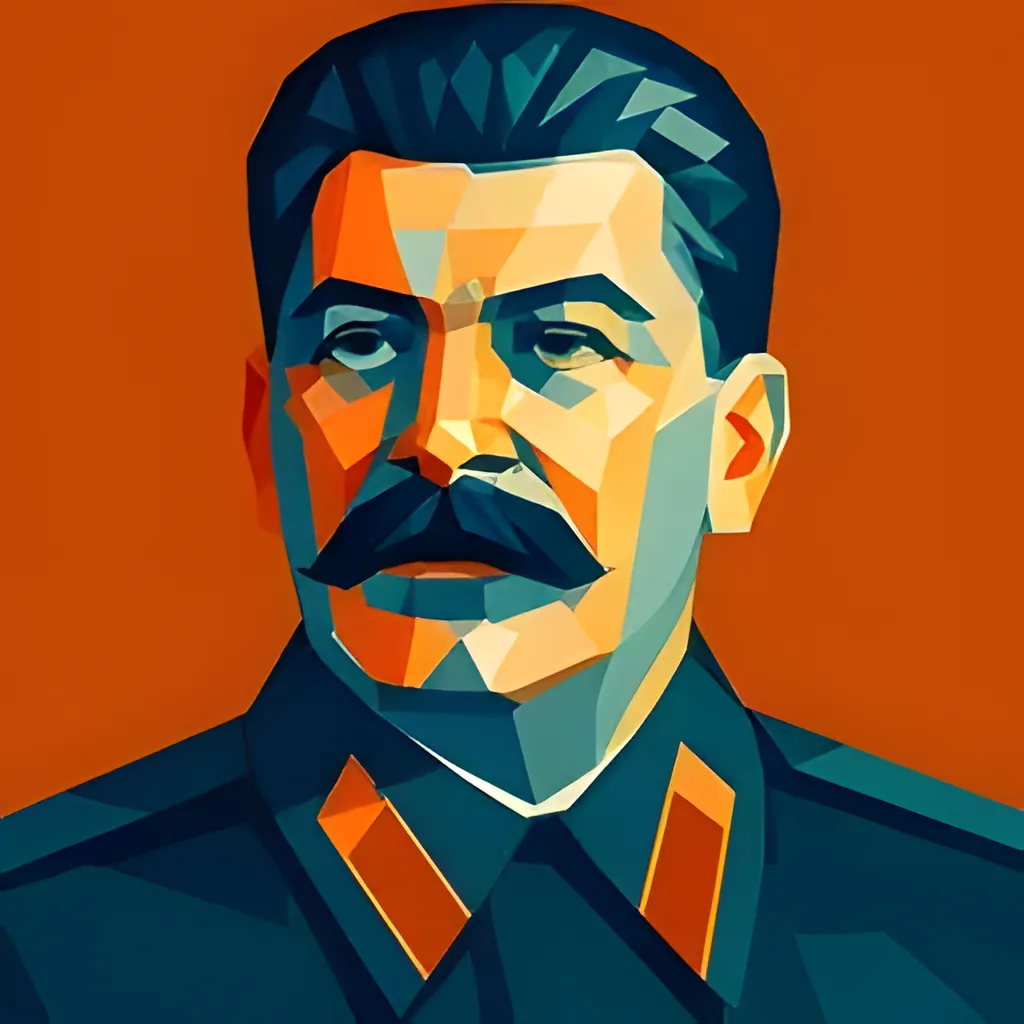
A life in brief
Joseph Stalin: life and timeline.
His mother wanted him to be a priest. The seminary meant to deliver that taught obedience, suppressed his Georgian language, and turned him into a reader of illegal Marxist literature. Joseph Stalin funded the Bolsheviks with bank robberies, was arrested eight times, and in 1922 took a job that looked purely administrative — General Secretary — then used it to decide who held every post in the party. Lenin saw it coming and asked in writing that he be removed. Nobody acted.
- 1878
Born in Gori
Born 18 December in Georgia, then part of the Russian Empire, to a cobbler who struggled with alcoholism and turned violent, and a seamstress determined to educate him. Smallpox scarred his face; injuries left his left arm shorter and stiff.
- 1894
The seminary
Wins a scholarship to the Tiflis Theological Seminary, one of Georgia's most prestigious schools. His mother hopes for the priesthood and a respected future. The school is built on religion, discipline and obedience.
- 1899
Expelled
Officially for failing to sit exams and chronic non-attendance — by then he had joined local socialist circles and revolutionary politics was consuming his time. He joins the Russian Social Democratic Labour Party and aligns with Lenin's Bolsheviks.
- 1902
The underground
Between 1902 and 1913 he is arrested eight times and repeatedly exiled to Siberia, escaping several times. He funds the party by criminal means including bank robberies, and settles on the name Stalin — man of steel.
- 1917
Revolution
In Siberian exile when the February Revolution overthrows Nicholas II. He returns to Petrograd, rejoins Lenin, takes editorial and party organisational roles and supports the October seizure of power — though Trotsky's Military Revolutionary Committee directs it.
- 1922
General Secretary
An administrative-looking post that gives him enormous power over party personnel decisions. Lenin's Letter to the Congress warns he has concentrated too much power and suggests removing him; after Lenin's death in 1924 the Central Committee, amid factional manoeuvring, chooses not to act.
- 1928
The First Five-Year Plan
With his rivals outmanoeuvred, he begins forced industrialisation. Heavy industry gets built, at tremendous human cost, supplied by the coerced labour of the expanding Gulag.
- 1932
Collectivisation and famine
Private farms are abolished and peasants forced onto collective farms. Kulaks who resist are executed, deported to labour camps or sent to remote regions to die. The Holodomor of 1932–33 kills millions, above all in Ukraine.
- 1936
The Great Purge
Between 1936 and 1938 he turns on the party itself. In 1937–38 alone more than a million people are arrested, and archival records show around 681,000 executed — loyal party members, officers, intellectuals and ordinary citizens, many tortured into confessing at staged show trials.
- 1939
The pact with Hitler
The Molotov–Ribbentrop non-aggression pact in August carries secret protocols dividing Eastern Europe. Germany and the USSR partition Poland in September; the Baltic states are occupied and annexed in 1940.
- 1941
Operation Barbarossa
In June, Hitler invades with over three million troops. The Red Army, stripped of experienced officers by Stalin's own purges, is overrun and millions are killed or captured. He withdraws from public view for several days before resuming leadership.
- 1953
Death at the dacha
He suffers a stroke on 1 March; by some accounts his guards are too terrified to enter his room, delaying treatment. He dies on 5 March, aged seventy-four, with another purge — the Doctors' Plot — apparently in preparation.
Major achievements
Joseph Stalin: major achievements.
- 01
Forced industrialisation
The First Five-Year Plan from 1928 built Soviet heavy industry at speed and turned an agrarian country into a modern industrial power. It ran on coerced labour, and the human cost was staggering.
- 02
Control of the party machine
He took the General Secretaryship in 1922 — administrative on paper — and turned personnel decisions into absolute power, outmanoeuvring Trotsky and isolating every rival through patience and back-room alliances rather than oratory.
- 03
Victory over Nazi Germany
After the catastrophe of 1941 he moved Soviet industry beyond the reach of German bombers, mobilised the entire population and rebuilt the Red Army. The USSR won at a cost of an estimated 27 million Soviet dead.
- 04
A superpower and a bloc
The Soviet Union tested an atomic bomb in 1949, challenging American dominance, and held a buffer of communist satellite states across Eastern Europe — the shape of the Cold War for the next four decades.
Turning points
Joseph Stalin: defining moments.
- 1894–1899
The seminary that made a revolutionary
His mother's plan for the priesthood put him in a school built on harsh discipline, obedience and Russifying policies that suppressed Georgian culture and language. He rebelled against the authority, read illegal revolutionary literature including Marx, had joined socialist circles by 1898, and was expelled in 1899.
- 1922–1928
The administrative job
General Secretary looked like paperwork. It controlled who got which post across the party, and he had already built a network of loyal supporters as Commissar for Nationalities. Lenin saw the danger and asked for his removal in writing; the Central Committee, busy with its own factional fights, let it go. By 1928 every rival was gone.
- 1936–1938
The Great Purge
Deepening paranoia became mass repression. Old revolutionaries who had fought beside Lenin, military commanders needed against a rearming Germany, and hundreds of thousands of ordinary citizens were arrested on fabricated charges; around 681,000 were executed in 1937–38. Anyone could be labelled a traitor and disappear overnight. Even his own secret police chiefs were purged in turn.
- 1941
The invasion he had helped make possible
The pact with Hitler collapsed in June 1941. The army was unprepared partly because he had purged its experienced officers, and millions of soldiers were killed or captured within months. He withdrew from view for several days — described variously as shock and hesitation — then returned and ran the war.
What you’ll take away
Lessons from Joseph Stalin’s life.
- 01
Watch the boring job
Everyone else wanted the platform and the theory. He took the post that decided appointments. Power that looks like administration is still power, and it compounds quietly while rivals give speeches.
- 02
A warning ignored is a warning wasted
Lenin identified the danger precisely and put it in writing. The Central Committee, distracted by its own manoeuvring, chose not to act, and the document stayed unpublished in the USSR until 1956 — by which time the cost was counted in millions.
- 03
Terror eats its own instruments
The purges took the officers he needed when Germany invaded, and eventually the police chiefs who had run the purges. A system built on fear cannot keep the competence it depends on.
Did you know
Facts about Joseph Stalin.
- 01
Did you know that Joseph Stalin's real surname was Jughashvili, and he adopted the name 'Stalin', which means 'man of steel' in Russian, while he was a revolutionary?
- 02
Did you know that before becoming a ruthless dictator, a young Stalin spent several years studying at a Georgian Orthodox seminary to become a priest?
- 03
Did you know that Stalin was nominated for the Nobel Peace Prize twice (in 1945 and 1948) for his efforts to end World War II?
If you liked Joseph Stalin…
Browse all → Philosopher & Economist16 min
Karl Marx
The Revolutionary Thinker Who Reshaped Modern Society
 European Commission President19 min
Ursula von der Leyen
From Doctor to Europe's Most Powerful Woman
 President of Finland17 min
Alexander Stubb
Navigating Power and Politics
 King & Conqueror15 min
Alexander the Great
The Young Conqueror Who Built the Ancient World’s Greatest Empire
FAQ
Frequently asked questions about Joseph Stalin.
What was Joseph Stalin the leader of?
The Soviet Union. He became General Secretary of the Communist Party in 1922, outmanoeuvred his rivals after Lenin's death in 1924, and ruled as the USSR's unchallenged dictator from the late 1920s until he died in 1953.
How did Stalin die?
Of a stroke. He collapsed at his dacha outside Moscow on the night of 1 March 1953, but his guards — afraid to enter his room uninvited — did not find him for hours, and doctors were slow to be called. He died on 5 March, aged seventy-four.
Where does the name Stalin come from?
He was born Ioseb Besarionis dze Jughashvili in Gori, Georgia. In the revolutionary underground he adopted various names, finally settling on Stalin, meaning 'man of steel' in Russian.
Did Lenin want Stalin removed?
Yes. In his Letter to the Congress — the so-called Testament of 1922–23 — Lenin warned that Stalin had concentrated too much power and suggested he be removed as General Secretary. After Lenin's death in 1924 the Central Committee, amid factional manoeuvring, chose not to implement it. The document remained unpublished in the USSR until 1956.
What was the Great Purge?
A campaign of mass repression between 1936 and 1938, driven by Stalin's fear that those around him were plotting against him. In 1937–38 alone more than a million people were arrested and archival records show around 681,000 executed. Many victims were loyal party members, officers and ordinary citizens, tortured into confessing at staged show trials.
How many people died because of Stalin?
Exact totals depend on definitions. Scholarly estimates commonly attribute many millions of premature deaths to his policies — mass executions, Gulag mortality, deadly deportations and the state-induced famines of the early 1930s — often summarised as the high single-digit to low double-digit millions.
Why is Stalin still popular in Russia?
Surveys by independent groups such as the Levada Center have found around half of respondents expressing positive or mixed-positive views in recent years. That view focuses on him as a symbol of strong state power and victory over Nazi Germany, while the repression is downplayed, justified, or treated as a necessary cost.
Published by Lyfestori, from Duck Pond Ventures Oy. About us and how to report a correction.
16 min · one sitting