Ursula von der Leyen
From Doctor to Europe's Most Powerful Woman
Born Ursula Gertrud Albrecht on 8 October 1958 in Brussels, Ursula von der Leyen trained as a doctor, raised seven children, served in Angela Merkel's cabinets for fourteen years and in 2019 became the first woman to lead the European Commission.
- 19 min listen
- European Commission President
- Physician
- European Green Deal
Ursula von der Leyen’s full 19 min audio biography, From Doctor to Europe's Most Powerful Woman, is available on Lyfestori for iOS. Listen to a free preview below.
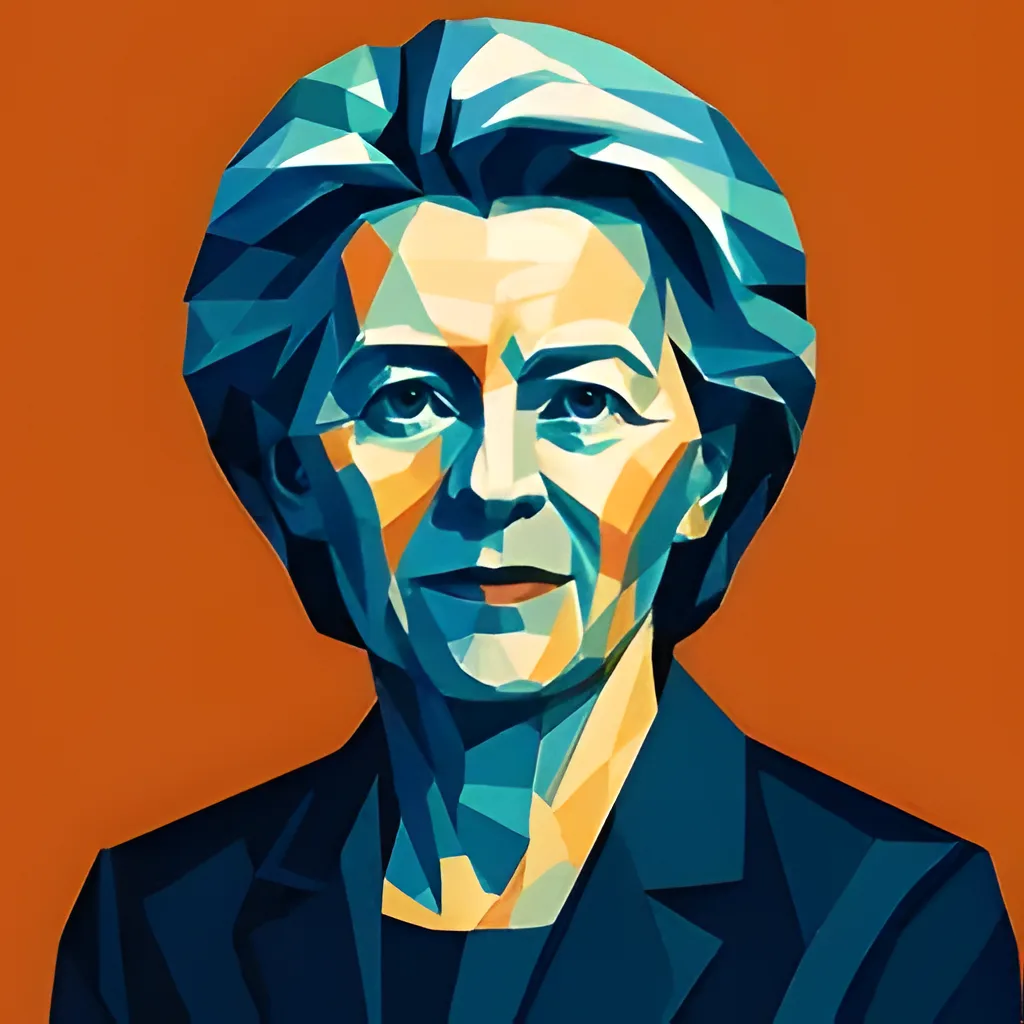
A life in brief
Ursula von der Leyen: life and timeline.
She studied economics, switched to medicine at twenty-two, and spent four years in Stanford as what she later called a housewife, raising a family that would reach seven children. Ursula von der Leyen entered politics on a small-town council in her forties. Twenty years later she was the first woman to lead the European Commission — elected by nine votes, trailing plagiarism findings and a consulting-contracts investigation from her time running Germany's military. Then a pandemic and a war made her indispensable.
- 1958
Born in Brussels
Born 8 October to Ernst Albrecht, one of the first European civil servants, working for what would become the EU. She grows up fluent in German and French.
- 1971
Move to Germany
At thirteen the family leaves Brussels when her father enters German politics. He becomes minister-president of Lower Saxony, and she learns to handle a media spotlight as a teenager.
- 1980
Switching to medicine
After economics at Göttingen, Münster and the London School of Economics, she enrols at Hanover Medical School — a complete reinvention rather than a career adjustment.
- 1991
The doctorate
She earns her medical doctorate with a thesis on infections in pregnant women, having married Heiko von der Leyen and qualified as a physician in 1987. The thesis will return to haunt her.
- 1992
Stanford
At thirty-four she moves to California when Heiko takes a Stanford post. For four years she raises children in Silicon Valley during its early boom, out of medicine and out of public life.
- 2001
Sehnde town council
Back in Germany, she is elected to the council of a small town near Hanover and becomes deputy mayor. She had joined the CDU in 1990, reportedly after her father's electoral defeat by Gerhard Schröder.
- 2005
Merkel's cabinet
Two years after entering the Lower Saxony parliament, she is made Federal Minister of Family Affairs. She introduces paid parental leave and expands childcare, then moves to Labour and Social Affairs in 2009 — where the financial crisis forces her to cut the kind of programmes she had championed.
- 2013
Defence minister
Merkel makes her Germany's first female defence minister: a doctor with no military experience running the Bundeswehr. Military leaders question the appointment from day one.
- 2015
VroniPlag
Investigators publish an analysis finding plagiarised passages on 27 of her dissertation's 62 pages — over 75% of the text on some. Hanover Medical School concludes in 2016 that the thesis contains plagiarism but that intentional deception cannot be proven.
- 2019
President of the Commission
A compromise candidate many MEPs had never heard of, she is elected on 16 July by nine votes — the first woman in the job. She takes office on 1 December promising a "geopolitical commission".
- 2022
Ukraine
Russia invades on 24 February. She coordinates unprecedented sanctions and aid, visits Kyiv repeatedly, and is recast from questionable compromise pick to wartime leader. Forbes names her the most powerful woman in the world.
- 2024
A second term
Re-elected in July with a far stronger majority than in 2019, leading a Commission that will serve until 2029.
Major achievements
Ursula von der Leyen: major achievements.
- 01
First woman to lead the European Commission
Elected in July 2019 by a margin of nine votes, she now heads the executive of a bloc of 450 million people and has been re-elected to a term running to 2029.
- 02
The 750 billion euro recovery fund
She helped negotiate a pandemic recovery package representing a level of financial solidarity between member states that had been unthinkable only years earlier.
- 03
Europe's response to the invasion of Ukraine
She coordinated unprecedented sanctions against Russia and military and financial aid to Ukraine, becoming one of Kyiv's most important allies in Europe.
- 04
The European Green Deal
The plan to make Europe the first climate-neutral continent by 2050 — the most ambitious climate programme attempted, requiring the transformation of energy, agriculture and transport.
- 05
German family policy
As family minister she attacked Germany's declining birth rate with paid parental leave and a large expansion of childcare, drawing on the experience of raising seven children herself.
- 06
The most powerful woman in the world
Forbes gave her the title in 2022 and again in 2023 and 2024 — a designation that would have looked absurd during her defence ministry years.
Turning points
Ursula von der Leyen: defining moments.
- 1992–1996
The Stanford years
At thirty-four, established as a physician, she left it all for California because her husband had a job there. Four years as a self-described housewife in the middle of Silicon Valley's boom — an interruption that turned into the basis of the family policy she later built a political career on.
- 2013–2019
The defence ministry
Handed a military with outdated equipment and broken procurement, she brought in consultants — hundreds of millions of euros to firms like McKinsey and Accenture, often without proper competitive bidding. Her state secretary for arms procurement was a former McKinsey executive. Her son worked at McKinsey. The Federal Audit Office investigation and the deleted phone data still shadow her.
- 2015–2016
The thesis
Plagiarism has ended German political careers. Findings covered 27 of her dissertation's 62 pages, and academics accused her of doing it deliberately. She denied it, blaming internet activists. Hanover Medical School found plagiarism but no provable intent, and critics — noting she personally knew the review commission's director — called it a whitewash.
- 2019
The compromise candidate
Her German career was stalling and she wasn't considered a serious contender to succeed Merkel. The European Council needed someone acceptable to everyone, and she had not campaigned for the job. Merkel backed her, and nine votes carried her.
- 2020–2022
The crises that made her
Vaccine procurement delays and border disputes exposed the bloc's limits. Then the recovery fund, then the invasion of Ukraine. The job she was given because nobody objected became the one she was defined by.
What you’ll take away
Lessons from Ursula von der Leyen’s life.
- 01
A career is not a straight line
Economics, then medicine, then four years out of the workforce entirely, then a town council seat in her forties. She reached the top of European politics having started later than almost anyone she governed alongside.
- 02
Inexperience has a bill
A doctor put in charge of the Bundeswehr outsourced the problem to consultants. The military leaders who questioned the appointment were right about the risk, and the procurement scandal outlived the ministry.
- 03
Crises decide reputations
She entered Brussels a backroom compromise with a thin mandate. The pandemic and the war gave her problems large enough that competence at them rewrote everything that came before.
Did you know
Facts about Ursula von der Leyen.
- 01
Did you know that Ursula von der Leyen, the President of the European Commission, is a trained medical doctor who previously worked in a women's clinic?
- 02
Did you know that she lived under an assumed name, Rose Ladson, while studying in London during the late 1970s to avoid being targeted by West German terrorists?
- 03
Did you know that before entering politics, von der Leyen was a stay-at-home mother who raised seven children?
If you liked Ursula von der Leyen…
Browse all → European Politician16 min
Kaja Kallas
Leading a Nation in a Digital Age
 Prime Minister of Finland15 min
Sanna Marin
The Young Leader Who Made History
 President of Finland17 min
Alexander Stubb
Navigating Power and Politics
 King & Conqueror15 min
Alexander the Great
The Young Conqueror Who Built the Ancient World’s Greatest Empire
FAQ
Frequently asked questions about Ursula von der Leyen.
What was Ursula von der Leyen's maiden name?
Albrecht. She was born Ursula Gertrud Albrecht, the daughter of Ernst Albrecht, a senior European civil servant who later became Minister-President of Lower Saxony. She took the name von der Leyen when she married the physician Heiko von der Leyen in 1986.
What nationality is Ursula von der Leyen?
German. She was born and spent her early childhood in Brussels, where her father worked for the European Economic Community, and moved to Lower Saxony in Germany with her family in 1971, when she was thirteen.
Who was President of the European Commission before von der Leyen?
Jean-Claude Juncker, the former Prime Minister of Luxembourg, who led the Commission from 2014 to 2019.
Is Ursula von der Leyen a medical doctor?
Yes. She qualified in 1987, worked as an assistant physician in a gynaecological clinic at Hanover Medical School, and earned a doctorate in 1991 with a thesis on infections in pregnant women.
What was the plagiarism scandal?
In 2015 the group VroniPlag Wiki found plagiarised passages on 27 of the 62 pages of her 1991 dissertation, with more than 75% of the text copied on some pages. She denied intent. In March 2016 Hanover Medical School concluded the thesis contained plagiarism but that deliberate deception could not be proven, and did not revoke her degree.
How did she become European Commission president?
As a compromise candidate. She had not campaigned, was outside the traditional selection process, and many MEPs had never heard of her. Merkel backed her, and on 16 July 2019 she was elected by a margin of nine votes — the first woman in the role.
What is the controversy over the Pfizer text messages?
In April 2021 it emerged that she had exchanged private texts with Pfizer CEO Albert Bourla while negotiating vaccine contracts worth billions. Her office refused freedom-of-information requests to release them, and the European Ombudsman accused her of maladministration for the refusal.
What is the European Green Deal?
Her signature programme: a plan to make Europe the world's first climate-neutral continent by 2050, requiring changes across energy, agriculture and transport. It has faced resistance from industry and member states over economic cost.
Published by Lyfestori, from Duck Pond Ventures Oy. About us and how to report a correction.
19 min · one sitting