Vladimir Lenin
The Man Who Set the World on Fire
Born Vladimir Ilyich Ulyanov on 22 April 1870 in Simbirsk, Russia, Vladimir Lenin led the Bolsheviks to power in the October Revolution of 1917 and founded the Soviet state. His vanguard party, Red Terror and New Economic Policy shaped twentieth-century communism from Moscow to Beijing, Hanoi and Havana.
- 19 min listen
- Revolutionary
- Founder of the Soviet state
- Marxist theorist
Vladimir Lenin’s full 19 min audio biography, The Man Who Set the World on Fire, is available on Lyfestori for iOS. Listen to a free preview below.
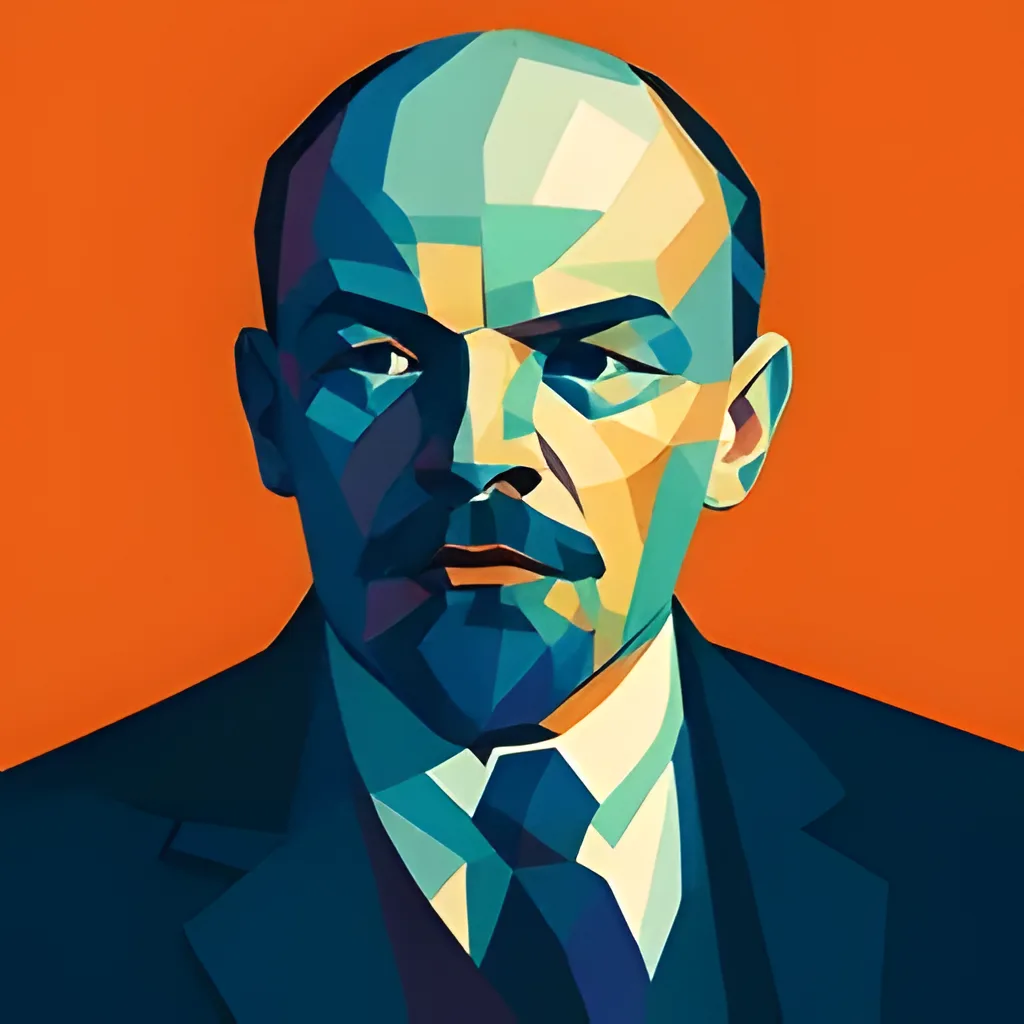
A life in brief
Vladimir Lenin: life and timeline.
His father's work as a schools inspector earned the family hereditary nobility; his elder brother was hanged at twenty-one for plotting to kill the Tsar. Vladimir Ulyanov turned to Marxism, spent three years in Siberian exile and most of the next seventeen abroad, arguing over party discipline in Geneva, London and Zurich. In April 1917 Germany let him cross its territory by train to Petrograd. Seven months later his Bolsheviks seized power, and the state he built — with the Cheka and the one-party system — outlived him by nearly seventy years.
- 1870
Born in Simbirsk
Born Vladimir Ilyich Ulyanov on 22 April in Simbirsk on the Volga. His father, Ilya, is a director of public schools whose civil-service rank later gives the family hereditary nobility.
- 1887
His brother is hanged
His eldest brother, Alexander, is executed in May for his part in a plot to assassinate Tsar Alexander III. That autumn Vladimir enrols at Kazan University and is expelled within months for joining a student protest.
- 1890
A law degree by self-study
Barred from university, he studies on his own and passes the St Petersburg University law examinations externally with the equivalent of a first-class degree. By 1893 he is a committed Marxist organising workers' circles in St Petersburg.
- 1897
Exile in Siberia
After his arrest in December 1895 and more than a year in prison, he is sentenced to three years' exile in Shushenskoye. He marries the revolutionary Nadezhda Krupskaya there in July 1898.
- 1901
Becomes "Lenin"
Now in Western Europe and co-editing the émigré newspaper Iskra, he first signs himself Lenin in December. The origin of the name is uncertain; one theory links it to Siberia's Lena River.
- 1903
Bolsheviks and Mensheviks
A year after his pamphlet What Is to Be Done? calls for a disciplined vanguard of professional revolutionaries, the party's Second Congress in Brussels and London splits. His faction takes the name Bolsheviks, "majority men".
- 1917
The sealed train and October
After the Tsar falls, Germany allows Lenin and his companions to cross its territory; he reaches Petrograd's Finland Station on 16 April and issues his April Theses. On 7 November (25 October Old Style) the Bolsheviks seize power.
- 1918
Brest-Litovsk and the Red Terror
He dissolves the elected Constituent Assembly in January and signs a punishing peace with Germany in March. On 30 August he is shot twice at a Moscow factory; the Red Terror carried out by the Cheka follows.
- 1921
The New Economic Policy
With the Civil War won but the country ruined by war and famine, he replaces grain requisitioning with a tax in kind and allows small private trade.
- 1922
Strokes and the Soviet Union
Suffers his first stroke in May and a second in December, the month the Union of Soviet Socialist Republics is formally created. Stalin has become General Secretary that April.
- 1923
The Testament
In a note dated 4 January he urges the party to remove Stalin as General Secretary. A third stroke in March leaves him unable to speak.
- 1924
Death at Gorki
Dies on 21 January at Gorki, outside Moscow, aged fifty-three. Against Krupskaya's wishes his body is embalmed and placed in a mausoleum on Red Square, where it remains.
Major achievements
Vladimir Lenin: major achievements.
- 01
The first communist state
The Bolshevik seizure of power in November 1917 created a state that, as the Soviet Union from 1922, lasted until 1991 and served as the model for communist parties around the world.
- 02
The vanguard party
What Is to Be Done? (1902) argued that workers would not become revolutionaries on their own and needed a tight organisation of professionals to lead them — the template Leninist parties followed for a century.
- 03
Winning the Civil War
Between 1918 and 1921 the Bolsheviks defeated the White armies and foreign intervention, with Leon Trotsky building the Red Army almost from nothing.
- 04
A pragmatic retreat
The New Economic Policy of 1921 reintroduced limited markets to revive a collapsed economy, showing a willingness to reverse course that his more rigid colleagues opposed.
- 05
The architecture of one-party rule
His government dissolved the Constituent Assembly, banned rival parties and built the Cheka secret police and its camps — institutions Stalin inherited and expanded.
Turning points
Vladimir Lenin: defining moments.
- 1887
Alexander's execution
His brother was hanged for conspiring to kill the Tsar, the same state that had ennobled their father. The famous line "We will go another way" is almost certainly apocryphal, but the loss pushed the seventeen-year-old towards radical politics.
- April 1917
The Finland Station
Arriving from Switzerland, he denounced the Provisional Government that his own party had been tolerating and demanded all power to the Soviets and an end to the war. Colleagues thought he had lost touch. Within three weeks he had won the party over.
- August 1918
The shooting
Two bullets struck him as he left a Moscow factory meeting; Fanny Kaplan was arrested and executed days later, though whether she fired is still disputed. The attempt became the trigger for the officially declared Red Terror.
- 1922–1923
Too late on Stalin
Weakened by strokes, he dictated notes judging possible successors and finally urged that Stalin be removed as General Secretary. The warning was read only in closed party sessions and suppressed; Stalin went on to destroy most of Lenin's old comrades.
Communism is Soviet power plus the electrification of the whole country.
Report to the Eighth All-Russian Congress of Soviets, December 1920
What you’ll take away
Lessons from Vladimir Lenin’s life.
- 01
Organisation beats numbers
The Bolsheviks were a minority in 1917, and the Mensheviks long had more followers. A small, disciplined group ready to act took power while larger parties debated.
- 02
Timing is a decision
From hiding in Finland he bombarded his party with demands to strike before the Provisional Government recovered. Most of his comrades wanted to wait.
- 03
Means shape the ends
He built the secret police and the one-party state as emergency tools. They outlasted the emergency, and the man he warned against inherited them.
If you liked Vladimir Lenin…
Browse all → Soviet Leader16 min
Joseph Stalin
The Dictator Who Ruled with an Iron Fist
 Philosopher & Economist16 min
Karl Marx
The Revolutionary Thinker Who Reshaped Modern Society
 Prime Minister17 min
Winston Churchill
The Man Who Refused to Surrender
 European Commission President19 min
Ursula von der Leyen
From Doctor to Europe's Most Powerful Woman
FAQ
Frequently asked questions about Vladimir Lenin.
What was Vladimir Lenin's real name?
Vladimir Ilyich Ulyanov. Lenin was a revolutionary pseudonym he first used in December 1901; like many underground activists, he wrote under assumed names to evade the Tsarist police.
Why did Vladimir Lenin change his name?
To protect himself and his work from the police. The origin of "Lenin" itself is uncertain — one theory links it to the Lena River in Siberia — and the "N." in "N. Lenin" did not stand for Nikolai.
Where was Vladimir Lenin born?
In Simbirsk, a provincial city on the Volga, on 22 April 1870. The city was renamed Ulyanovsk in his honour in 1924.
How did Vladimir Lenin come to power?
Through the October Revolution of 1917. After returning from exile in April, he persuaded the Bolsheviks to seize power, and on 7 November (25 October Old Style) their forces took Petrograd and arrested the Provisional Government.
How did Vladimir Lenin die?
After a series of strokes. The first came in May 1922 and a third, in March 1923, left him unable to speak; he died at Gorki, near Moscow, on 21 January 1924, aged fifty-three. Doctors attributed it to severe arteriosclerosis of the brain.
Is Vladimir Lenin's body still on display?
Yes. His embalmed body lies in the Lenin Mausoleum on Red Square in Moscow, maintained by a team of specialists — against the wishes of his widow, Nadezhda Krupskaya.
Did Vladimir Lenin have children?
No. He married Nadezhda Krupskaya in Siberian exile in 1898, and the couple had no children.
Who succeeded Vladimir Lenin?
Joseph Stalin, after a power struggle with Trotsky, Zinoviev, Kamenev and Bukharin — despite Lenin's own written recommendation that Stalin be removed as General Secretary.
Published by Lyfestori, from Duck Pond Ventures Oy. About us and how to report a correction.
19 min · one sitting