Karl Marx
The Revolutionary Thinker Who Reshaped Modern Society
Born Karl Heinrich Marx on 5 May 1818 in Trier, Prussia, Karl Marx was a philosopher, economist and revolutionary who co-wrote The Communist Manifesto with Friedrich Engels and spent decades in London exile writing Das Kapital — ideas that shaped the politics of the twentieth century.
- 16 min listen
- Historical materialism
- Political economy
- The Communist Manifesto
Karl Marx’s full 16 min audio biography, The Revolutionary Thinker Who Reshaped Modern Society, is available on Lyfestori for iOS. Listen to a free preview below.
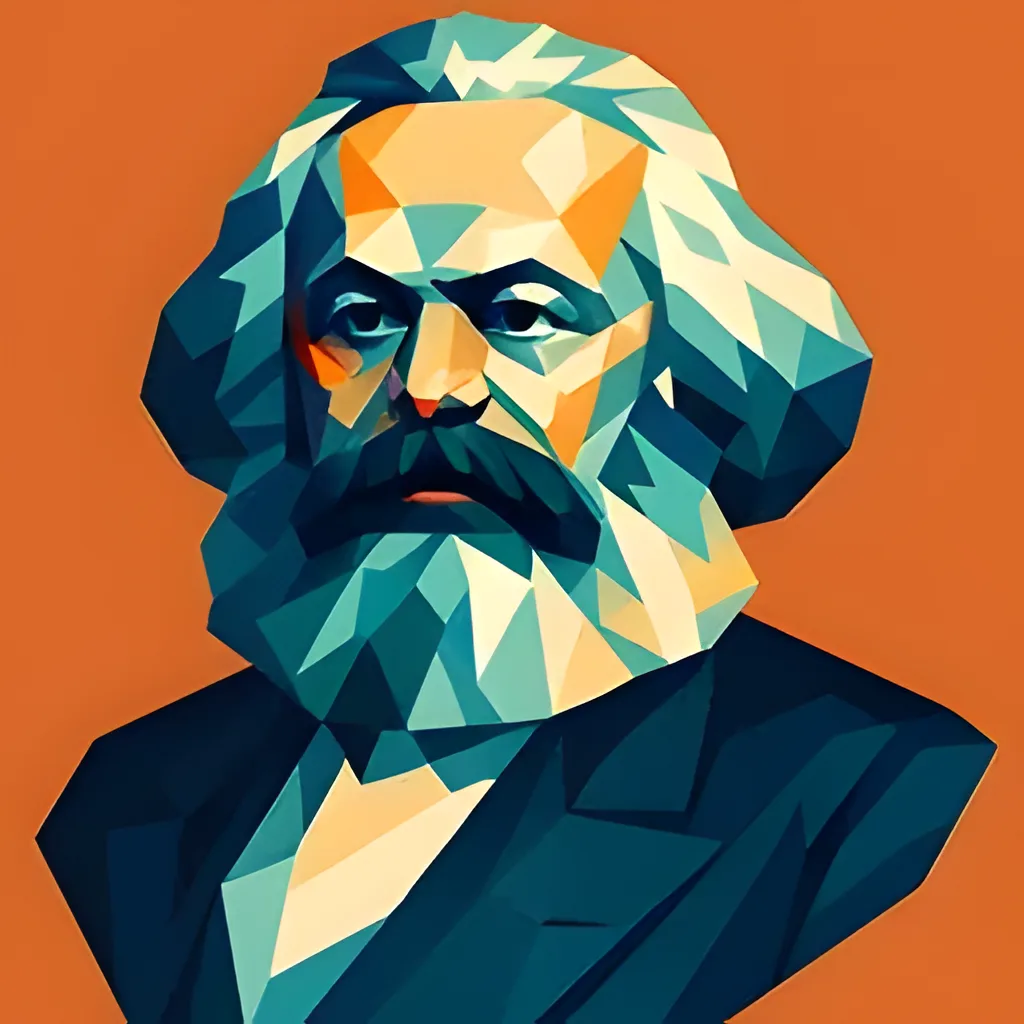
A life in brief
Karl Marx: life and timeline.
He worked through business reports and government statistics in the reading room of the British Museum, trying to prove that capitalism would destroy itself. Karl Marx wrote in exile and in poverty, from a cramped Soho apartment, kept afloat by money from Friedrich Engels, the son of a textile manufacturer. Only three of his seven children reached adulthood. About a dozen people came to his grave in 1883. Within a century, governments ruled in his name.
- 1818
Born in Trier
Born 5 May in Trier, in the Rhineland region of Prussia. His father, a successful lawyer, had converted from Judaism to Lutheranism under laws barring Jews from the legal profession.
- 1835
Law at Bonn
Enrols to study law, mostly to satisfy his father. His heart is in philosophy and literature. He runs up debts, falls in with bad company and his grades slip.
- 1836
Transferred to Berlin
His father moves him to the stricter University of Berlin. There he encounters Hegel — history advancing through conflict between opposing forces — and joins the Young Hegelians.
- 1841
A doctorate and no career
Completes a dissertation on ancient Greek philosophy. His radical politics make an academic post impossible, so he turns to journalism instead.
- 1843
The paper is shut down
Prussian authorities close the Rheinische Zeitung over his attacks on censorship and economic inequality. He marries Jenny von Westphalen and moves to Paris.
- 1844
Meets Engels
In Paris he meets Friedrich Engels, who has been observing industrial capitalism up close in Manchester. Engels becomes his closest friend, collaborator and financial support for life.
- 1845
Expelled to Brussels
France expels him at Prussia's request. In Brussels he develops historical materialism: economic relationships form the foundation of all social and political structures.
- 1848
The Communist Manifesto
Published with Engels as revolutions sweep Europe. It frames history as a series of class struggles and calls on workers to unite against their capitalist oppressors.
- 1849
Exile in London
Settles in London for good after the revolutions fail. Poverty in Soho, survival on money from Engels and article fees — and access to the British Museum library.
- 1867
Das Kapital, volume one
Publishes his analysis of how capitalist production works, how surplus value is appropriated, and why the system tends toward crisis, concentration and a reserve army of labour.
- 1881
Jenny dies
His wife, editor and anchor of forty years dies of cancer in December. His daughter Jenny Longuet dies just over a year later. He never recovers from either.
- 1883
Death in London
Dies 14 March, aged 64. Engels finds him sitting quietly in his chair. About a dozen people attend the funeral at Highgate Cemetery.
Major achievements
Karl Marx: major achievements.
- 01
Historical materialism
Argued that economic relationships form the foundation of all social and political structures, and that history advances through struggles between those who own the means of production and those who must sell their labour to survive.
- 02
Surplus value
Showed that workers create more value than they receive in wages, and that capitalists keep the difference as profit — an exploitation built into the system regardless of any individual capitalist's intentions.
- 03
The Communist Manifesto
With Engels, wrote the 1848 pamphlet that framed history as class struggle and predicted capitalism would create its own destruction by concentrating wealth while expanding the working class.
- 04
Das Kapital
A scientific analysis of capitalism rather than a moral complaint: how value is created and appropriated, and why the system tends toward crisis. Dense, difficult, and written for scholars rather than general readers.
- 05
A prediction that held
His argument that capitalism would face recurring crises proved remarkably accurate, from the Great Depression to recent financial crises.
Turning points
Karl Marx: defining moments.
- 1836
Sent to Berlin
His father moved him from Bonn to a stricter university, hoping to steady a son who was drifting. Instead Marx found Hegel and the Young Hegelians, who used Hegel's methods to critique religion and politics. The intervention backfired productively.
- 1843
Censorship closes the door
Prussian authorities shut down his newspaper over his criticism of censorship and economic inequality. An academic career was already impossible; now journalism was too. He left for Paris, then the centre of socialist and communist thinking.
- 1844
Meeting Engels
Engels had studied working conditions in Manchester, at a cotton-spinning firm his father part-owned. What he had seen of industrial capitalism fitted Marx's emerging theories exactly. Engels became the collaborator — and, for decades, the reason the Marx family ate.
- 1849
The reading room
Permanent exile in London gave him two things: poverty in a cramped Soho apartment, and the British Museum. He chose to spend the years on economic data and government statistics rather than agitation, wanting to prove capitalism's collapse rather than merely condemn it.
A specter is haunting Europe—the specter of communism.
Karl Marx and Friedrich Engels, The Communist Manifesto, 1848
What you’ll take away
Lessons from Karl Marx’s life.
- 01
Study the thing you want to change
He could have kept writing manifestos. Instead he spent decades on business reports and government statistics, because he wanted an argument that would survive contact with evidence.
- 02
Ideas outrun their author
A dozen people came to his funeral. Within a century, states claiming his name ruled millions — often building systems he might not have recognised or approved. You do not control what happens to your work.
- 03
Someone has to pay for the thinking
Das Kapital exists because Engels sent money for decades. Independent intellectual work is rarely as independent as it looks.
Did you know
Facts about Karl Marx.
- 01
Did you know that Karl Marx lived much of his life in extreme poverty in London and relied heavily on financial support from his friend and collaborator, Friedrich Engels?
- 02
Did you know that before writing 'The Communist Manifesto', Marx actually worked as a European correspondent for a major American newspaper, the New York Daily Tribune?
- 03
Did you know that Marx's famous work 'Das Kapital' was so massive that he only published the first volume during his lifetime, with Engels completing the next two after his death?
If you liked Karl Marx…
Browse all → Economist17 min
Adam Smith
The Father of Modern Economics Who Shaped How We Think About Wealth and Society
 Pre-Socratic Philosopher22 min
Anaximander
The First Scientist
 Philosopher22 min
Aristotle
The Master of Those Who Know
 Spiritual Teacher15 min
Buddha
The Prince Who Found Enlightenment and Changed the World
FAQ
Frequently asked questions about Karl Marx.
What is Karl Marx known for?
His critique of capitalism and his theory of history as a struggle between classes, set out in The Communist Manifesto (1848, written with Friedrich Engels) and Das Kapital (volume one, 1867). His ideas became the foundation of Marxism and inspired socialist and communist movements around the world.
Was Karl Marx Jewish?
By descent, yes: both his parents came from Jewish families with long lines of rabbis. His father converted to Lutheranism to keep practising law under Prussian restrictions on Jews, Karl was baptised as a child, and as an adult he was an atheist.
When did Karl Marx live?
From 1818 to 1883. Born in Trier, he studied in Bonn and Berlin, was expelled from Paris and Brussels for his political writing, and spent his last 34 years in exile in London, where he died on 14 March 1883. He is buried in Highgate Cemetery.
Did Karl Marx write The Communist Manifesto alone?
No. He wrote it with Friedrich Engels, published in 1848 as revolutions swept Europe. Engels also supported him financially for decades and, after Marx's death, edited and published the second and third volumes of Das Kapital.
Did Marx finish Das Kapital?
No. He planned three volumes and published only the first, in 1867. Engels edited and published the second in 1885 and the third in 1894, after Marx's death. Declining health and the breadth of his research kept him from finishing.
Was Marx famous when he died?
No. He died on 14 March 1883 in relative obscurity, known mainly within small circles of activists and intellectuals. About a dozen people attended his funeral at Highgate Cemetery.
Was Marx responsible for communist dictatorships?
His ideas inspired both liberation movements and authoritarian regimes. Countries claiming to follow Marxist principles — the Soviet Union, China, Cuba — often created systems that Marx himself might not have recognised or approved.
How did Marx support his family?
Badly. The family lived in poverty in Soho, surviving mainly on money sent by Engels and occasional payments for articles Marx wrote for American newspapers. Of their seven children, only three survived to adulthood.
Published by Lyfestori, from Duck Pond Ventures Oy. About us and how to report a correction.
16 min · one sitting