Vincent van Gogh
The Tortured Artist Who Created Beauty from Pain
Born Vincent Willem van Gogh on 30 March 1853 in Groot-Zundert, the Netherlands, Vincent van Gogh only began painting at twenty-seven, produced some 2,100 works in a decade — including The Starry Night and Sunflowers — and died at thirty-seven having sold almost nothing.
- 17 min listen
- Post-Impressionism
- The Starry Night
- Painter
Vincent van Gogh’s full 17 min audio biography, The Tortured Artist Who Created Beauty from Pain, is available on Lyfestori for iOS. Listen to a free preview below.
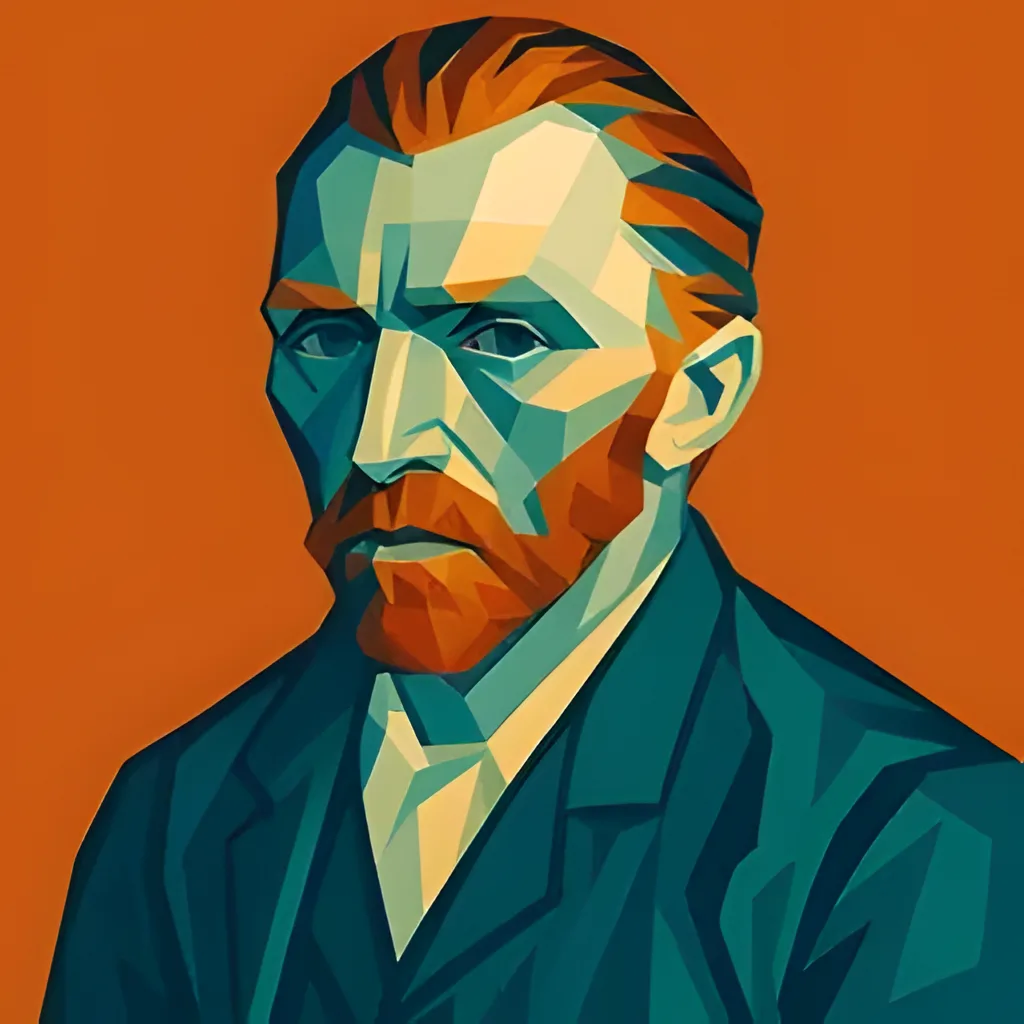
A life in brief
Vincent van Gogh: life and timeline.
One documented sale of an oil painting in his lifetime — The Red Vineyard — against nearly two thousand artworks made in just over a decade. Vincent van Gogh did not start drawing seriously until he was twenty-seven, having already failed as an art dealer, a teacher, and a lay preacher whose church found his methods too radical. He painted three hundred works in fifteen months in Arles, cut off his left ear that December, and made The Starry Night from an asylum.
- 1853
Born in Groot-Zundert
Born 30 March in a small Dutch village to Theodorus, a Protestant minister, and Anna Carbentus. He is named after a brother who died exactly a year earlier to the day, and grows up passing a grave bearing his own name.
- 1869
The art trade
At sixteen he leaves school for his uncle's gallery in The Hague, part of Goupil and Company, and is posted to London and Paris. His religious intensity and contempt for the commercial art market eventually cost him the job.
- 1880
Drawing, at twenty-seven
After teaching in England, studying theology, and preaching to Belgian coal miners — giving away his possessions to share their poverty until the church judged him too radical — he starts drawing. He teaches himself from manuals and from Jean-François Millet.
- 1881
Kee, and the first paintings
He falls for his widowed cousin Kee Vos-Stricker, who refuses him outright; family accounts say he held his hand in a candle flame to prove his love. He begins painting in dark, earthy colours under Anton Mauve, who drops him when Vincent moves in with Sien Hoornik, a pregnant prostitute.
- 1885
The Potato Eaters
Months of work on a peasant family eating by lamplight — weathered hands and faces painted with sympathy rather than idealised. It is widely considered his first masterpiece.
- 1886
Paris
He moves in with Theo and meets the Impressionists and Post-Impressionists — Monet, Renoir, Cézanne — plus Toulouse-Lautrec, Bernard and Gauguin. The dark palette gives way to light and colour. The city's noise wears him down.
- 1888
Arles
In February he leaves for Provence, chasing better light and cheaper rent. In fifteen months he produces nearly 300 paintings and drawings, among them Sunflowers, The Bedroom and The Café Terrace at Night.
- 1888
The ear
Gauguin joins him in October to start an artists' colony; the two clash constantly. On 23 December, after a confrontation, Vincent cuts off most of his left ear with a razor and delivers it to a woman at a nearby brothel. Gauguin leaves Arles at once.
- 1889
Saint-Rémy
After Arles residents petition to have him removed, he admits himself to the Saint-Paul-de-Mausole asylum in May. He paints nearly 150 works there, including The Starry Night in June — done from memory and imagination, not the window.
- 1890
Auvers-sur-Oise
He leaves the asylum in May for a town near Theo, under Dr Paul Gachet. He paints seventy pictures in seventy days. On 27 July he sustains a gunshot wound and dies two days later at thirty-seven, Theo beside him. Theo dies about six months after that.
Major achievements
Vincent van Gogh: major achievements.
- 01
Nearly two thousand artworks
Made in just over a decade, by a man who first picked up drawing seriously at twenty-seven and was dead at thirty-seven.
- 02
The Starry Night
Painted in June 1889 from inside an asylum, from memory rather than observation — a night sky that fuses what he saw with what he felt, and his most famous work.
- 03
The Arles year
Nearly 300 paintings and drawings in fifteen months, including Sunflowers, The Bedroom and The Café Terrace at Night — one of the most concentrated bursts of production in the history of painting.
- 04
The letters to Theo
His correspondence with his brother is considered among the most moving documents in art history, an unbroken record of what he was trying to do and why.
- 05
The groundwork of modern art
His colour and brushwork opened the way for Fauvism and Expressionism, and reached forward to Matisse, Derain, Pollock and de Kooning.
Turning points
Vincent van Gogh: defining moments.
- 1880
Starting at twenty-seven
He had already been fired as an art dealer, failed as a teacher, and been stripped of his lay preachership for living in the same poverty as the miners he served. Every career his family wanted for him was closed. He began to draw, copying manuals, with ten years left.
- 1886–1888
Paris changes the colours
He arrived painting in Dutch browns and blacks. Two years among the Impressionists rebuilt his palette entirely. When he left for Arles, he had the technique to match what he had always been trying to say.
- December 1888
Gauguin, and the razor
The artists' colony he had dreamed of lasted two months. Gauguin painted from imagination, Vincent from life, and neither would yield. After a confrontation on 23 December he cut off most of his left ear. Gauguin left immediately; the crises never stopped after that.
- 1889–1890
Painting from inside the asylum
He committed himself voluntarily to Saint-Paul-de-Mausole after his neighbours petitioned to be rid of him. Between breakdowns that left him unable to work at all, he made nearly 150 paintings in a year — including the one everybody knows.
…dug the earth with those very hands they put in the dish.
Vincent van Gogh, writing to Theo about The Potato Eaters
What you’ll take away
Lessons from Vincent van Gogh’s life.
- 01
Twenty-seven is not late
He came to art after every other path had thrown him out, and had a decade to work. The output was nearly two thousand pieces, most of the century's best-known paintings among them.
- 02
One believer is enough
Theo paid the bills, sent the paint, and read every letter. Vincent had almost no audience and no market. He had a brother, and that turned out to be the whole difference.
- 03
The market is not the verdict
One documented oil sale while he lived. The same paintings now sell for hundreds of millions and fill a museum in Amsterdam. What the buyers of 1888 thought of the work told you nothing about the work.
Did you know
Facts about Vincent van Gogh.
- 01
Did you know that Vincent van Gogh only sold one painting, 'The Red Vineyard', during his entire lifetime, despite creating over 900 paintings in just ten years?
- 02
Did you know that before dedicating his life to art at age 27, van Gogh attempted to work as an art dealer, a teacher, and a missionary preacher in a poor mining village?
- 03
Did you know that Vincent van Gogh painted his most famous work, 'The Starry Night', from memory while looking out the east-facing window of his asylum room in Saint-Rémy-de-Provence?
If you liked Vincent van Gogh…
Browse all → Painter16 min
Pablo Picasso
The Revolutionary Artist Who Transformed Modern Art
 Sculptor & Painter18 min
Michelangelo
The Divine Artist Who Sculpted the Renaissance
 Artist & Inventor18 min
Leonardo da Vinci
The Ultimate Renaissance Man
 Fashion Designer16 min
Coco Chanel
The Revolutionary Designer Who Liberated Women's Fashion
FAQ
Frequently asked questions about Vincent van Gogh.
What was Vincent van Gogh's full name?
Vincent Willem van Gogh. He was named after his grandfather — and after a stillborn brother, also called Vincent Willem, born exactly a year earlier.
How did Theo van Gogh die?
Vincent's brother and lifelong supporter Theo fell seriously ill soon after Vincent's death and died in Utrecht on 25 January 1891, aged thirty-three, probably from the effects of syphilis. In 1914 he was reburied beside Vincent in Auvers-sur-Oise.
How many paintings did Van Gogh sell in his lifetime?
There is one documented sale of an oil painting — The Red Vineyard — though he did receive some income from drawings and small commissions. Today his works sell for tens to hundreds of millions of dollars.
Did Van Gogh cut off his whole ear?
He cut off most of his left ear, and likely all of it, with a razor on 23 December 1888 after a confrontation with Paul Gauguin. He wrapped it and delivered it to a woman at a nearby brothel before collapsing from blood loss.
What mental illness did Van Gogh have?
It remains debated. Suggestions include bipolar disorder, temporal lobe epilepsy, and acute intermittent porphyria. What is clear is that he alternated between periods of extraordinary productivity and breakdowns that left him unable to work.
How did Van Gogh die?
He sustained a gunshot wound, likely to the abdomen, at Auvers-sur-Oise on 27 July 1890 and died two days later, aged thirty-seven, with Theo at his side. Most accounts conclude he shot himself, though some research has proposed an accidental shooting.
Where was The Starry Night painted?
At the Saint-Paul-de-Mausole asylum in Saint-Rémy, in June 1889, where he had voluntarily admitted himself. He painted it from memory and imagination rather than directly from the view.
Published by Lyfestori, from Duck Pond Ventures Oy. About us and how to report a correction.
17 min · one sitting