Coco Chanel
The Revolutionary Designer Who Liberated Women's Fashion
Born Gabrielle Bonheur Chanel on 19 August 1883 in Saumur, France, Coco Chanel grew up in a convent orphanage, opened a hat shop in Paris in 1910, and freed women from the corset with jersey dresses, the little black dress and Chanel No. 5 — a legacy shadowed by her conduct during the Nazi occupation.
- 16 min listen
- Chanel No. 5
- Little black dress
- The Chanel suit
Coco Chanel’s full 16 min audio biography, The Revolutionary Designer Who Liberated Women's Fashion, is available on Lyfestori for iOS. Listen to a free preview below.
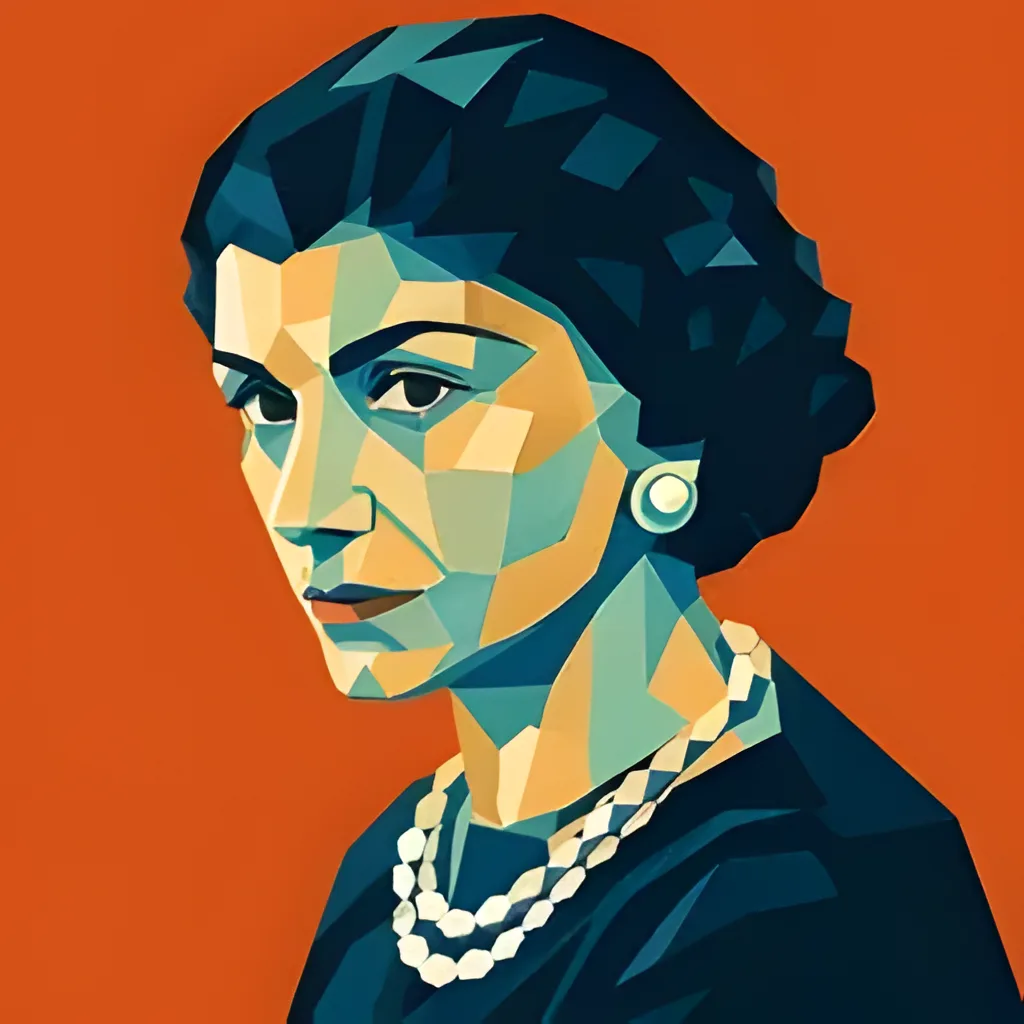
A life in brief
Coco Chanel: life and timeline.
Her mother died when she was eleven and her father abandoned the children. Gabrielle Chanel and her sisters were sent to the Abbey of Aubazine, where nuns in black and white taught her to sew. She sang in cabarets in Moulins, picked up the name Coco, and opened a hat shop in Paris in 1910 on a lover's money. She cut jersey — a men's underwear fabric — into dresses women could move in, put her lucky number on a perfume bottle, and spent the war at the Ritz under German occupation.
- 1883
Born in Saumur
Born 19 August to Eugénie Jeanne Devolle, a laundrywoman in a charity hospital, and Albert Chanel, a travelling salesman who sold work clothes at markets. The family moves constantly and lives in extreme poverty.
- 1908
Balsan's château
Étienne Balsan, a wealthy textile heir she met while singing, invites her to live at his château near Paris. She finds the corsets, feathered hats and heavy skirts of wealthy women impractical, and starts making simpler clothes for herself out of elements of men's dress.
- 1910
Chanel Modes
With backing from Arthur 'Boy' Capel, she opens a millinery at 21 rue Cambon in Paris. Her hats are far simpler than the ornate headpieces in fashion, and the actress Gabrielle Dorziat wears them in a popular play.
- 1913
Deauville
Opens a boutique at the fashionable seaside resort and expands into clothing, using jersey — a fabric until then reserved for men's underwear — to make dresses and suits women can actually move in.
- 1914
The war changes the customer
As women enter the workforce to replace men who have gone to the front, they need clothes that allow mobility. Her clean lines, neutral colours and casual luxury suit the new reality exactly.
- 1919
Boy Capel dies
Her greatest love and strongest supporter is killed in a car accident. She channels the grief into her work and into establishing her independence.
- 1921
Chanel No. 5
A blend of over eighty ingredients — aldehydes among them, for a distinctive sparkle — launched when single-flower scents dominate. Named after her lucky number and bottled in a plain rectangle that resembles a whiskey decanter.
- 1926
The little black dress
Vogue publishes a drawing of it and predicts it will become 'a sort of uniform for all women of taste', comparing it to Ford's Model T. She had already made black a modern colour rather than a mourning one.
- 1939
The house closes
At the outbreak of war she shuts her couture house and takes up residence at the Ritz in Paris, where she remains through the German occupation.
- 1954
The comeback
At seventy-one she returns to challenge Dior's New Look — cinched waists, full skirts — which she considers a step backward for women. French critics call her old-fashioned; American editors and buyers welcome her.
- 1971
Death at the Ritz
Dies 10 January, aged eighty-seven, in her suite at the Ritz. She had spent her final day at the rue Cambon boutique, working on a new collection.
Major achievements
Coco Chanel: major achievements.
- 01
Clothes women could move in
She used jersey, until then reserved for men's underwear, to make dresses and suits. She liberated women from corsets, shortened skirts to reveal the ankle, and borrowed from men's tailoring — letting women take part more fully in the working and social life of the modern world.
- 02
Chanel No. 5
Launched in 1921 against a fashion for single-flower scents: over eighty ingredients including aldehydes, named for her lucky number, in a plain rectangular bottle modelled more on a whiskey decanter than on the ornate flasks of the era.
- 03
The little black dress
Vogue drew it in 1926 and predicted it would become a uniform for all women of taste, comparing it to Ford's Model T. The prediction held. She had turned black from the colour of mourning into the colour of modern sophistication.
- 04
The Chanel suit
The centrepiece of her 1950s return: a collarless boxy tweed jacket with braided trim, a slim straight skirt, and a small chain sewn into the hem so it hung properly. Her argument that elegance comes from simplicity and ease, in one garment.
- 05
An empire on her own terms
From a convent sewing room to a house she controlled down to the last fitting, she proved a woman could build and run a business of that scale despite her gender and her origins — making costume jewellery, trousers, tanned skin and the boyish garçonne line fashionable along the way.
Turning points
Coco Chanel: defining moments.
- Childhood
Aubazine
Her mother died of tuberculosis when she was eleven; her father, unable or unwilling to keep his children, abandoned them. The abbey that took her in was austere — nuns in black and white habits, clean lines, geometric patterns. It taught her to sew, gave her a work ethic, and handed her the aesthetic she would later sell to the world.
- 1908–1913
Seeing the clothes from inside
Living at Balsan's château, she watched wealthy women manage laced corsets, enormous feathered hats and long heavy skirts, and concluded the clothes were impractical. She began making her own from elements of men's dress. Boy Capel recognised the ambition and financed it: the hat shop became a boutique, the boutique became a house.
- 1919
Losing Boy Capel
The man who had backed her when she was a seamstress who sang in cabarets died in a car accident. It devastated her personally and professionally. She answered by working harder, and by making sure she would never again depend on anyone's support.
- 1939–1945
The occupation
She closed the couture house and lived at the Ritz through the German occupation. She was involved with Hans Günther von Dincklage, a German intelligence officer, and archival evidence shows contact with the Abwehr. She also tried to use anti-Jewish laws to take control of Parfums Chanel from the Wertheimers, her Jewish partners, who had already protected their interests legally. Questioned after the liberation, she was never charged — but opinion had turned, and she left for Switzerland.
- 1954
Coming back at seventy-one
Dior's New Look had put women back into cinched waists and full skirts. She read it as a reversal of everything she had done and returned to fight it. The French press called her dated. The Americans bought the clothes. The Chanel suit outlived the argument.
What you’ll take away
Lessons from Coco Chanel’s life.
- 01
Constraint can become a style
The convent gave her black and white, clean lines and geometry because it had nothing else to give. She spent a career selling that austerity back to people who could afford anything they wanted.
- 02
Design for the life people actually have
She won partly because the world changed and she had already dressed for it. When women went into wartime workforces, the clothes that let them move were hers. Practical was the luxury.
- 03
Achievement does not settle the account
She freed a generation from the corset, and she spent the occupation at the Ritz with a German intelligence officer while trying to seize her partners' company under anti-Jewish laws. Both are hers. Neither cancels the other.
Did you know
Facts about Coco Chanel.
- 01
Did you know that Coco Chanel popularized the 'Little Black Dress' in 1926, completely transforming black clothing from a symbol of mourning into a staple of high fashion?
- 02
Did you know that Coco grew up in an orphanage run by nuns in Aubazine, France, where she learned the sewing skills that would launch her career?
- 03
Did you know that Coco Chanel lived in a luxurious suite at the Ritz Hotel in Paris for over 30 years, where she eventually passed away in 1971?
If you liked Coco Chanel…
Browse all → Painter16 min
Pablo Picasso
The Revolutionary Artist Who Transformed Modern Art
 Filmmaker & Comedian17 min
Charlie Chaplin
The Little Tramp Who Became Cinema's Greatest Icon
 Chef15 min
Jamie Oliver
The Chef Who Changed How Britain Eats
 Composer16 min
Johann Sebastian Bach
The Master Who Shaped Western Classical Music
FAQ
Frequently asked questions about Coco Chanel.
What was Coco Chanel's real name?
Gabrielle Bonheur Chanel. She was born on 19 August 1883 in the charity hospital of Saumur, in western France, and picked up the nickname “Coco” while singing in cabarets in Moulins as a young woman.
Why did Coco Chanel grow up in an orphanage?
After her mother died in 1895, her father, a travelling market trader, left her and her sisters at the convent orphanage of Aubazine. The nuns there taught her to sew, and the black-and-white austerity of the abbey is often seen in her later designs.
How did Coco Chanel die?
She died on 10 January 1971 in her suite at the Hôtel Ritz in Paris, where she had lived for more than thirty years. She was eighty-seven and was still working on a new collection.
Why is she called Coco?
She picked the name up singing in cafés and small cabarets in Moulins in her late teens. It was possibly inspired by songs she often performed, such as 'Ko Ko Ri Ko' and 'Qui qu'a vu Coco?'. The singing career was brief. The name was not.
What did Coco Chanel actually change about women's clothes?
She used jersey, a fabric reserved for men's underwear, to make dresses and suits that were comfortable. She moved women away from corsets, shortened skirts to reveal the ankle, helped make trousers acceptable in leisure and resort settings, encouraged costume jewellery alongside precious gems, and presented black as modern rather than mournful.
What did she do during the Second World War?
She closed her couture house in 1939 and lived at the Ritz in Paris through the German occupation. She was involved with Hans Günther von Dincklage, a German intelligence officer, and archival evidence shows contact with the Abwehr. She also attempted to use anti-Jewish laws to take Parfums Chanel from her Jewish partners, the Wertheimers. French authorities questioned her after the liberation but never charged her; she settled in Switzerland.
Did she really say 'take one thing off' before leaving the house?
The line — like 'Luxury must be comfortable, otherwise it is not luxury' — is widely attributed to her, but the exact origin is uncertain. What is documented is the philosophy behind them: simplicity, authenticity and self-confidence rather than excess or decoration.
What happened to Chanel after she died?
The house grew. Karl Lagerfeld became artistic director in 1983 and modernised it while respecting its heritage, staying until his death in 2019. His longtime collaborator Virginie Viard led the brand from 2019 until her departure in 2024.
Published by Lyfestori, from Duck Pond Ventures Oy. About us and how to report a correction.
16 min · one sitting