Pablo Picasso
The Revolutionary Artist Who Transformed Modern Art
Born on 25 October 1881 in Málaga, Spain, with a baptismal name of more than a dozen parts, Pablo Picasso co-founded Cubism, painted Les Demoiselles d'Avignon and Guernica, and produced tens of thousands of works across seventy-five years — a legacy now weighed against his treatment of the women in his life.
- 16 min listen
- Cubism
- Modern art
- Guernica
Pablo Picasso’s full 16 min audio biography, The Revolutionary Artist Who Transformed Modern Art, is available on Lyfestori for iOS. Listen to a free preview below.
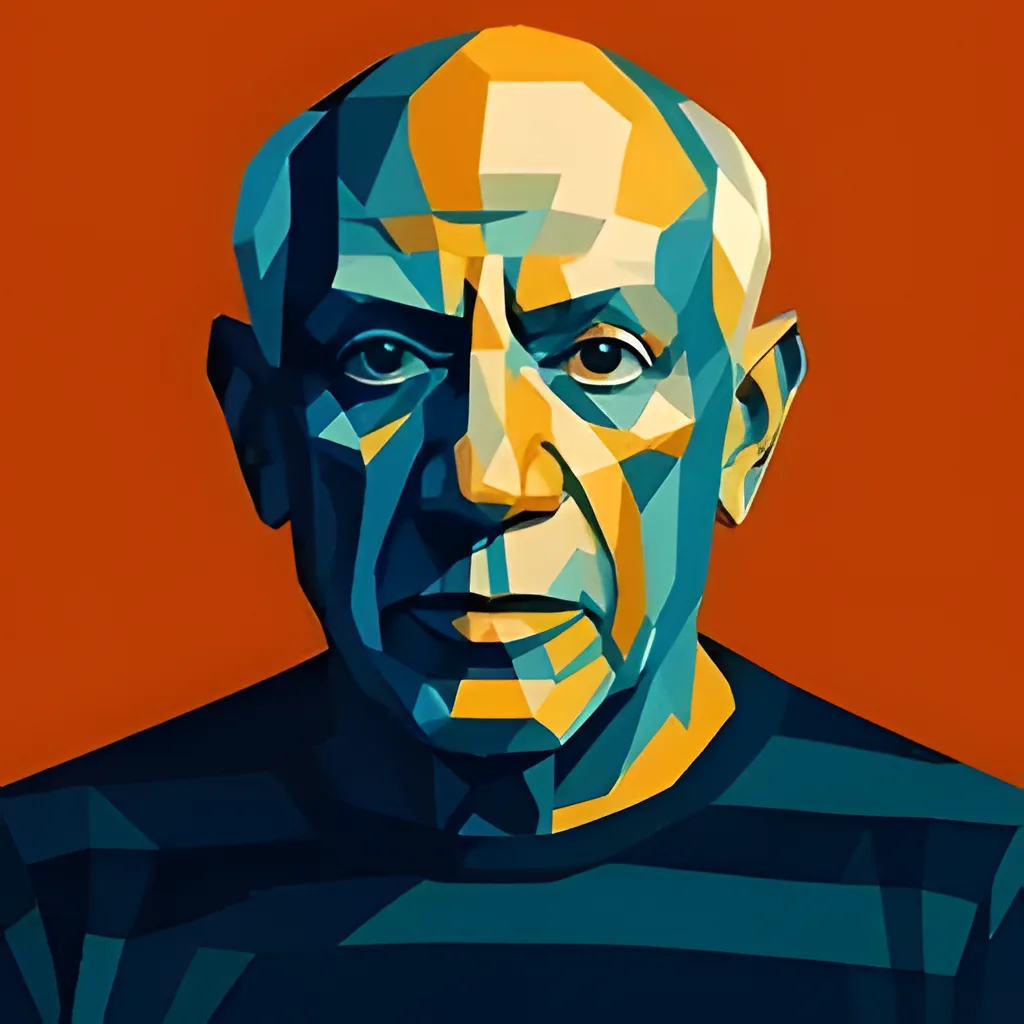
A life in brief
Pablo Picasso: life and timeline.
His father taught him to paint at seven, and by thirteen the son had reportedly outrun the teacher. Pablo Picasso passed the Barcelona art school entrance exam in a day — other candidates took a month — then found the Madrid academy so stifling he stopped attending and taught himself in the Prado instead. In 1907 he painted five women with faces borrowed from African masks, abandoned perspective, and broke with centuries of Western tradition. He left about 50,000 works.
- 1881
Born in Málaga
Born 25 October with a name running to more than a dozen parts; he later used only his mother's, Picasso. His father José Ruiz Blasco was an art teacher and painter known for naturalistic pigeons.
- 1895
Barcelona
The family moves when his father takes a post at the School of Fine Arts. Admitted below the usual age, he finishes the entrance exam in a single day — a process that took other students a month.
- 1900
First trip to Paris
At nineteen he arrives in the centre of the art world and heads for the avant-garde of Montmartre, meeting the work of Toulouse-Lautrec, Degas and Cézanne.
- 1901
The Blue Period begins
His close friend Carlos Casagemas takes his own life in February. For three years he paints almost entirely in blue and blue-green — poverty, isolation, sadness. 'The Old Guitarist' and 'The Blue Room' come out of it.
- 1904
The Rose Period
Settled in the Bateau-Lavoir, a rundown Montmartre building full of struggling artists, his palette warms to pinks and earth tones and fills with circus performers, harlequins and acrobats. He meets Fernande Olivier.
- 1907
Les Demoiselles d'Avignon
Five nude women, no traditional perspective, faces on the right drawn from African masks he had seen in ethnographic museums. Many call it the most important painting of the twentieth century. Cubism starts here.
- 1912
Collage
Synthetic Cubism brings brighter colour and real materials — newspaper, wallpaper, rope — glued onto the canvas, pushing at what a painting is allowed to be made of.
- 1918
Olga and the neoclassical turn
He marries the Russian ballerina Olga Khokhlova and spends seven years working in a more traditional register while keeping his modernist innovations — proof he could run several styles at once.
- 1937
Guernica
A massive canvas answering the bombing of Guernica in the Spanish Civil War. It becomes the defining anti-war image of the century.
- 1944
After the occupation
He had sat out the war in Paris, his work branded degenerate by the Nazis, forbidden to exhibit and harassed. On liberation he joins the French Communist Party, calling it the party of the poor and oppressed.
- 1961
Jacqueline
At seventy-nine he marries Jacqueline Roque, his companion since 1953. She sits for more than 400 paintings in his last years.
- 1973
Death at Mougins
He dies on 8 April at ninety-one, at home in the south of France, working to the end.
Major achievements
Pablo Picasso: major achievements.
- 01
Cubism
Developed with Georges Braque between 1907 and 1914. It broke objects into geometric shapes and showed them from several angles at once, discarding the single fixed viewpoint Western painting had used for centuries.
- 02
Les Demoiselles d'Avignon
The 1907 canvas that started it — widely held to be the most important painting of the twentieth century, and a clean break with the tradition he had mastered as a boy.
- 03
Guernica
His 1937 response to the bombing of a Basque town, and the proof that a modernist could make political art that lands. It remains one of the most recognisable anti-war works ever painted.
- 04
Range across every medium
Roughly 50,000 works: paintings, sculpture, thousands of prints, stage designs, tapestries, over 4,000 ceramics made at the Madoura studio in Vallauris, and public sculpture like the Cor-Ten steel Chicago Picasso in Daley Plaza.
- 05
Running his own market
He kept ownership of much of his output and involved himself in how it was shown and sold. That commercial instinct helped build the modern art market — his work now sets auction records, from Les Femmes d'Alger at $179.4 million in 2015 to Femme à la montre at $139.3 million in 2023.
Turning points
Pablo Picasso: defining moments.
- Age sixteen
Walking out of the academy
He got into Spain's foremost art school in Madrid and stopped going to class. The formal instruction was stifling. He spent the time in the Prado instead, working through Velázquez, Goya and El Greco on his own terms — the masters he needed, chosen by him rather than assigned.
- 1901
Casagemas
The suicide of a close friend in February turned his palette blue for three years and gave him his first real subject: poverty, isolation, grief. The technical prodigy became an artist with something to say.
- 1907
Les Demoiselles d'Avignon
He had mastered academic painting as a child. In 1907 he threw out perspective, took faces from African masks, and painted something ugly and unresolved on purpose. Everything modern art did afterwards runs through that canvas.
- 1937
Guernica
A town was bombed and he answered on a scale nobody could ignore. It proved his fractured, multi-angle language could carry moral weight, not just formal invention — and it made him a political figure for the rest of his life.
Drink to me, drink to my health. You know I can't drink anymore.
Pablo Picasso, reportedly his last words, 1973
What you’ll take away
Lessons from Pablo Picasso’s life.
- 01
Earn the right to break it
He could out-paint his own teacher at thirteen and cleared an entrance exam in a day. The rules he discarded in 1907 were rules he had already mastered completely. That is why the break read as an argument and not as incompetence.
- 02
Do not settle into your best style
Blue, Rose, Cubism, neoclassical, Surrealism, ceramics, late expressive work — he kept leaving styles that were working. Critics wrote off his late paintings as decline; they are now read as an old man arguing with mortality.
- 03
Genius does not excuse the person
He was cruel to the women who sat for him, several of whom suffered badly and two of whom died by suicide after his death. The paintings are not diminished by saying so, and the record should not be tidied.
Did you know
Facts about Pablo Picasso.
- 01
Did you know that Pablo Picasso's full birth name consists of 23 different words, honoring various saints and relatives?
- 02
Did you know that when the famous 'Mona Lisa' was stolen from the Louvre in 1911, the police actually brought Picasso in for questioning as a prime suspect?
- 03
Did you know that Picasso was incredibly prolific, creating an estimated 50,000 artworks during his lifetime, including paintings, sculptures, ceramics, and drawings?
If you liked Pablo Picasso…
Browse all → Painter17 min
Vincent van Gogh
The Tortured Artist Who Created Beauty from Pain
 Artist & Inventor18 min
Leonardo da Vinci
The Ultimate Renaissance Man
 Sculptor & Painter18 min
Michelangelo
The Divine Artist Who Sculpted the Renaissance
 Fashion Designer16 min
Coco Chanel
The Revolutionary Designer Who Liberated Women's Fashion
FAQ
Frequently asked questions about Pablo Picasso.
What is Pablo Picasso's full name?
Pablo Diego José Francisco de Paula Juan Nepomuceno María de los Remedios Cipriano de la Santísima Trinidad Ruiz y Picasso — a list of saints and relatives, as was customary for a Spanish Catholic baptism. Ruiz was his father's surname and Picasso his mother's; he signed his work with hers from around 1901.
What is Picasso's most famous painting?
Most often Guernica (1937), his huge black-and-white response to the bombing of a Basque town during the Spanish Civil War, now in the Museo Reina Sofía in Madrid. Les Demoiselles d'Avignon (1907), which opened the way to Cubism, is usually ranked as his most influential.
How did Picasso die?
Of heart failure, at his home in Mougins in the south of France, on 8 April 1973. He was ninety-one and had been working until shortly before his death.
What is Cubism?
An approach Picasso developed with Georges Braque from 1907, breaking subjects into geometric shapes and showing them from several viewpoints at once instead of one. Analytical Cubism, from 1909, used muted colours and dense geometric analysis; Synthetic Cubism, from 1912, brought brighter colour and collage — real newspaper, wallpaper and rope stuck to the canvas.
What is Guernica about?
Picasso painted it in 1937 in response to the bombing of Guernica during the Spanish Civil War. The huge canvas became a powerful anti-war symbol and showed he could take on political subjects directly through a modernist language.
How many artworks did Picasso create?
Over 50,000 across his lifetime, in nearly every medium available — painting, sculpture, ceramics, prints, stage design and tapestry. He was working until he died at ninety-one, having produced thousands of works in his final decades alone.
Why is Picasso a controversial figure?
His treatment of women. He had many relationships with women much younger than him — he met Marie-Thérèse Walter when she was seventeen — and modern scholars have criticised how he treated them. Several partners suffered depression and mental health problems, and both Marie-Thérèse Walter and Jacqueline Roque died by suicide after his death.
Published by Lyfestori, from Duck Pond Ventures Oy. About us and how to report a correction.
16 min · one sitting