Michelangelo
The Divine Artist Who Sculpted the Renaissance
Born Michelangelo di Lodovico Buonarroti Simoni on 6 March 1475 in Caprese, near Florence, Michelangelo carved the Pietà and David before he was thirty, painted the Sistine Chapel ceiling and The Last Judgment, and designed the dome of St Peter's — working for the Medici and a succession of popes until his death in Rome at eighty-eight.
- 18 min listen
- Renaissance
- Sculpture
- Sistine Chapel
Michelangelo’s full 18 min audio biography, The Divine Artist Who Sculpted the Renaissance, is available on Lyfestori for iOS. Listen to a free preview below.
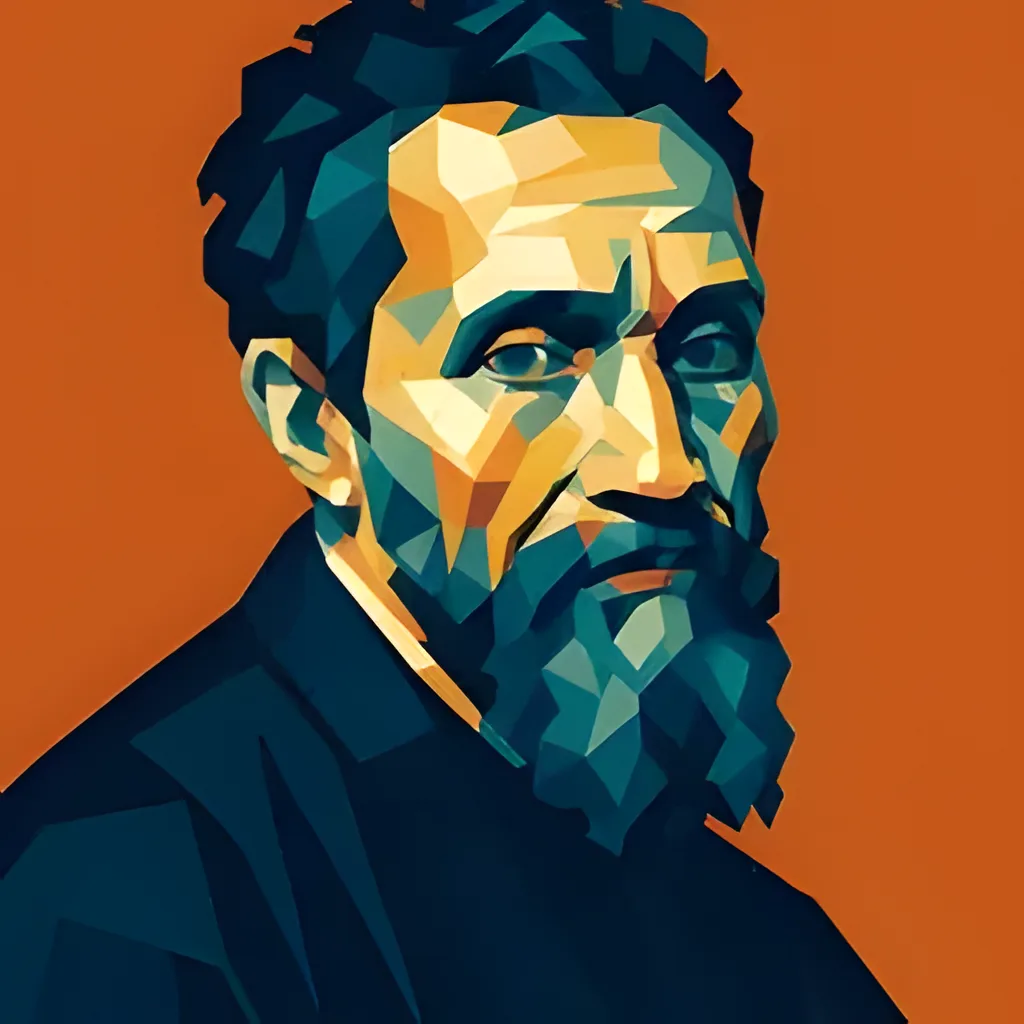
A life in brief
Michelangelo: life and timeline.
His father thought art was beneath the family's status and apprenticed him to a painter anyway, at thirteen. Michelangelo left after about a year to carve stone instead. He finished the Pietà at twenty-four and signed it — the only work he ever signed — after overhearing visitors credit it to someone else. He took a marble block other sculptors had abandoned for thirty-five years and made David out of it. He insisted he was not a painter, then spent four years on the Sistine ceiling.
- 1475
Born in Caprese
Born 6 March in a Tuscan mountain town to a government official of Florence's minor nobility. The family moves to Florence, the heart of Renaissance art, while he is an infant.
- 1488
Apprenticed against his father's wishes
Lodovico considered art a lowly profession beneath the family, then conceded to his son's talent. At thirteen Michelangelo is apprenticed to Domenico Ghirlandaio for three years — and leaves after about one, for sculpture.
- 1492
The Medici years end
Lorenzo the Magnificent, who had taken him into the palace and treated him almost as a son, dies. Michelangelo had carved the Battle of the Centaurs at about seventeen, and studied classical sculpture in Lorenzo's garden among scholars, poets and Neoplatonists.
- 1494
Flight from Florence
Savonarola's rise, condemning Medici luxury and patronage, makes the city dangerous. He flees to Venice and Bologna, carving small sculptures for the tomb of Saint Dominic and gaining valuable experience in marble.
- 1499
The Pietà
He had reached Rome in 1496, where Cardinal Riario commissioned the Bacchus. Cardinal Jean de Bilhères then commissioned this: Mary cradling the dead Christ, finished at twenty-four, her robes carved from a single block. He signed it across her chest after overhearing visitors credit another artist — the only work he ever signed.
- 1504
David
Over two years of work in secret on a damaged block that other sculptors had partly worked and left exposed for some thirty-five years. Seventeen feet tall, showing David before the fight rather than after. Florence placed it before the Palazzo Vecchio, where it stood until 1873.
- 1505
The tomb of Julius II
Summoned to Rome to design a massive freestanding monument with over forty sculptures. Julius turns to rebuilding St Peter's instead and sets the tomb aside; Michelangelo, insulted, flees back to Florence.
- 1508
The Sistine ceiling
Julius will not be refused. Michelangelo insists he is a sculptor, not a painter, then paints roughly 5,800 square feet standing with his head craned back on a scaffold of his own design — a strain he complained about in a famous sonnet.
- 1512
The ceiling unveiled
Nine scenes from Genesis, from the separation of light and darkness to the drunkenness of Noah, surrounded by prophets, sibyls and ignudi. The Creation of Adam becomes one of the world's most recognisable images. It creates a visual language that shapes painting for centuries.
- 1541
The Last Judgment
Begun in 1536 on the altar wall of the same chapel. Christ is a stern judge; the saved and damned swirl around him. The optimistic humanism of the ceiling is gone, shaped by the Reformation, the 1527 sack of Rome and his own age. The nudity draws later censorship.
- 1546
St Peter's
Paul III appoints him chief architect, a post he holds until his death. His dome, completed after he dies, dominates Rome's skyline and has been copied in capitol buildings and churches worldwide.
- 1564
Death in Rome
Dies 18 February, weeks before his eighty-ninth birthday, having worked on the Rondanini Pietà until days before. His body is secretly taken to Florence and buried at Santa Croce.
Major achievements
Michelangelo: major achievements.
- 01
David
Seventeen feet of marble, carved in secret over two years from a block others had abandoned, showing the hero in the tense moment before battle rather than after victory. Florence read it as itself: a small republic standing against more powerful enemies.
- 02
The Sistine Chapel ceiling
Roughly 5,800 square feet painted virtually alone between 1508 and 1512, with nine Genesis scenes including the Creation of Adam. It revolutionised painting and gave artists a new visual language for centuries.
- 03
The Pietà
Finished at twenty-four. Extraordinary technical mastery, perfect proportions, and Mary's flowing robes carved from a single block of marble — the work that established him as Rome's premier sculptor.
- 04
The dome of St Peter's
Designed as chief architect from 1546 and completed after his death. Its profile dominates Rome and has been copied in capitol buildings and churches around the world.
- 05
The Last Judgment
The altar wall of the Sistine Chapel, 1536–1541 — a darker work shaped by the Reformation, the sack of Rome and his own advancing age, and unconventional enough to draw censorship campaigns.
- 06
Over three hundred poems
Written in later life, revealing his inner thoughts and spiritual struggles. Many were addressed to Vittoria Colonna, the noblewoman and poet who became his closest friend.
Turning points
Michelangelo: defining moments.
- 1488–1492
The Medici palace
Ghirlandaio's workshop gave him technique and, more usefully, access to Florence's artistic circles. Lorenzo de' Medici noticed him and invited him to live in the palace, where he was treated almost like a son. Surrounded by scholars, poets and philosophers, he studied classical sculpture in the garden and absorbed Neoplatonism — the idea that physical beauty reflects divine beauty. Lorenzo's death in 1492 ended it abruptly.
- 1501–1504
The block nobody wanted
Florence's government wanted a symbol for its newly restored republic. The marble had been partially worked by other sculptors decades earlier, then left exposed and unused for roughly thirty-five years. Most artists saw damage. He worked in secret for over two years and produced David.
- 1508–1512
Forced to paint
He wanted to build Julius II's tomb; Julius wanted the Sistine ceiling. Michelangelo protested that he was a sculptor, not a painter. Julius would not be refused. He painted standing with his head craned back, assistants mainly preparing plaster, and complained of the physical strain in a sonnet — then changed painting permanently.
- 1505–1545
The tragedy of the tomb
Julius's tomb followed him for forty years: conceived with over forty sculptures, set aside, revived, scaled down by the pope's heirs after his death in 1513, argued over in legal disputes. The version finished in 1545 bears little resemblance to the original design — though it holds Moses, one of his most powerful sculptures.
- 1534
Leaving Florence for good
He had worked for the Medici, then served the republic that expelled them as chief of fortifications, then feared for his life when they returned in 1530. Pardoned but disillusioned, he left in 1534 and never went back. His last thirty years were spent in Rome, serving a succession of popes and turning increasingly to architecture, poetry and religion.
The tragedy of the tomb.
Michelangelo, on the forty-year saga of Pope Julius II's tomb
What you’ll take away
Lessons from Michelangelo’s life.
- 01
Take the damaged material
The David block had been botched and left in a yard for thirty-five years. Everyone else saw a ruined commission. The constraint is what produced the figure.
- 02
Sign your work
He carved his name across Mary's chest only after hearing visitors credit the Pietà to another artist. Once was enough — but he made the point, and never had to make it again.
- 03
Do the work you refused
He said he was a sculptor and not a painter, and meant it. Four years of forced painting produced the ceiling that redefined the medium.
Did you know
Facts about Michelangelo.
- 01
Did you know that Michelangelo painted the legendary ceiling of the Sistine Chapel while standing upright, not lying on his back as popular myth suggests?
- 02
Did you know that Michelangelo fiercely disliked painting and considered himself primarily a sculptor, even signing his letters 'Michelangelo, sculptor'?
- 03
Did you know that he frequently clashed with Pope Julius II, who commissioned the Sistine Chapel, and Michelangelo even painted some of his critics into hell in 'The Last Judgment'?
If you liked Michelangelo…
Browse all → Artist & Inventor18 min
Leonardo da Vinci
The Ultimate Renaissance Man
 Painter16 min
Pablo Picasso
The Revolutionary Artist Who Transformed Modern Art
 Painter17 min
Vincent van Gogh
The Tortured Artist Who Created Beauty from Pain
 Fashion Designer16 min
Coco Chanel
The Revolutionary Designer Who Liberated Women's Fashion
FAQ
Frequently asked questions about Michelangelo.
How old was Michelangelo when he painted the Sistine Chapel?
He was thirty-three when he began the ceiling in 1508 and thirty-seven when it was unveiled in 1512. He returned more than twenty years later to paint The Last Judgment on the altar wall, working on it from his early sixties until 1541.
Who did Michelangelo work for?
The most powerful patrons of the Renaissance. He grew up in the household of Lorenzo de' Medici in Florence, and later worked for a series of popes — above all Julius II, who commissioned the Sistine ceiling and his tomb — as well as Leo X, Clement VII and Paul III, who put him in charge of St Peter's.
What is Michelangelo's full name?
Michelangelo di Lodovico Buonarroti Simoni. He was born on 6 March 1475 in Caprese, a village in Tuscany where his father was serving as a local magistrate, and grew up in Florence.
Why did Michelangelo paint the Sistine Chapel if he was a sculptor?
Pope Julius II commissioned it and would not be refused. Michelangelo had come to Rome in 1505 to build Julius's tomb and was frustrated when the pope turned to rebuilding St Peter's instead. He resisted the ceiling, insisting he was a sculptor, then painted roughly 5,800 square feet between 1508 and 1512.
Is the Pietà really the only work Michelangelo signed?
Yes. He carved his name across Mary's chest after overhearing visitors attribute the sculpture to another artist. He completed it in 1499, at twenty-four.
What was wrong with the David marble?
It had been partially worked by other sculptors decades earlier and then left exposed and unused for roughly thirty-five years. Michelangelo took the flawed block, worked in secret for over two years, and completed the seventeen-foot statue in 1504.
Where is David now?
In the Galleria dell'Accademia in Florence. It stood in front of the Palazzo Vecchio, the seat of government, from 1504 until 1873, when it was moved; a replica now occupies the original site.
Did Michelangelo design the dome of St Peter's?
Yes. Pope Paul III appointed him chief architect of St Peter's Basilica in 1546, a position he held until his death in 1564. The dome was not completed until after he died, but the design is his, and it became one of architecture's most influential creations.
Published by Lyfestori, from Duck Pond Ventures Oy. About us and how to report a correction.
18 min · one sitting