Rigoberta Menchú Tum
The Indigenous Voice Who Spoke for the Voiceless
Born on 9 January 1959 in Chimel, in Guatemala's highlands, into a K'iche' Maya family, Rigoberta Menchú Tum lost her parents and a brother in Guatemala's civil war, told the world about it in I, Rigoberta Menchú, and in 1992 became the first Indigenous person to win the Nobel Peace Prize.
- 17 min listen
- Nobel Peace Prize
- Indigenous rights
- K'iche' Maya
Rigoberta Menchú Tum’s full 17 min audio biography, The Indigenous Voice Who Spoke for the Voiceless, is available on Lyfestori for iOS. Listen to a free preview below.
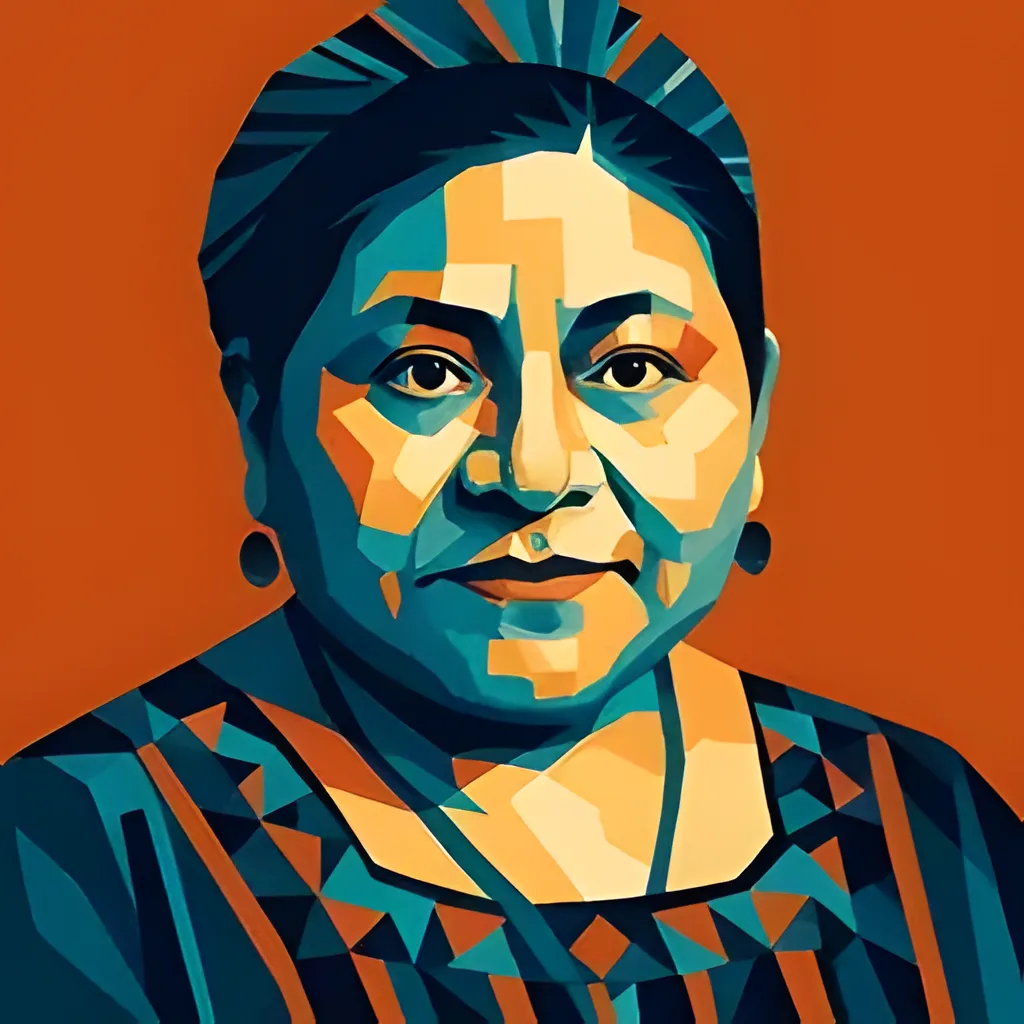
A life in brief
Rigoberta Menchú Tum: life and timeline.
Rigoberta Menchú Tum was born in a one-room adobe house in the Guatemalan highlands, one of nine children in a K'iche' Maya family who grew corn and picked coffee on the coast each harvest. She started plantation work at eight. By twenty-two she had lost a brother, her father and her mother to the army and the police, and had fled to Mexico. She told her story to an anthropologist, and the book that resulted made Guatemala's war impossible to ignore. In 1992 she won the Nobel Peace Prize.
- 1959
Born in Chimel
Born 9 January in the village of Chimel in Guatemala's Quiché province, one of nine children of Vicente Menchú and Juana Tum. The family home is one adobe room with no electricity or running water.
- 1967
Eight years old, on the plantations
Joins her family picking coffee and cotton on the coastal estates each harvest, where wages barely cover survival and children die of malnutrition and disease. She later described being seriously sickened by pesticide exposure in the fields.
- 1979
Her brother is killed
Her teenage brother Petrocinio is captured by government forces and killed along with other young men from the area — a message to anyone who might resist. She is twenty.
- 1980
Both parents killed
Her father Vicente dies when police assault the Spanish Embassy in Guatemala City, which he and other activists had occupied in protest; the raid triggers a fire that kills 36 to 37 people. Her mother Juana Tum is abducted, tortured and killed in the months that follow.
- 1981
Exile in Mexico
Fearing for her own life, she crosses the border and joins thousands of Guatemalan refugees — many of them indigenous survivors of village massacres — in the camps.
- 1982
Telling her story
Meets Elisabeth Burgos, a Venezuelan anthropologist documenting the experiences of indigenous women in Central America, who records and transcribes several days of interviews.
- 1983
I, Rigoberta Menchú
The book from those interviews is published and translated widely. For many readers in Europe and North America it is the first detailed account of the violence against Guatemala's indigenous people.
- 1988
Back in Guatemala
Returns to the country and continues advocacy from inside it, while keeping up international work on truth and reconciliation.
- 1992
The Nobel Peace Prize
At thirty-three she becomes the first Guatemalan and the first indigenous woman to receive it, honoured for work on social justice and ethno-cultural reconciliation based on respect for the rights of indigenous peoples.
- 1993
The foundation
Uses her new prominence to establish the Rigoberta Menchú Tum Foundation, working on indigenous rights, education and cultural preservation.
- 1996
The war ends
Peace accords close a thirty-six-year conflict that killed or disappeared more than 200,000 people, the vast majority of them indigenous civilians, according to the UN-sponsored truth commission.
- 2007
Running for president
Stands for the presidency of Guatemala, and again in 2011. She wins neither, but the campaigns push indigenous issues into national politics and show the growing participation of Maya communities.
Major achievements
Rigoberta Menchú Tum: major achievements.
- 01
Nobel Peace Prize, 1992
The first indigenous woman and the first Guatemalan to receive it, at thirty-three, for work on social justice and ethno-cultural reconciliation.
- 02
I, Rigoberta Menchú
Her 1983 testimony became required reading in many universities and put a human face on the statistics about human rights abuses in Central America.
- 03
The Rigoberta Menchú Tum Foundation
Founded in 1993 to promote indigenous rights, education and cultural preservation.
- 04
Indigenous rights at the UN
As a UNESCO Goodwill Ambassador and a participant in UN initiatives, she helped build the momentum behind the 2007 Declaration on the Rights of Indigenous Peoples.
- 05
Indigenous politics in Guatemala
Ran for president in 2007 and 2011. Neither campaign won, but both raised awareness of indigenous issues and demonstrated the growing political participation of Guatemala's Maya communities.
Turning points
Rigoberta Menchú Tum: defining moments.
- 1967
The coastal plantations
At eight she was working the harvest with her family, in conditions where children died of malnutrition and disease and she was herself poisoned by pesticide. The injustice was not an idea she was taught; it was the job.
- 1979
Her brother's death
Petrocinio was captured and killed by government forces. It forced her to see that this was not an isolated cruelty but a pattern of mass repression aimed at indigenous communities — and from that point she knew she could not stay silent.
- 1980–1981
Losing both parents, losing the country
Her father died in the fire at the Spanish Embassy; her mother was abducted, tortured and killed within months. With nothing left to protect her, she crossed into Mexico and joined the refugee camps.
- 1982–1983
The book
Several days of interviews with Elisabeth Burgos became I, Rigoberta Menchú. The testimony travelled where she could not, reached universities and governments across Europe and North America, and turned a private catastrophe into an international argument about indigenous rights.
What you’ll take away
Lessons from Rigoberta Menchú Tum’s life.
- 01
Testimony is a weapon
She had no army, no office and no money. She had an account of what had happened, told plainly, and it reached governments and universities that the killings themselves had not.
- 02
Name the pattern, not just the wound
Her brother's death could have stayed a family tragedy. She insisted on treating it as evidence of a system, which is what made it possible to organise against.
- 03
Speak for the community, not the self
When critics questioned details of her book, her defenders argued it was written to carry the collective experience of Guatemala's indigenous people. The abuses it described were separately documented by human rights organisations.
If you liked Rigoberta Menchú Tum…
Browse all → Environmental Activist17 min
Wangari Maathai
The Tree Planting Activist Who Won The Nobel Peace Prize
 Labor Leader15 min
César Chávez
A Farm-worker Who Became One of America’s Most Influential Labor Leaders
 Climate Activist16 min
Greta Thunberg
The Young Activist Who Sparked a Global Climate Movement
 Independence Leader19 min
Mahatma Gandhi
The Father of a Nation
FAQ
Frequently asked questions about Rigoberta Menchú Tum.
What is Rigoberta Menchú known for?
Campaigning for the rights of Indigenous peoples and for justice for the victims of Guatemala's civil war. Her 1983 testimony I, Rigoberta Menchú brought international attention to the army's violence against Maya communities, and in 1992, at thirty-three, she won the Nobel Peace Prize.
Is Rigoberta Menchú still alive?
Yes. She remains an active campaigner for Indigenous and women's rights in Guatemala and Mexico; in 2026 Guatemala's international book fair was dedicated to her.
Where was Rigoberta Menchú born?
In Chimel, a small village in the department of El Quiché in Guatemala's north-western highlands, on 9 January 1959. Her family were K'iche' Maya farmers who also worked seasonally on coffee plantations on the coast.
What did Rigoberta Menchú win the Nobel Peace Prize for?
The Norwegian Nobel Committee honoured her in 1992 for her work for social justice and ethno-cultural reconciliation based on respect for the rights of indigenous peoples. At thirty-three she was the first Guatemalan and the first indigenous woman to receive it.
What happened to her family?
Her teenage brother Petrocinio was captured and killed by government forces in 1979. Her father Vicente died in 1980 when police assaulted the occupied Spanish Embassy in Guatemala City and a fire killed 36 to 37 people. Her mother Juana Tum was abducted, tortured and killed in the months that followed.
Is 'I, Rigoberta Menchú' accurate?
Some critics questioned whether particular events happened exactly as she described them. Supporters argue the book was meant to represent the collective experience of Guatemala's indigenous people rather than only her own, and that the broader violence it describes is well documented by human rights organisations.
How many people died in Guatemala's civil war?
More than 200,000 people were killed or disappeared across thirty-six years of conflict, from 1960 to 1996, the vast majority of them indigenous civilians, according to the UN-sponsored truth commission.
What does she do now?
She remains active in indigenous rights advocacy, travelling frequently to speak at international conferences, and continues to work on protecting indigenous lands and cultures, expanding education and economic opportunity, and fighting racism and discrimination.
Published by Lyfestori, from Duck Pond Ventures Oy. About us and how to report a correction.
17 min · one sitting