Greta Thunberg
The Young Activist Who Sparked a Global Climate Movement
Born Greta Tintin Eleonora Ernman Thunberg on 3 January 2003 in Stockholm, Greta Thunberg began a solitary school strike outside Sweden's parliament at fifteen, inspired the global Fridays for Future movement, and was named Time Person of the Year in 2019.
- 16 min listen
- Fridays for Future
- Climate activism
- Time Person of the Year
Greta Thunberg’s full 16 min audio biography, The Young Activist Who Sparked a Global Climate Movement, is available on Lyfestori for iOS. Listen to a free preview below.
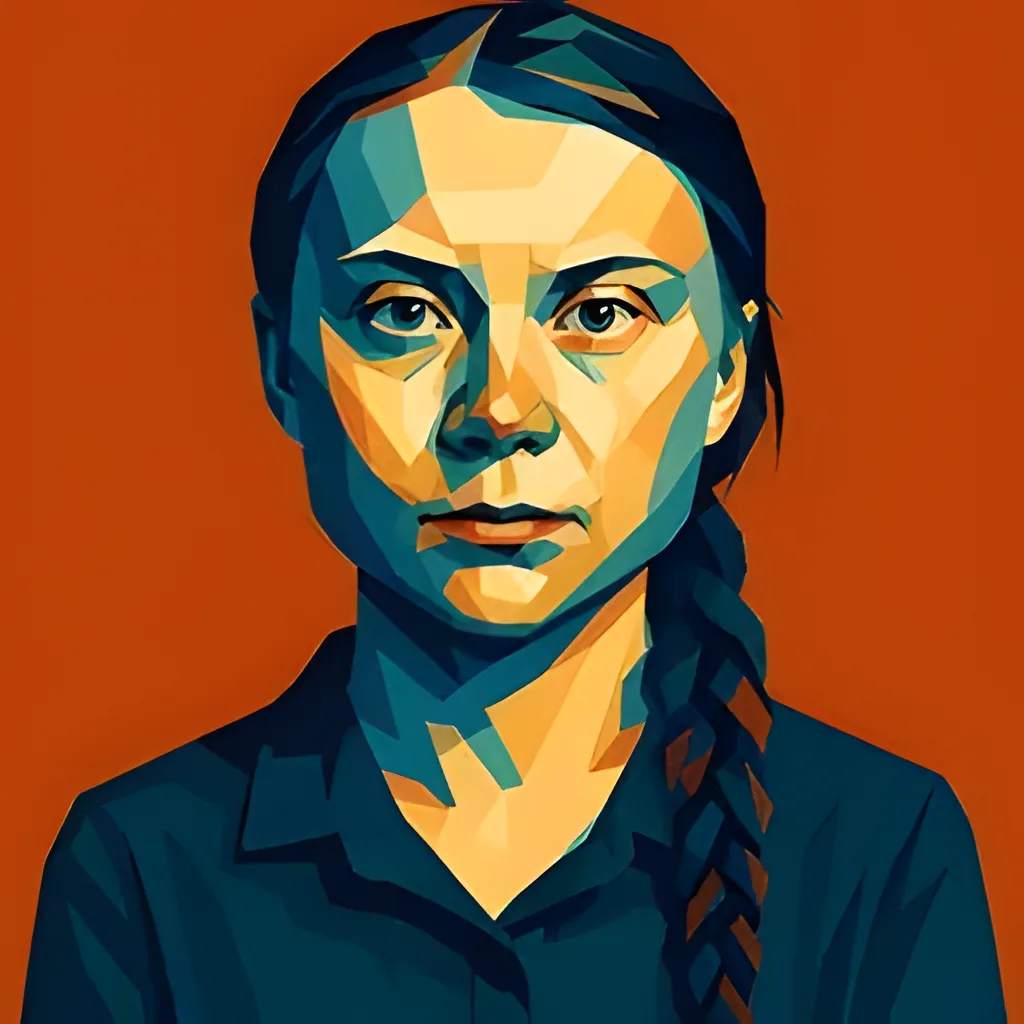
A life in brief
Greta Thunberg: life and timeline.
She learned about climate change at eight and could not stop thinking about it. She stopped eating and stopped speaking, and lost around ten kilograms in two months. At fifteen, after Sweden's hottest summer on record, Greta Thunberg skipped school and sat down outside parliament with a hand-painted sign. She sat there alone. Within a year students in some 150 countries were walking out on Fridays, and she was standing in front of the UN telling world leaders they had stolen her childhood.
- 2003
Born in Stockholm
Born 3 January to Malena Ernman, an opera singer who represented Sweden at Eurovision, and Svante Thunberg, an actor and author.
- 2018
School strike for climate
On 20 August, after a summer of record heat and wildfires in Sweden, she sits outside the Swedish Parliament with a handmade sign reading 'School Strike for Climate', vowing to stay every school day until the September election.
- 2018
Fridays for Future
After the election she keeps going, every Friday. Students in Australia, Belgium, Germany and elsewhere start their own Friday strikes. One girl's protest becomes an international movement.
- 2018
COP24 in Poland
In December she addresses the UN Climate Change Conference, telling delegates they are not mature enough to tell the truth, and that a system which cannot produce solutions should itself be changed. The speech goes viral.
- 2019
Across the Atlantic
Refusing to fly, she sails to New York on a racing yacht rigged with solar panels and underwater turbines. The two-week crossing draws enormous coverage and makes the point that she lives by her own argument.
- 2019
'How dare you'
At the UN Climate Action Summit in New York she accuses world leaders of betraying young people despite decades of knowing the science. Millions watch it.
- 2019
The global strikes
Organisers estimate the September strikes mobilise millions of people across roughly 150 to 185 countries — among the largest environmental protests ever held.
- 2019
Time Person of the Year
Named at sixteen, the youngest person ever to receive it. She is also nominated for the Nobel Peace Prize.
- 2020
Striking through a pandemic
COVID-19 makes mass gatherings impossible. Fridays for Future moves to online and socially distanced strikes, and she leans on social media to keep the issue alive.
- 2021
Widening the argument
Nominated for the Nobel Peace Prize again, having been nominated in 2019 and 2020. Her focus broadens to indigenous rights, environmental racism, and the uneven burden climate change places on developing countries.
Major achievements
Greta Thunberg: major achievements.
- 01
Fridays for Future
A movement built from one girl on a pavement into school strikes on every continent, organising some of the largest environmental protests in history.
- 02
Time Person of the Year, 2019
The youngest person ever named, at sixteen. She has also been nominated for the Nobel Peace Prize in 2019, 2020 and 2021.
- 03
Changing the frame
Climate change had been discussed as a distant problem or a technical policy file. She recast it as an urgent moral question — a betrayal of young people and the generations after them.
- 04
Access without compromise
She met the French President, the Pope and members of the European Parliament, testified before the US Congress and spoke at Davos, and gave none of them a softer version of the message.
- 05
Living the argument
She refuses to fly, travelling by train, electric car and boat however long it takes — a costly consistency that made her hard to dismiss.
Turning points
Greta Thunberg: defining moments.
- Aged eight
Learning what was coming
Most children hear about climate change and move on to something else. She could not. The gap between what scientists were saying and how little anyone was doing about it lodged in her and would not leave.
- Before 2018
Stopping
The distress became physical. She stopped eating and stopped speaking, losing around ten kilograms in roughly two months. Her family reorganised around it: her mother largely gave up international opera work and stopped flying, and the household went plant-based. With medical support she recovered — but the concern only sharpened.
- August 2018
Sitting down alone
Fifteen years old, a hand-painted sign, and a decision that she could not go to school as normal while the planet was in crisis. Passers-by took photos. Nobody joined her at first. Within days it was on social media and the story had left Sweden.
- September 2019
In front of the world
The UN speech made her globally famous and globally attacked. Supporters called it moral clarity; critics said adults were using her. The abuse that followed went after her age, her autism and her face rather than her argument.
You have stolen my dreams and my childhood with your empty words. How dare you!
Greta Thunberg, UN Climate Action Summit, New York, 2019
What you’ll take away
Lessons from Greta Thunberg’s life.
- 01
Difference can be an instrument
Asperger's, OCD and selective mutism were treated as limitations. She calls them her superpowers — the reason she could see the problem plainly and refuse to look away from it.
- 02
Repetition beats spectacle
No launch, no campaign, no organisation. One person outside one building, every Friday, until it was impossible to ignore. The consistency was the strategy.
- 03
Don't offer comfort you don't have
Her speeches were uncomfortable because she declined to soften them with false hope. She argued that action, not hope, is what actually addresses the crisis — and that honesty was the point.
Did you know
Facts about Greta Thunberg.
- 01
Did you know that Greta Thunberg started her global climate movement by skipping school to sit entirely alone outside the Swedish parliament building with a homemade sign?
- 02
Did you know that Thunberg convinced her parents to lower their family's carbon footprint by adopting a vegan diet and giving up air travel completely?
- 03
Did you know that Greta sailed across the Atlantic Ocean on a zero-emissions yacht for 15 days just to attend a UN climate conference in New York without flying?
If you liked Greta Thunberg…
Browse all → Environmental Activist17 min
Wangari Maathai
The Tree Planting Activist Who Won The Nobel Peace Prize
 Labor Leader15 min
César Chávez
A Farm-worker Who Became One of America’s Most Influential Labor Leaders
 Independence Leader19 min
Mahatma Gandhi
The Father of a Nation
 Civil Rights Leader17 min
Malcolm X
The Revolutionary Who Transformed Black Consciousness in America
FAQ
Frequently asked questions about Greta Thunberg.
How did Greta Thunberg become famous?
In August 2018, at fifteen, she skipped school to sit outside the Swedish parliament with a sign reading “School strike for climate.” Photos spread online, students around the world copied her as Fridays for Future, and her blunt speeches — at COP24 in 2018 and the UN in 2019 (“How dare you”) — made her a global figure.
What is Greta Thunberg's full name?
Greta Tintin Eleonora Ernman Thunberg. She was born on 3 January 2003 in Stockholm.
Who are Greta Thunberg's parents?
Malena Ernman, an opera singer who represented Sweden at Eurovision in 2009, and Svante Thunberg, an actor and author. Her grandfather Olof Thunberg was also an actor.
Why won't Greta Thunberg fly?
Because she will not ask of others what she won't do herself. She travels by train, electric car and boat instead, even when it costs her weeks. To reach the 2019 UN summit in New York she crossed the Atlantic on a racing yacht fitted with solar panels and underwater turbines.
What is Fridays for Future?
The movement that grew out of her strike. After Sweden's September 2018 election she kept protesting every Friday, and students in Australia, Belgium, Germany and dozens of other countries began doing the same. By September 2019, organisers estimated the global strikes drew millions across roughly 150 to 185 countries.
Has she won the Nobel Peace Prize?
She has been nominated multiple times — in 2019, 2020 and 2021. Time magazine did name her Person of the Year in 2019, making her the youngest person ever to receive that honour, and she holds honorary doctorates from several universities.
How does her autism relate to her activism?
She was diagnosed with Asperger's syndrome, along with obsessive-compulsive disorder and selective mutism — an anxiety condition that leaves a person unable to speak in certain situations. Rather than treat them as limitations, she describes them as her superpowers: they let her see the world differently and focus intensely on what matters.
Published by Lyfestori, from Duck Pond Ventures Oy. About us and how to report a correction.
16 min · one sitting