René Descartes
The Philosopher Who Taught the World to Think
Born on 31 March 1596 in La Haye en Touraine, France — a town since renamed Descartes in his honour — René Descartes was a philosopher and mathematician who wrote “I think, therefore I am,” created the Cartesian coordinate system, and is often called the father of modern philosophy.
- 18 min listen
- Father of Modern Philosophy
- Analytic geometry
- Rationalism
René Descartes’s full 18 min audio biography, The Philosopher Who Taught the World to Think, is available on Lyfestori for iOS. Listen to a free preview below.
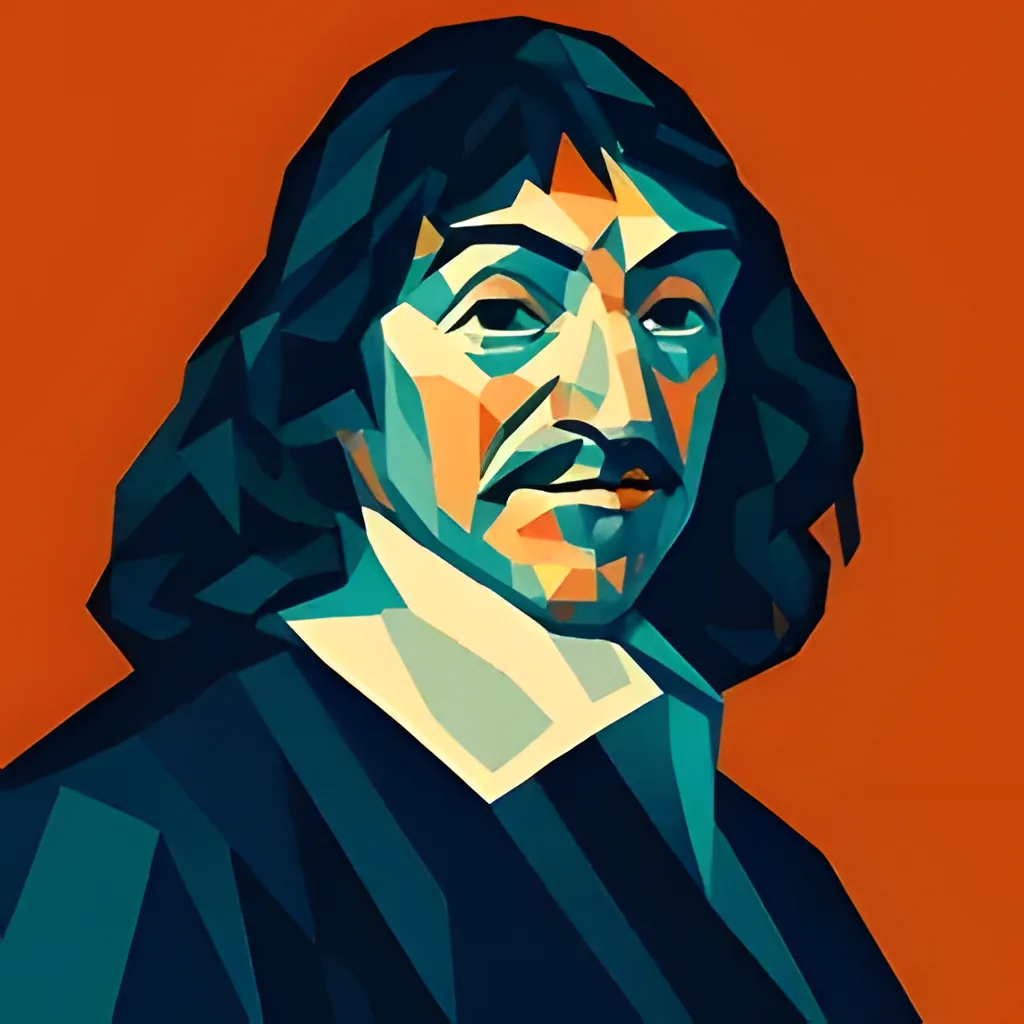
A life in brief
René Descartes: life and timeline.
René Descartes was a frail child whose Jesuit teachers let him stay in bed late — a habit he kept for life, and where much of his thinking got done. He trained as a lawyer, never practised, and joined two armies instead. Shut indoors by winter weather in 1619, he resolved to doubt everything he had been taught until something survived. What survived was the fact that he was doubting. From that single point he rebuilt knowledge, and invented coordinate geometry on the way.
- 1596
Born in La Haye
Born 31 March in La Haye en Touraine, a Loire Valley town later renamed Descartes in his honour. His mother dies before his first birthday, and he is raised by his grandmother and a nurse.
- 1607
Sent to La Flèche
His father enrols him at the Jesuit Collège Royal Henri-Le-Grand, one of the finest schools in Europe. His delicate health earns him permission to stay in bed each morning while the other boys keep the schedule.
- 1616
A law degree he never uses
Takes his degree at the University of Poitiers, following his father into law with no intention of practising it. He leaves for travel and military service instead.
- 1618
Meets Isaac Beeckman
Joins the army of Prince Maurice of Nassau in the Dutch Republic, where service is more politics than fighting. He meets the Dutch mathematician who becomes his mentor and turns him toward applying mathematics to nature.
- 1619
The stove-heated room
Stationed in Germany on 10 November and trapped indoors by winter, he spends the day thinking, and reports a series of revelations showing how all knowledge might be united into one system built on mathematical reasoning.
- 1628
Settles in the Dutch Republic
Moves to Holland for its religious tolerance and intellectual freedom, and stays for most of his remaining twenty years, changing address often to protect his privacy.
- 1637
Discourse on the Method
Published in French rather than Latin to reach readers outside the universities. Three appendices demonstrate the method in geometry, optics and meteorology.
- 1641
Meditations on First Philosophy
Six meditations take the reader through systematic doubt to a foundation for knowledge, argue that God must exist, and separate mind from body as two distinct substances.
- 1649
Summoned to Stockholm
Queen Christina of Sweden hires him as her philosophy tutor. She wants her lessons at five o'clock in the morning.
- 1650
Death in Sweden
The Swedish winter and the dawn schedule wear him down. He develops pneumonia in February and dies on the eleventh, aged fifty-three.
Major achievements
René Descartes: major achievements.
- 01
Analytic geometry
Showed that geometric problems could be solved with algebraic equations. The Cartesian coordinate system, with its x and y axes, still carries his name and still underpins everything from computer graphics to space navigation.
- 02
Systematic doubt
Built a method that discards every inherited belief until something undeniable remains, making reason rather than tradition or authority the test of truth.
- 03
Algebraic notation
Developed the notation for exponents, and the convention of using letters from the start of the alphabet for known quantities and letters from the end for unknowns.
- 04
The law of refraction
Independently derived and first published what is often called Snell–Descartes' law, advancing the understanding of lenses and contributing to better telescopes and microscopes.
- 05
Mind-body dualism
Argued the mind is a non-physical substance able to exist apart from the body. Critics asked how two separate substances could interact at all — a problem neuroscience has made harder, not easier.
Turning points
René Descartes: defining moments.
- 1607–1615
Permission to stay in bed
His teachers at La Flèche excused the frail boy from the morning schedule. Those quiet uninterrupted hours became the habit of a lifetime, and many of his best insights arrived in them. The weakness made the space.
- 1619
A day indoors in Germany
Trapped by winter weather in what he called a stove-heated room, he spent 10 November thinking about mathematics and philosophy, and came out convinced that all knowledge could be united into a single system built on mathematical reasoning. Everything he wrote afterwards followed from that day.
- 1628
Leaving France for Holland
He settled in the Dutch Republic because it tolerated independent thinkers, and stayed roughly twenty years, living quietly and moving house often to keep working uninterrupted. Both major books were written there.
- 1649–1650
The Queen's five o'clock lessons
Christina of Sweden wanted philosophy at dawn — the exact opposite of the routine that had sustained him since boyhood. He went reluctantly. The schedule and the Swedish winter broke his health, and pneumonia killed him within months of arriving.
I think, therefore I am.
René Descartes — his conclusion from systematic doubt
What you’ll take away
Lessons from René Descartes’s life.
- 01
Doubt is a tool, not a mood
He doubted everything on purpose, to find what would survive it. The point was never scepticism for its own sake but a foundation solid enough to build on.
- 02
Protect the hours that think
The late mornings his teachers allowed a sickly boy became the routine that produced his work — and the schedule that took them away helped kill him.
- 03
Write for readers, not for peers
He published the Discourse in French rather than Latin so people outside the universities could follow the argument. The method spread because ordinary readers could use it.
Did you know
Facts about René Descartes.
- 01
Did you know that René Descartes reportedly invented the Cartesian coordinate system while lying in bed watching a fly crawl on the ceiling, realizing he could describe its position using two intersecting lines?
- 02
Did you know that Descartes preferred to stay in bed until noon reading and thinking, a lifelong habit he formed as a sickly student at a Jesuit college?
- 03
Did you know that Rene Descartes's famous philosophical statement 'Cogito, ergo sum' (I think, therefore I am) was a desperate attempt to find one undeniable truth when doubting everything else in existence?
If you liked René Descartes…
Browse all →
FAQ
Frequently asked questions about René Descartes.
What is René Descartes known for?
Three things above all: the phrase “I think, therefore I am,” the starting point of his attempt to rebuild knowledge on certain foundations; the Cartesian coordinate system, which joined algebra and geometry; and mind–body dualism, the idea that the mind is a different kind of thing from the body.
What was René Descartes's religion?
He was a Catholic, educated by Jesuits at La Flèche, and his Meditations set out to prove the existence of God and the soul. Even so, he chose to live in the Protestant Dutch Republic for most of his career, and after his death some of his works were placed on the Church's Index of Prohibited Books.
What does 'I think, therefore I am' actually mean?
It is the one thing his method of doubt could not remove. He questioned his body, the external world and even mathematical truths, but the act of doubting proved something was doing the doubting. That became the foundation he rebuilt knowledge on.
Why is Descartes called the father of modern philosophy?
His work bridged medieval and modern thought. He insisted that reason, not tradition or authority, decides what is true, and gave individuals a method for thinking things through for themselves — a principle that fed the Enlightenment and modern democratic thought.
What is the Cartesian coordinate system?
The x and y axes used to plot points on a graph. Descartes showed geometric problems could be restated as algebraic equations, creating analytic geometry. The system remains essential to fields from computer graphics to space navigation.
Was Descartes wrong about anything?
Often. He explained planetary motion with a theory of vortices that was later disproved, treated animals as machines without consciousness, and sometimes let reason alone lead him against observation. His insistence on mechanical explanation still helped found modern physics.
How did Descartes die?
Of pneumonia in Stockholm on 11 February 1650, aged fifty-three, after Queen Christina's five o'clock philosophy lessons and the Swedish winter wore him down. Some historians have speculated about poisoning, but most evidence supports natural causes.
Published by Lyfestori, from Duck Pond Ventures Oy. About us and how to report a correction.
18 min · one sitting