Isaac Newton
The Man Who Changed Our Understanding of the Universe
Born on 4 January 1643 in Woolsthorpe, Lincolnshire, three months after his father's death, Isaac Newton worked out calculus, the laws of motion and universal gravitation, set them out in the Principia, built the first practical reflecting telescope, and later ran the Royal Mint.
- 19 min listen
- Laws of motion
- Universal gravitation
- Master of the Mint
Isaac Newton’s full 19 min audio biography, The Man Who Changed Our Understanding of the Universe, is available on Lyfestori for iOS. Listen to a free preview below.
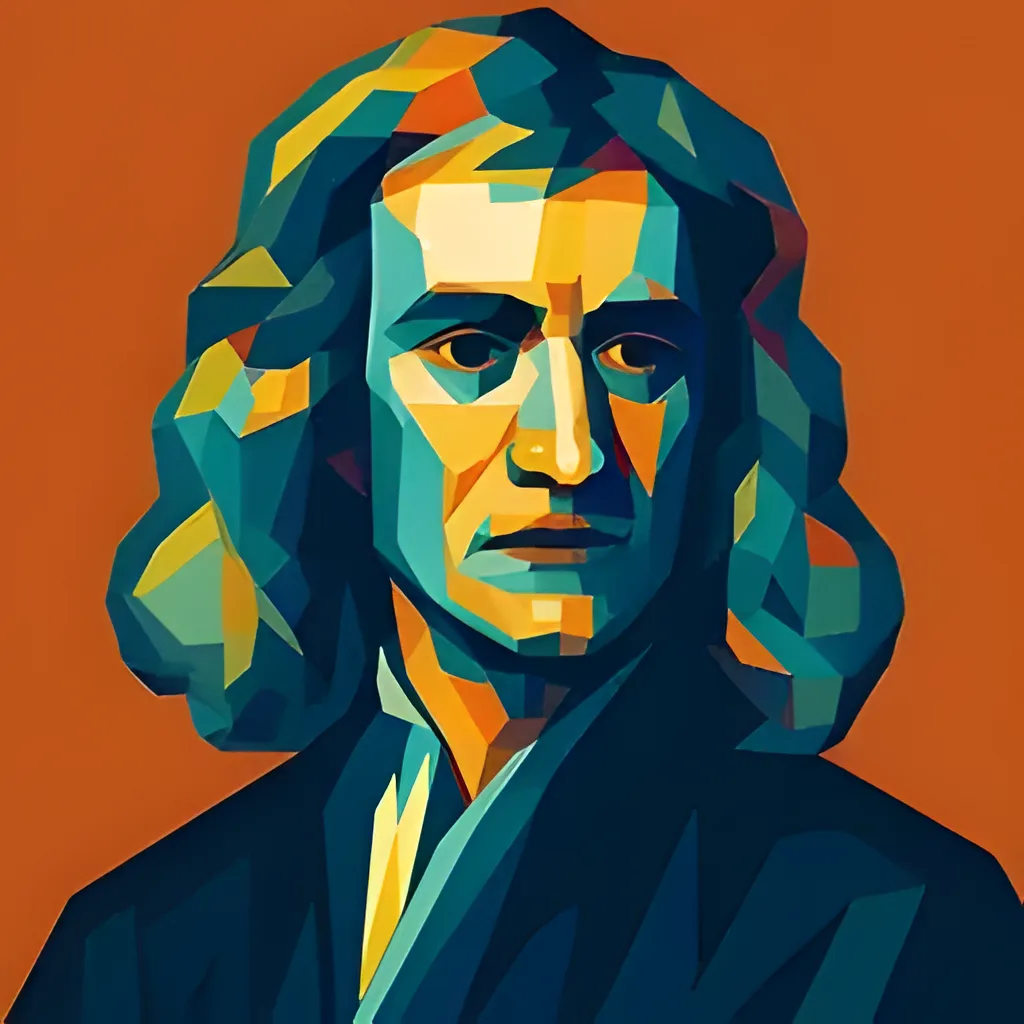
A life in brief
Isaac Newton: life and timeline.
His father died three months before he was born. His mother remarried, and at three he was sent away to live with his grandmother — a separation he never quite got over. Isaac Newton was an unremarkable schoolboy and a worse farmer, more interested in reading under trees than tending livestock. Then the plague closed Cambridge and sent him home for eighteen months. In that time he built calculus, took white light apart with a prism, and worked out why the moon does not fall.
- 1643
Born in Woolsthorpe
Born 4 January in a small Lincolnshire village. His father, a farmer of the same name, had died three months earlier.
- 1646
Sent to his grandmother
His mother Hannah remarries Reverend Barnabas Smith, who has little interest in raising another man's child. Isaac, three, is sent to live with Margery Ayscough.
- 1661
Trinity College, Cambridge
Enters as a subsizar — a student who works as a servant to wealthier students to pay for his education. A humbling position for a proud young man.
- 1665
The plague sends him home
The Great Plague closes the university. Over eighteen months at Woolsthorpe he develops calculus, splits white light with a prism, and begins the theory of universal gravitation. He calls it his annus mirabilis.
- 1667
Return to Cambridge
Comes back as a fellow of Trinity College, his reputation as a mathematician beginning to spread.
- 1669
Lucasian Professor
Appointed to one of England's most prestigious academic chairs at twenty-six. His lectures are so advanced they are often poorly attended — sometimes he lectures to empty chairs.
- 1687
The Principia
Publishes 'Philosophiæ Naturalis Principia Mathematica', laying out three laws of motion and universal gravitation. Edmund Halley urged him to write it and paid for its printing.
- 1696
Warden of the Royal Mint
Leaves Cambridge for London. England's currency is in chaos from counterfeiting and coin clipping; he reforms the minting process and pursues forgers like a detective.
- 1699
Master of the Mint
Promoted after his success as Warden. He holds the post until his death.
- 1703
President of the Royal Society
Elected to lead the institution whose members had once criticised his work on light.
- 1705
Knighted
Queen Anne makes him Sir Isaac Newton, recognising his contributions to science and his service to the crown.
- 1727
Death in London
Dies 31 March, aged eighty-four. He is buried in Westminster Abbey, an honour usually reserved for royalty.
Major achievements
Isaac Newton: major achievements.
- 01
The three laws of motion
Objects keep doing what they are doing unless a force acts; force relates mass to acceleration; every action has an equal and opposite reaction. Together they became the foundation of classical mechanics.
- 02
Universal gravitation
Every object attracts every other, with a force set by their masses and the distance between them. The same pull that drops an apple holds the moon in orbit.
- 03
Calculus
A mathematics for motion and change — areas under curves, rates of change. Leibniz developed it independently later; Newton got there first but did not publish.
- 04
The composition of white light
A prism in a darkened room showed white light is not pure but a mixture of every colour of the rainbow, overturning centuries of thinking about colour.
- 05
The reflecting telescope
Built the first one, using mirrors instead of lenses to sidestep chromatic aberration. Six inches long, it matched far larger instruments and caused a sensation at the Royal Society.
- 06
Reform of the coinage
As Warden and then Master of the Mint he rebuilt England's minting process and added security features, prosecuting counterfeiters personally.
Turning points
Isaac Newton: defining moments.
- 1646
Sent away
A stepfather who did not want him and a mother who left him behind at his grandmother's house. Newton grew up feeling abandoned, and it hardened into a fierce independence — and a suspicion of other people — that never left him.
- 1665–1667
The interruption that made him
The plague closed Cambridge and sent students home. For most it was a lost year and a setback. Alone at Woolsthorpe with no lectures and no supervision, Newton did the work that would remake mathematics, optics and astronomy.
- As a young professor
Hooke's criticism
When he published his findings on light, Robert Hooke attacked his conclusions. Newton, who could not tolerate criticism, reacted badly — and began a lifelong habit of sitting on finished work rather than exposing it to attack.
- 1696
Leaving science for the Mint
After the Principia his interest in research faded. He took a government job in London and threw his whole intensity at it, turning a scientist's precision on a broken currency and the men forging it.
What you’ll take away
Lessons from Isaac Newton’s life.
- 01
Empty time is not wasted time
The plague looked like a catastrophe interrupting his degree. Eighteen months with nothing scheduled and no one to please produced more than the rest of his career.
- 02
Teach yourself past the syllabus
Cambridge taught Aristotle. Newton read Galileo, Kepler and Descartes on his own, filling notebooks and working problems no professor had set. The independence was the talent.
- 03
A thin skin has a price
Stung once by Hooke, he withheld work for years and fought bitter priority disputes. The science survived; the peace of mind did not.
Did you know
Facts about Isaac Newton.
- 01
Did you know that Isaac Newton invented the mathematical field of calculus before he turned 24, largely during a period when his university was closed due to the bubonic plague?
- 02
Did you know that in addition to physics, Newton was deeply obsessed with alchemy and spent years secretly trying to discover the Philosopher's Stone to turn lead into gold?
- 03
Did you know that as Warden of the Royal Mint, Newton personally went undercover in London taverns to gather evidence against notorious counterfeiters, leading to several of their executions?
If you liked Isaac Newton…
Browse all → Astronomer22 min
Galileo Galilei
The Father of Modern Science
 Theoretical Physicist20 min
Albert Einstein
The Genius Who Changed Our Understanding of the Universe
 Philosopher & Mathematician18 min
René Descartes
The Philosopher Who Taught the World to Think
 Tech CEO17 min
Jensen Huang
The Dishwasher Who Built the AI Empire
FAQ
Frequently asked questions about Isaac Newton.
What did Isaac Newton discover?
The three laws of motion and the law of universal gravitation, which explained both falling apples and orbiting planets; that white light is made up of a spectrum of colours; and — independently of Leibniz — calculus. He also built the first practical reflecting telescope.
What was Isaac Newton's religion?
He was a deeply religious Protestant Christian who wrote more about theology and biblical prophecy than about physics. Privately he rejected the doctrine of the Trinity — a view he kept secret, since it could have cost him his Cambridge post.
How did Isaac Newton die?
In his sleep in Kensington, London, on 20 March 1727 (Old Style), aged eighty-four, after suffering from a painful bladder stone. He was buried in Westminster Abbey. Mercury later found in his hair suggests his alchemy experiments exposed him to toxic metals.
Did an apple really fall on Newton's head?
The apple story is likely true, though probably embellished over the years. Newton told it himself in old age: watching objects fall made him ask why they drop straight down rather than at an angle. It did not land on his head.
Who invented calculus, Newton or Leibniz?
Both, independently. Newton's version came first, but he did not publish it immediately, and Gottfried Leibniz arrived at his own later. The question of priority became one of the bitterest disputes of Newton's life.
Why did Newton run England's mint?
In 1696 he left Cambridge to become Warden of the Royal Mint, at a time when counterfeiting and coin clipping had thrown the currency into chaos. He reformed minting, hunted forgers personally, and was promoted to Master in 1699 — a job he kept until he died.
Was Newton only a scientist?
No. He spent years on alchemy, trying to transform base metals, and wrote more than a million words on theology and church history. He privately rejected the doctrine of the Trinity — a belief that would have been treated as heresy had it been known.
Published by Lyfestori, from Duck Pond Ventures Oy. About us and how to report a correction.
19 min · one sitting