John Locke
The Philosopher Who Shaped Modern Democracy
Born on 29 August 1632 in Wrington, Somerset, John Locke trained in medicine at Oxford, served the Earl of Shaftesbury, fled to Holland, and wrote the Two Treatises of Government and An Essay Concerning Human Understanding — works that made him the father of liberalism and shaped the Declaration of Independence.
- 15 min listen
- Father of Liberalism
- Natural rights
- Enlightenment
John Locke’s full 15 min audio biography, The Philosopher Who Shaped Modern Democracy, is available on Lyfestori for iOS. Listen to a free preview below.
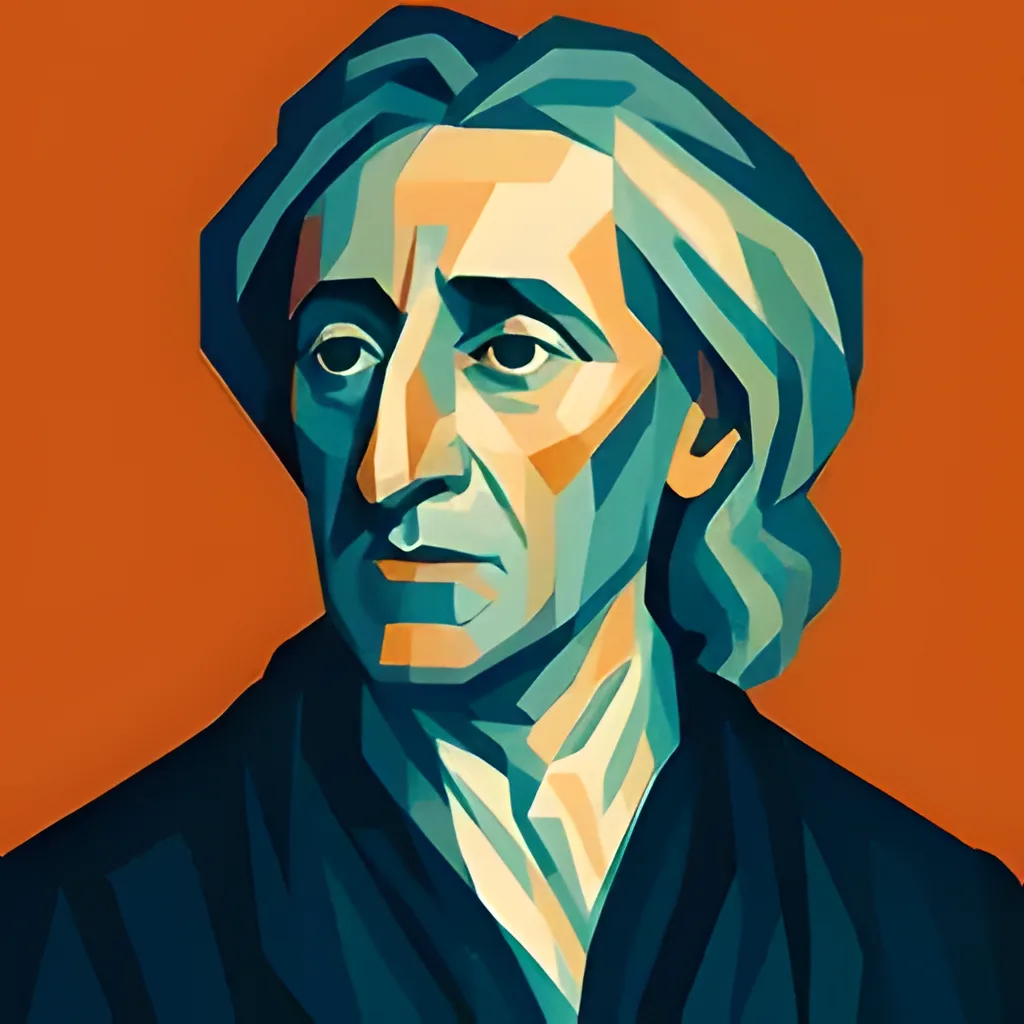
A life in brief
John Locke: life and timeline.
He was a schoolboy at Westminster, within walking distance of Whitehall, when Charles I was executed outside the Banqueting House in 1649. John Locke trained in medicine, found Oxford's reverence for ancient authorities boring and restrictive, and became physician and adviser to one of England's most dangerous politicians. When that patron fell, Locke fled to Holland — and wrote the case that people are born with rights no king grants, and may overthrow any government that fails to protect them.
- 1632
Born in Wrington
Born 29 August in a small Somerset village. His father was a country lawyer and clerk to local magistrates; his mother Agnes Keene came from a family of tanners. The family lived modestly but comfortably.
- 1642
The English Civil War
War between Charles I and Parliament begins when Locke is a child and rages for nearly a decade. His father serves as a cavalry officer on the Parliamentarian side, exposing his son early to arguments about political authority and the limits of royal power.
- 1647
Westminster School
Admitted at fourteen to one of England's most prestigious schools, with a rigorous classical curriculum in Latin, Greek and some Hebrew. He excels — and later criticises its harsh discipline and outdated teaching methods.
- 1649
The king is executed
Charles I is beheaded outside the Banqueting House at Whitehall, within walking distance of Locke's school. Some accounts suggest he may have seen the proceedings, which left a lasting impression on contemporaries about the limits of royal power.
- 1652
Christ Church, Oxford
He begins fifteen years at Oxford, where medieval scholasticism still rules and students memorise and debate ancient authorities like Aristotle rather than investigate. He finds it restrictive, prefers the new experimental philosophy, and begins questioning everything he has been taught.
- 1666
Meeting Shaftesbury
Anthony Ashley Cooper, later Earl of Shaftesbury, needs a personal physician and is impressed by Locke's medical knowledge and sharp intellect. Locke joins his London household — and with it, politics, commerce and high society.
- 1683
Exile in Holland
With Shaftesbury dead and the Rye House Plot uncovered, Locke fears for his safety and flees. Six of the most productive years of his intellectual life follow, in one of the most tolerant societies in Europe.
- 1689
The Glorious Revolution
William and Mary take the English throne; Locke returns in Mary's entourage and begins publishing. Two Treatises of Government appears anonymously, and A Letter Concerning Toleration the same year.
- 1690
An Essay Concerning Human Understanding
Published at the end of 1689 with a title page dated 1690, it causes a sensation: the mind at birth is a blank slate, a tabula rasa, and all knowledge comes from experience through the senses.
- 1696
The Board of Trade
He serves until 1700, helping shape English colonial and economic policy, by now one of England's most respected intellectuals.
- 1704
Death at Oates
Dies 28 October at Oates Manor in Essex, home of his friends Sir Francis and Lady Masham, aged seventy-two. He never married or had children.
- 1776
The Declaration of Independence
Jefferson's 'life, liberty, and the pursuit of happiness' adapts Locke's 'life, liberty, and property'. The argument that government rests on the consent of the governed, and may be overthrown, comes from the Second Treatise.
Major achievements
John Locke: major achievements.
- 01
Two Treatises of Government
Developed largely between 1679 and 1683 and revised in exile. The First Treatise dismantles divine-right monarchy; the Second grounds government in natural rights, the consent of the governed, and a right of revolution.
- 02
An Essay Concerning Human Understanding
His argument that the mind at birth is a blank slate and all knowledge comes from the senses overturned the belief in innate ideas — and made education, environment and experience the things that form a person.
- 03
A Letter Concerning Toleration
Religious belief is a matter of personal choice, not government coercion, and civil magistrates have no authority over conscience. Radical in an age that treated religious unity as essential to political stability — though he excluded atheists, and at times Catholics, from it.
- 04
Natural rights
Life, liberty and property come from God or nature, not from government. People form governments by social contract to protect them, and may overthrow one that fails. It made governments the servants of the people rather than their masters.
- 05
The Father of Liberalism
His arguments for limited government and individual rights became the foundation of liberal political theory, visible in democratic constitutions from the United States to South Africa and in the Universal Declaration of Human Rights.
Turning points
John Locke: defining moments.
- 1652–1666
Rejecting his own education
Oxford still ran on scholasticism: memorise the ancient authorities, debate the established texts, don't investigate. He found it boring and restrictive and turned to the experimental philosophy championed by Bacon, and to Descartes on doubt and systematic reasoning. The commitment to testing ideas against observation lasted the rest of his life.
- 1666
Becoming Shaftesbury's man
Being hired as a physician put him inside real political power. Shaftesbury was a leading opponent of royal absolutism and a champion of parliamentary rights. Through him Locke met scientists, merchants and politicians, worked on colonial affairs for the Lords Proprietors of Carolina and the Council of Trade, and watched the Exclusion Crisis from the inside.
- 1683–1689
Exile as a workshop
Shaftesbury's fall and the Rye House Plot made England unsafe for his allies. In Holland — tolerant, thick with religious refugees and political exiles — Locke could develop his ideas without fear of persecution. He finished the Essay and wrote the Two Treatises and the Letter Concerning Toleration there. The most productive years of his life were the ones he spent as a fugitive.
- 1689
Publishing, but not signing
He returned with the Glorious Revolution and published — but never publicly acknowledged the Two Treatises in his lifetime. The book argued that people may rebel against unjust government, and that remained dangerous to have written, even in the England it had helped to justify.
What you’ll take away
Lessons from John Locke’s life.
- 01
Ideas outrun their author
He died in 1704. American colonists reached for his writings in the 1760s and 1770s; Jefferson rewrote his phrase in 1776; the philosophes carried his tolerance argument across Europe. He saw none of it.
- 02
Where you can think matters
Fifteen years at Oxford produced questions. Six years as a political refugee in Holland produced the books. Environments do not merely support work — they decide which work is possible at all.
- 03
The blank slate is a political claim
If nobody is born noble or common, good or evil, then people are made by their education and their conditions — and those can be changed. His theory of knowledge was also an argument that society could be improved.
Did you know
Facts about John Locke.
- 01
Did you know that John Locke's ideas on 'life, liberty, and property' directly influenced the United States Declaration of Independence?
- 02
Did you know that despite being known as a philosopher, Locke actually trained in medicine and saved the life of Lord Ashley (later the Earl of Shaftesbury) by performing an operation on his liver?
- 03
Did you know that John Locke never married and had no children, leaving most of his estate to the scholar Damaris Masham?
If you liked John Locke…
Browse all → Philosopher & Mathematician18 min
René Descartes
The Philosopher Who Taught the World to Think
 Philosopher16 min
David Hume
The Scottish Philosopher Who Questioned Everything We Know
 Economist17 min
Adam Smith
The Father of Modern Economics Who Shaped How We Think About Wealth and Society
 Pre-Socratic Philosopher22 min
Anaximander
The First Scientist
FAQ
Frequently asked questions about John Locke.
Why is John Locke famous?
For arguing that people have natural rights to life, liberty and property, and that government rests on the consent of the governed and can be resisted if it betrays them — ideas that shaped the American and French revolutions. In philosophy he is equally known for the idea that the mind starts as a blank slate, or tabula rasa.
How did John Locke die?
Peacefully, after years of asthma and failing health, at Oates, Sir Francis Masham's manor house in Essex, on 28 October 1704. He was seventy-two.
What are Locke's natural rights?
Life, liberty and property. He argued they come from God or nature rather than from any government, that people form governments through a social contract to protect them, and that a government which fails to protect them or becomes tyrannical may be overthrown and replaced.
Did Locke write the Declaration of Independence?
No. Jefferson wrote it in 1776, and it echoes Lockean themes — natural rights, consent of the governed, the right to overthrow tyranny — while drawing heavily on contemporaneous sources such as George Mason's Virginia Declaration of Rights. Jefferson's 'life, liberty, and the pursuit of happiness' adapts Locke's 'life, liberty, and property'.
What is tabula rasa?
Locke's claim, in An Essay Concerning Human Understanding, that the human mind at birth is a blank slate and all knowledge arrives through experience and the senses. It challenged the prevailing belief that humans are born with innate ideas — and made education crucially important.
Why did Locke publish the Two Treatises anonymously?
It was dangerous. The work argued that people had the right to rebel against unjust government, an idea many found alarming. He never publicly acknowledged authorship in his lifetime, despite the book's immediate influence and his own standing as one of England's most respected intellectuals.
How tolerant was Locke really?
His Letter Concerning Toleration urged broad religious freedom and argued that civil magistrates lack authority over conscience — a radical position for the time. But he controversially excluded atheists, and at times Roman Catholics, from that toleration.
Published by Lyfestori, from Duck Pond Ventures Oy. About us and how to report a correction.
15 min · one sitting