Galileo Galilei
The Father of Modern Science
Born on 15 February 1564 in Pisa, the son of a musician, Galileo Galilei turned the newly invented telescope on the sky, discovered Jupiter's moons and the phases of Venus, championed the Sun-centred universe, and was tried by the Inquisition in 1633 — spending his last years under house arrest.
- 22 min listen
- Father of Modern Science
- Astronomy
- Tried by the Inquisition
Galileo Galilei’s full 22 min audio biography, The Father of Modern Science, is available on Lyfestori for iOS. Listen to a free preview below.
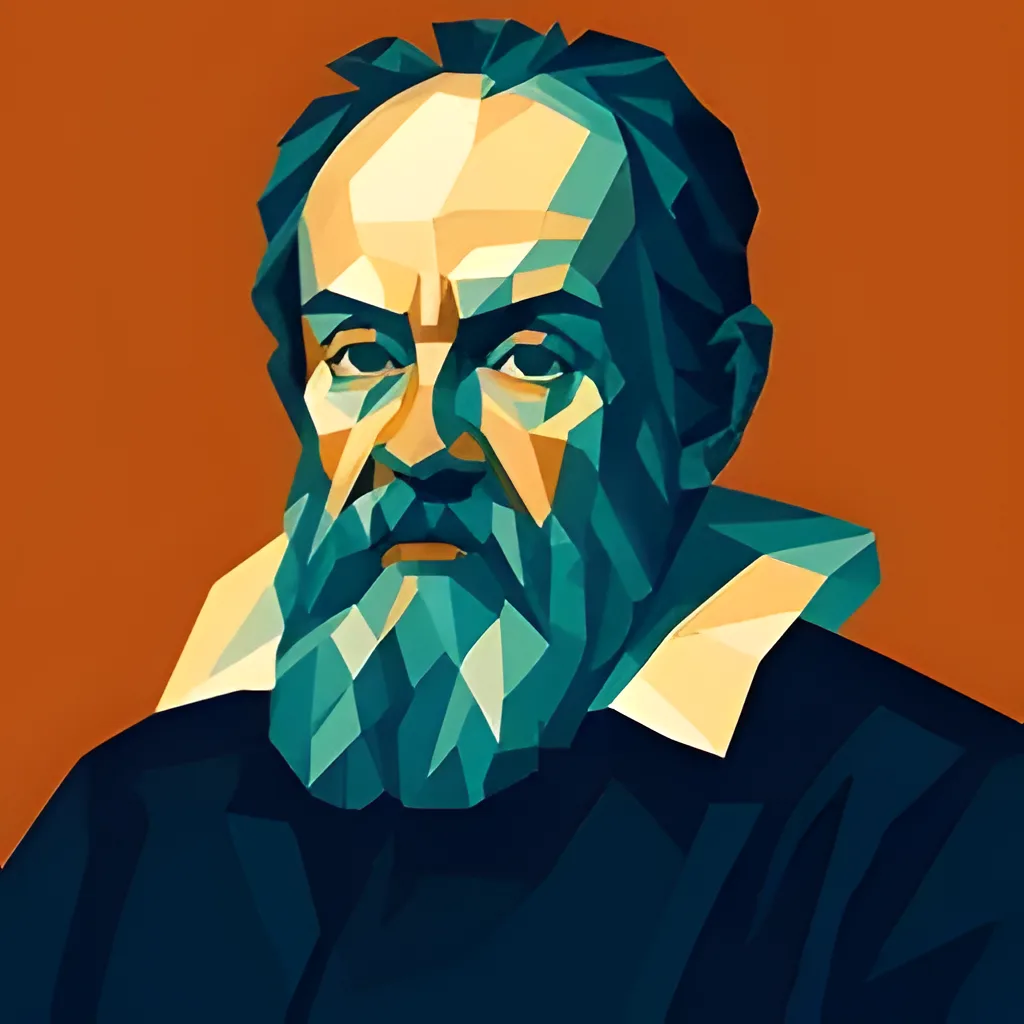
A life in brief
Galileo Galilei: life and timeline.
He enrolled at Pisa to study medicine and walked out four years later without a degree, having spent his time at mathematics lectures he was not supposed to attend. Galileo Galilei preferred dropping weights from heights to reading Aristotle. When news of a Dutch spyglass reached Italy in 1609, he built his own and made it better, then pointed it at the sky. It showed mountains on the moon and four points of light circling Jupiter. That view made him famous, and it put him in front of the Inquisition.
- 1564
Born in Pisa
Born 15 February in Tuscany, eldest of six. His father Vincenzo was a musician and music theorist who ran experiments on strings and pitch — an experimental habit his son inherited.
- 1581
Medical school
Enrols at the University of Pisa at seventeen to study medicine, the stable career his father wanted. He finds it boring and starts slipping into mathematics lectures without permission.
- 1585
Leaves without a degree
Quits Pisa with no qualification and returns to Florence, teaching private mathematics lessons to get by while studying Euclid and Archimedes.
- 1589
Lecturer at Pisa
Returns to his old university as a professor at twenty-five. Writes 'De Motu' (On Motion), arguing that motion should be analysed mathematically rather than reasoned about philosophically.
- 1592
Padua
His contract at Pisa is not renewed — his ideas irritate the Aristotelians. He moves to the University of Padua in the Republic of Venice, where he stays eighteen years.
- 1609
The telescope
Hearing of a Dutch device that makes distant things look closer, he builds one within months and improves it from three or four times magnification to twenty or more. Venetian officials pay well for a tool that spots ships early.
- 1610
The Starry Messenger
Publishes 'Sidereus Nuncius' in March: craters and mountains on the moon, four moons orbiting Jupiter, the Milky Way resolved into countless stars. It is a sensation across Europe.
- 1616
The prohibition
The Church declares heliocentrism 'false and contrary to Holy Scripture'. Cardinal Robert Bellarmine privately warns Galileo not to teach or defend it. He goes quiet for years.
- 1632
The Dialogue
Publishes 'Dialogue Concerning the Two Chief World Systems' in Italian, to reach ordinary readers. Its geocentric character, Simplicio, is made to look foolish while voicing the pope's own arguments.
- 1633
Trial and house arrest
Summoned to Rome at nearly seventy. Under threat of torture he kneels on 22 June and renounces the claim that the Earth moves. Sentenced to house arrest at his villa in Arcetri.
- 1638
Two New Sciences
Blind since the previous year and barred from astronomy, he publishes his work on motion and the strength of materials — smuggled out to the Netherlands because it is banned in Italy. Many consider it his best book.
- 1642
Death at Arcetri
Dies 8 January, aged seventy-seven, still under house arrest. Condemned by the Church, he is denied consecrated ground until 1737, when his remains are moved to Santa Croce in Florence.
Major achievements
Galileo Galilei: major achievements.
- 01
The moons of Jupiter
Four points of light that shifted position night after night. They orbited Jupiter, not Earth — the first hard evidence that the universe did not turn around us.
- 02
A better telescope
Took a Dutch novelty magnifying three or four times and within months built one reaching twenty or more, good enough to resolve the Milky Way into individual stars.
- 03
Falling bodies
Aristotle said heavy things fall faster. Galileo dropped weights from heights, timed them, and found that without air resistance everything falls at the same rate.
- 04
Two New Sciences
Written under house arrest, it founded the mathematical study of motion and the strength of materials — and gave Newton the ground to build his laws of motion on.
- 05
The experimental method
His real legacy: settle questions by observing, measuring and testing, not by consulting ancient books. That reflex is now what science means.
Turning points
Galileo Galilei: defining moments.
- 1581–1585
Walking out of medicine
His father sent him to Pisa for a profitable career. Galileo attended mathematics lectures he had no permission to attend, argued his way out of medical school, and left with no degree and no income — only a subject he could not stop thinking about.
- 1609
Pointing the tube upward
Everyone else saw a commercial and military instrument for spotting ships. Galileo sold it as that, took the salary, and then aimed it at the night sky — where it dismantled a thousand years of cosmology in a few months.
- 1632
The character called Simplicio
The Dialogue put the geocentric case in the mouth of a fool, using arguments Pope Urban VIII had made to Galileo privately. Urban had been his friend and patron. He felt betrayed and humiliated, and the protection Galileo had counted on vanished.
- 1633
Kneeling
At nearly seventy, sick, and threatened with torture, he read a statement 'cursing and detesting' his errors and swore never to say such things again. He kept his life; the book was banned and he never left house arrest.
What you’ll take away
Lessons from Galileo Galilei’s life.
- 01
Go and look
The moon was smooth and perfect because Aristotle said so, and nobody checked. Galileo checked. Most received wisdom has never been tested by the people repeating it.
- 02
Mind who you embarrass
The science was defensible; putting the pope's arguments in the mouth of an idiot named Simplicio was not. He lost a patron and gained a trial, over a matter of tone.
- 03
Constraints are not the end
Banned from astronomy, blind, confined to his villa, he went back to the physics of his youth and wrote his most influential book. He was seventy-four.
Did you know
Facts about Galileo Galilei.
- 01
Did you know that Galileo Galilei originally enrolled at the University of Pisa to study medicine at age seventeen, but found it boring and eventually left without a degree to pursue mathematics?
- 02
Did you know that while the original Dutch telescopes could only magnify objects three or four times, Galileo built his own improved version that could magnify objects twenty times or more?
- 03
Did you know that Galileo's sentence from the Roman Inquisition was surprisingly lenient, allowing him to serve his house arrest at his villa in Arcetri rather than in a Church prison?
If you liked Galileo Galilei…
Browse all →

FAQ
Frequently asked questions about Galileo Galilei.
What did Galileo discover?
With his improved telescope: the four largest moons of Jupiter, the phases of Venus, mountains and craters on the Moon, sunspots and countless stars in the Milky Way. In physics he showed that falling bodies accelerate at the same rate regardless of weight and worked out the laws of the pendulum and projectile motion.
What was Galileo's full name?
Galileo di Vincenzo Bonaiuti de' Galilei — “Galileo, son of Vincenzo, of the Bonaiuti de' Galilei family.” Following a Tuscan custom, the eldest son's first name echoed the family surname.
How did Galileo die?
Of a fever and heart trouble, at his villa in Arcetri near Florence on 8 January 1642, aged seventy-seven. He had been blind for four years and was still under house arrest.
Did Galileo really say 'And yet it moves'?
Almost certainly not. The legend says he muttered 'Eppur si muove' as he rose from renouncing heliocentrism, but the story is probably an invention. It survives because it captures something true about him — that he knew the facts would outlast the verdict.
Did Galileo invent the telescope?
No. The device came out of the Netherlands, and word of it reached Italy in 1609. Galileo built his own version, improved it from three or four times magnification to twenty or more, and was the first to make serious astronomical use of it.
Why was Galileo put on trial?
For defending the Copernican idea that Earth orbits the sun after the Church had prohibited it in 1616. His 1632 'Dialogue' argued the case plainly enough that the ban was clearly broken, and it insulted Pope Urban VIII along the way.
Was Galileo ever forgiven by the Church?
Slowly. He was refused burial in consecrated ground, and his remains were only moved to a monument at Santa Croce in Florence in 1737. The Catholic Church formally acknowledged his contribution to knowledge in 1992, more than 350 years after his condemnation.
Published by Lyfestori, from Duck Pond Ventures Oy. About us and how to report a correction.
22 min · one sitting