Anaximander
The First Scientist
Born around 610 BC in Miletus, a Greek city on the coast of today's Turkey, Anaximander was a pupil of Thales who tried to explain the world without gods — proposing the boundless apeiron as the origin of everything, drawing what ancient writers called the first map of the known world, and suggesting that humans descended from fish-like creatures.
- 22 min listen
- Pre-Socratic philosopher
- Miletus
- First world map
Anaximander’s full 22 min audio biography, The First Scientist, is available on Lyfestori for iOS. Listen to a free preview below.
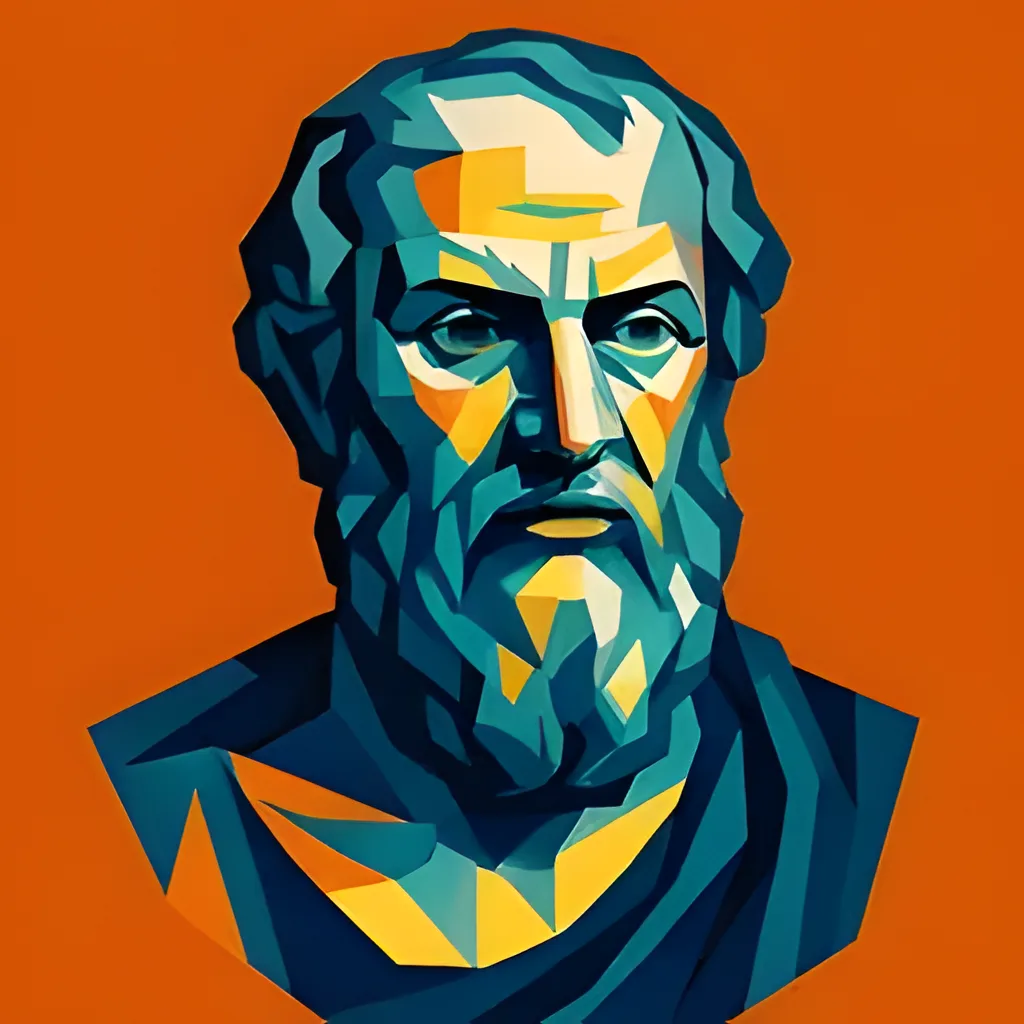
A life in brief
Anaximander: life and timeline.
Anaximander of Miletus asked why the world works, and answered without gods. He argued his own teacher was wrong: everything cannot come from water, because water is wet and cold and much of the world is dry and hot. He proposed instead the apeiron — the boundless — something no one could see or touch, deduced because it had to exist. He drew the first known map of the world, said the Earth floats unsupported in space, and suggested humans descended from fish. None of his writing survives.
- 610
Born in Miletus (c. 610 BC)
Born around 610 BC into a prominent family in a prosperous Greek city on the coast of what is now Turkey — a trading crossroads rich enough to support people who did nothing but think. Almost nothing is known of his childhood; what we have comes from writers who lived centuries later.
- 585
Thales predicts an eclipse
His teacher Thales, about fourteen years his senior and often called the first philosopher, predicts a solar eclipse — a demonstration that nature runs on principles a person can work out in advance, rather than on the moods of gods.
Major achievements
Anaximander: major achievements.
- 01
The first map of the world
The earliest world map we know of: the Mediterranean at the centre, Europe, Asia and Africa around it, the whole inhabited world ringed by ocean. Making it meant interrogating merchants, sailors and travellers — and solving the problem of putting a curved Earth onto a flat surface, which cartographers still wrestle with.
- 02
The apeiron
He argued the source of everything could not be water, air, fire or earth: any of those would dominate the rest, yet nature holds a balance between hot and cold, wet and dry. So the source must be neutral, infinite in extent and eternal — the boundless. Something no one could observe, argued for because it had to be there.
- 03
An Earth that floats
While others thought the Earth flat and propped on something underneath, he said it was cylindrical and hung freely in space, held in place by being equidistant from everything else. Cosmic balance instead of physical support.
- 04
Weather and earthquakes without gods
Earthquakes came from the Earth drying out and cracking, not Poseidon's anger. Rain came from evaporation and condensation, not Zeus opening the heavens. Lightning was wind breaking through cloud. The details were wrong; the move was everything.
- 05
Life out of the sea
He proposed that the first living things formed in water, enclosed in spiny bark-like coverings, and that some adapted to land as the Earth dried. Humans, he reasoned, must have developed inside fish-like creatures — because human infants are helpless far too long to have survived on their own.
- 06
The first prose in Greek philosophy
His book, apparently called On Nature, was the first philosophical prose work in Greek, written when serious writing meant poetry. Prose let him set out an argument systematically. None of it survives.
Turning points
Anaximander: defining moments.
- 6th century BC
A city at the crossroads
Miletus was rich, and it traded with Egyptians, Babylonians and Persians. Its people learned Egyptian geometry and Babylonian astronomy, and met rival explanations for the same events — which is how you begin asking which explanation is actually right. The city was also wealthy enough to keep people who spent their time thinking rather than surviving, and his family could afford to give him that time.
- Under Thales
Learning to look for causes
Thales taught that natural events have underlying principles rather than divine whims. For thousands of years humans had explained thunder as the anger of Zeus and earthquakes as the movements of Poseidon. Anaximander took the method — and then turned it on the man who had taught it to him.
- The break with his teacher
Water cannot be the answer
Thales said everything was made of water. Anaximander thought it through: water is wet and cold, yet much of the world is dry and hot. How could fire come from water? How could dry earth? The conclusion was that his respected teacher was wrong — and the willingness to say so on the strength of reasoning alone is one of the hallmarks of scientific thinking.
- After his death
Everything lost
Not one of his writings survives. We know him through later writers — Aristotle above all, two centuries on, who disagreed with much of it but took the approach seriously enough to argue with it in detail. What reaches us is fragments and secondhand reports, and even those show the originality.
… pay penalty and retribution to each other for their injustice according to the assessment of time.
Anaximander — the most famous surviving fragment, which may be directly his
What you’ll take away
Lessons from Anaximander’s life.
- 01
Argue with your teacher
He owed Thales the method, and used it to dismantle Thales' conclusion. Loyalty to a person is not loyalty to the truth, and following the reasoning instead is where science starts.
- 02
Being wrong is not the point
The sun is not twenty-seven times the size of the Earth. Earthquakes are not the ground cracking as it dries. He was wrong constantly, and he matters anyway — because he was asking the right kind of question and answering it the right kind of way.
- 03
You may posit what you cannot see
Nobody can observe the apeiron. He argued it must exist because it explains what we do observe. Proposing an unobservable to account for the observable became a standard move in physics twenty-five centuries later.
Did you know
Facts about Anaximander.
- 01
Did you know that Anaximander is credited with creating the first known map of the world, a groundbreaking achievement that visualized the Earth as a unified, measurable system?
- 02
Did you know that over two thousand years before Darwin, Anaximander proposed an early theory of evolution, suggesting that humans evolved from fish-like creatures that first adapted to life on land?
- 03
Did you know that Anaximander introduced the concept of the "apeiron," or the boundless, proposing that the universe was made of an infinite, eternal substance rather than just water or air?
If you liked Anaximander…
Browse all →

FAQ
Frequently asked questions about Anaximander.
What is Anaximander known for?
For some of the first attempts to explain nature without myth. He proposed the apeiron — an endless, boundless substance — as the source of all things, pictured the Earth as a cylinder floating unsupported at the centre of the cosmos, is credited with the first map of the known world, and argued that the first humans must have developed from creatures that lived in water.
When and where was Anaximander born?
Around 610 BC in Miletus, a wealthy Greek trading city in Ionia, on the west coast of what is now Turkey. He is thought to have died around 546 BC, aged about sixty-four, but no account of how he died survives.
What is the apeiron?
Greek for 'the unlimited' or 'the boundless' — Anaximander's answer to what everything comes from. He argued it could not be any familiar element, because water or fire or earth would dominate the others, whereas nature holds a balance between hot and cold and wet and dry. So the source must be neutral, infinite and eternal, with pairs of opposites separating out from it and recombining.
Did Anaximander really propose evolution?
He proposed that life first arose in the sea, enclosed in spiny bark-like coverings, and that some creatures adapted to land as the Earth dried out. He thought humans developed inside fish-like creatures, reasoning that human babies are helpless too long to have survived otherwise. The specifics are wrong, but the idea that species change over time and that humans are related to other life came over two thousand years before Darwin.
Did Anaximander make the first map?
He is the first person we know of to have drawn a map of the world. It placed the Mediterranean at the centre, surrounded by Europe, Asia and Africa, with the whole inhabited world ringed by ocean.
Why are none of his writings left?
None survived. He apparently wrote the first prose work in Greek philosophy, called On Nature, covering cosmology, geography and biology. We know it only through later writers — especially Aristotle — who quoted or summarised his views centuries afterwards.
Who taught Anaximander, and whom did he teach?
He studied under Thales, about fourteen years his senior and often called the first philosopher, and he taught Anaximenes. Those three men of Miletus began what we now call natural philosophy.
Published by Lyfestori, from Duck Pond Ventures Oy. About us and how to report a correction.
22 min · one sitting