Quentin Tarantino
The Maverick Director Who Revolutionized Cinema
Born Quentin Jerome Tarantino on 27 March 1963 in Knoxville, Tennessee, Quentin Tarantino dropped out of high school, learned film behind a video-store counter in Manhattan Beach, and became one of Hollywood's most influential directors with Reservoir Dogs, Pulp Fiction, Kill Bill and Django Unchained.
- 18 min listen
- Palme d'Or
- Screenwriting
- Independent cinema
Quentin Tarantino’s full 18 min audio biography, The Maverick Director Who Revolutionized Cinema, is available on Lyfestori for iOS. Listen to a free preview below.
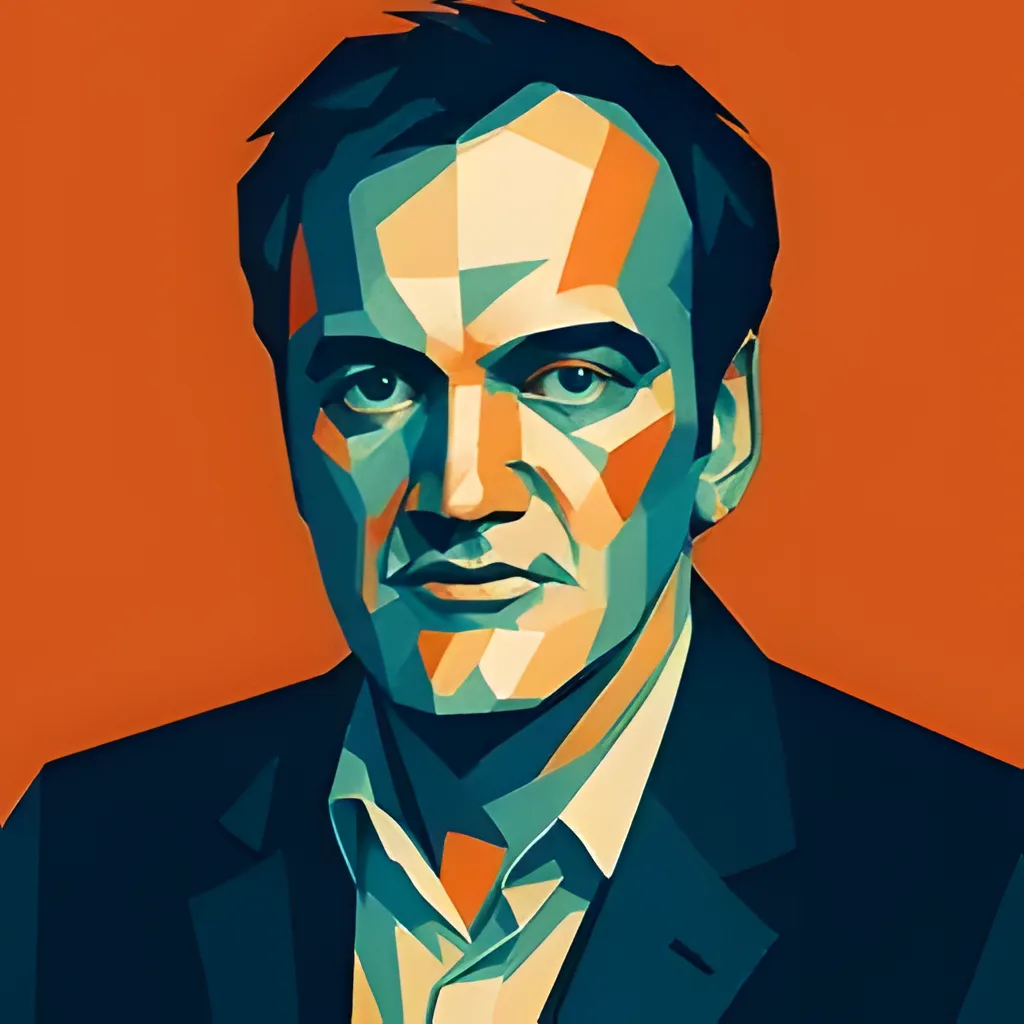
A life in brief
Quentin Tarantino: life and timeline.
He dropped out of high school at fifteen and went to the movies instead — several times a day, art house to exploitation, spaghetti westerns to martial arts. Quentin Tarantino's film school was a video rental counter in Manhattan Beach, where he argued about pacing with a coworker named Roger Avary. Reservoir Dogs cost $1.2 million. Pulp Fiction cost $8.5 million, made over $200 million, won the Palme d'Or, and taught a generation to tell stories out of order.
- 1963
Born in Knoxville
Born 27 March in Tennessee to Connie McHugh, who was sixteen. His father Tony Tarantino was an actor and musician, and largely absent. At two, his mother moved them to California — the South Bay, then Torrance.
- 1987
True Romance
His first completed screenplay already carries the signature: sharp dialogue, pop culture references, time out of order, sudden violence. Nobody will produce it — he is an unknown with no credentials.
- 1992
Reservoir Dogs
Written and directed for $1.2 million. A jewellery heist told almost entirely in a warehouse after the fact, jumping back and forth to reveal what went wrong. It premieres at Sundance and makes him the major new voice in independent film.
- 1994
Pulp Fiction
Interlocking stories of hitmen, boxers and small-time criminals, told out of sequence. It takes over $200 million on an $8.5 million budget, wins the Palme d'Or at Cannes and his first Academy Award for Best Original Screenplay, and revives John Travolta's career.
- 1997
Jackie Brown
He could have had any budget he wanted. He adapted Elmore Leonard's Rum Punch instead, told it straight, and built it around Pam Grier — a tribute to the blaxploitation films she had starred in.
- 2003
Kill Bill
Conceived as one film, too big for one, released as two volumes in 2003 and 2004. Uma Thurman's Bride hunts the colleagues who tried to kill her at her wedding. Shot with Robert Richardson, it moves from black-and-white duels to animated sequences, and gives cinema the House of Blue Leaves fight.
- 2009
Inglourious Basterds
Jewish-American soldiers hunt Nazis in occupied France, and history is rewritten in a burning cinema. Christoph Waltz wins an Academy Award as Hans Landa, introduced in a twenty-minute conversation with a French farmer that is almost all talk and almost unbearable.
- 2012
Django Unchained
A freed slave becomes a bounty hunter to rescue his wife, in a spaghetti western aimed straight at American slavery. It provokes real argument about whether a white filmmaker should tell this story this way — and refuses to soften what slavery was.
- 2015
The Hateful Eight
Eight strangers in a Wyoming haberdashery during a blizzard, structured like a stage play. He shot it in Ultra Panavision 70, a format unused since the 1960s.
- 2019
Once Upon a Time in Hollywood
A fading western star and his stunt double in 1969 Los Angeles. More elegiac than anything he had made, and it redirects the Manson murders into another alternate history.
- 2021
The Vista
He buys the historic Los Angeles cinema and restores it, alongside the New Beverly, which he owns and programmes on 35mm only.
Major achievements
Quentin Tarantino: major achievements.
- 01
Pulp Fiction
Over $200 million worldwide on an $8.5 million budget, the Palme d'Or, and an Academy Award for its screenplay. It proved independent film could beat the studios on their own terms and changed American cinema's sense of what a mainstream hit could look like.
- 02
Reservoir Dogs
A first feature for $1.2 million, set mostly in one warehouse, that generated its tension from people talking rather than anything happening. It made Sundance his launchpad and independent film his territory.
- 03
Two screenwriting Oscars
Two Academy Awards for his scripts, with films grossing over two billion dollars worldwide across three decades.
- 04
Non-linear storytelling
Presenting events out of order forced audiences to assemble the story themselves, and let him control exactly when they learned what. Countless directors took it; film schools now teach it.
- 05
Defending the theatre
He owns and programmes the New Beverly Cinema on 35mm only, and bought and restored the historic Vista Theatre in 2021 — arguing for movies seen in a room with other people, and shooting The Hateful Eight in a 70mm format nobody had used since the 1960s.
Turning points
Quentin Tarantino: defining moments.
- Age fifteen
Dropping out
He was a bad student who left high school and went to the cinema several times a day instead — art house, exploitation, spaghetti westerns, martial arts, no hierarchy between them. While other directors learned theory in a classroom, he was accumulating the raw material nobody else had bothered to watch.
- 1980s
Video Archives
The job at a Manhattan Beach rental store paid him to watch more films and argue about them all day with customers and with Roger Avary, who became a lifelong collaborator. It was an unaccredited film school on pacing, dialogue and genre-mixing, and it is the whole explanation for the voice.
- 1992
Reservoir Dogs at Sundance
$1.2 million, one warehouse, a heist you never see. He proved he could hold an audience with conversation and structure alone — and that the years of watching had produced something original rather than derivative.
- 1994
Pulp Fiction
The film that made him inescapable: a cultural event, a Palme d'Or, an Oscar, and a puzzle audiences enjoyed solving. It rewrote the economics of independent film and licensed a generation of directors to break chronology.
What you’ll take away
Lessons from Quentin Tarantino’s life.
- 01
Obsession beats credentials
No film school, no degree, no connections — just a decade of watching everything and thinking hard about why it worked. He arrived with a deeper education in cinema than most graduates, assembled entirely on his own time.
- 02
Take the disreputable stuff seriously
Exploitation pictures, kung fu, blaxploitation, spaghetti westerns — genres critics dismissed as trash. He treated them with intelligence and craft, and dragged them up in the estimation of everyone else.
- 03
Hold the final cut
He has negotiated and kept creative control as his budgets grew, which is why thirty years of films sound like one person. The consistency is contractual as much as artistic.
Did you know
Facts about Quentin Tarantino.
- 01
Did you know that Quentin Tarantino never went to film school, but instead learned about movies while working as a clerk at a Video Archives rental store in California?
- 02
Did you know that Quentin Tarantino famously hates product placement and instead uses fictional brands across his movies, like Big Kahuna Burger and Red Apple cigarettes?
- 03
Did you know that the script for Quentin Tarantino's 'Pulp Fiction' was actually written in a small apartment in Amsterdam, which is why the characters frequently discuss European fast food differences?
If you liked Quentin Tarantino…
Browse all →
FAQ
Frequently asked questions about Quentin Tarantino.
How did Quentin Tarantino get his start?
Behind the counter at Video Archives, a rental store in Manhattan Beach, California, where he watched and argued about films for years. He took acting classes and wrote the scripts for True Romance and Natural Born Killers; selling them helped fund his directing debut, Reservoir Dogs, which got made in 1992 after Harvey Keitel signed on.
What is Quentin Tarantino's full name?
Quentin Jerome Tarantino. He was born on 27 March 1963 in Knoxville, Tennessee, to a sixteen-year-old mother, and moved with her to Los Angeles as a young child.
Did Quentin Tarantino go to film school?
No. He was a poor student and dropped out of high school at fifteen. He educated himself by watching films obsessively — often several a day — and then by working at Video Archives, a rental store in Manhattan Beach, where he watched more and argued about them with customers and with Roger Avary.
How many Academy Awards has Tarantino won?
Two, both for screenwriting — the first for Pulp Fiction's original screenplay — with numerous other nominations. Pulp Fiction also won the Palme d'Or at Cannes, and his films have grossed over two billion dollars worldwide.
Is Tarantino really retiring after ten films?
That is his stated plan — he treats his career as a finished artistic statement rather than an open-ended business. Nine films are complete, and speculation continues about what the tenth will be and whether he will actually stop.
Why is Tarantino a controversial figure?
For his use of racial language, particularly in Django Unchained, and for his depiction of violence against women. Questions have also been raised about his working relationships with actors, especially in the wake of allegations against his longtime collaborator Harvey Weinstein. Supporters argue his films should be judged on artistic merit, and point to the range of roles he has written and the difficult historical subjects he takes on.
Published by Lyfestori, from Duck Pond Ventures Oy. About us and how to report a correction.
18 min · one sitting