Alfred Hitchcock
The Master of Suspense Who Redefined Cinema
Born Alfred Joseph Hitchcock on 13 August 1899 in Leytonstone, London, the son of a greengrocer, Alfred Hitchcock started out designing silent-film title cards and became the “Master of Suspense,” directing more than fifty features including Rear Window, Vertigo, Psycho and The Birds.
- 15 min listen
- Master of Suspense
- Film direction
- Pure cinema
Alfred Hitchcock’s full 15 min audio biography, The Master of Suspense Who Redefined Cinema, is available on Lyfestori for iOS. Listen to a free preview below.
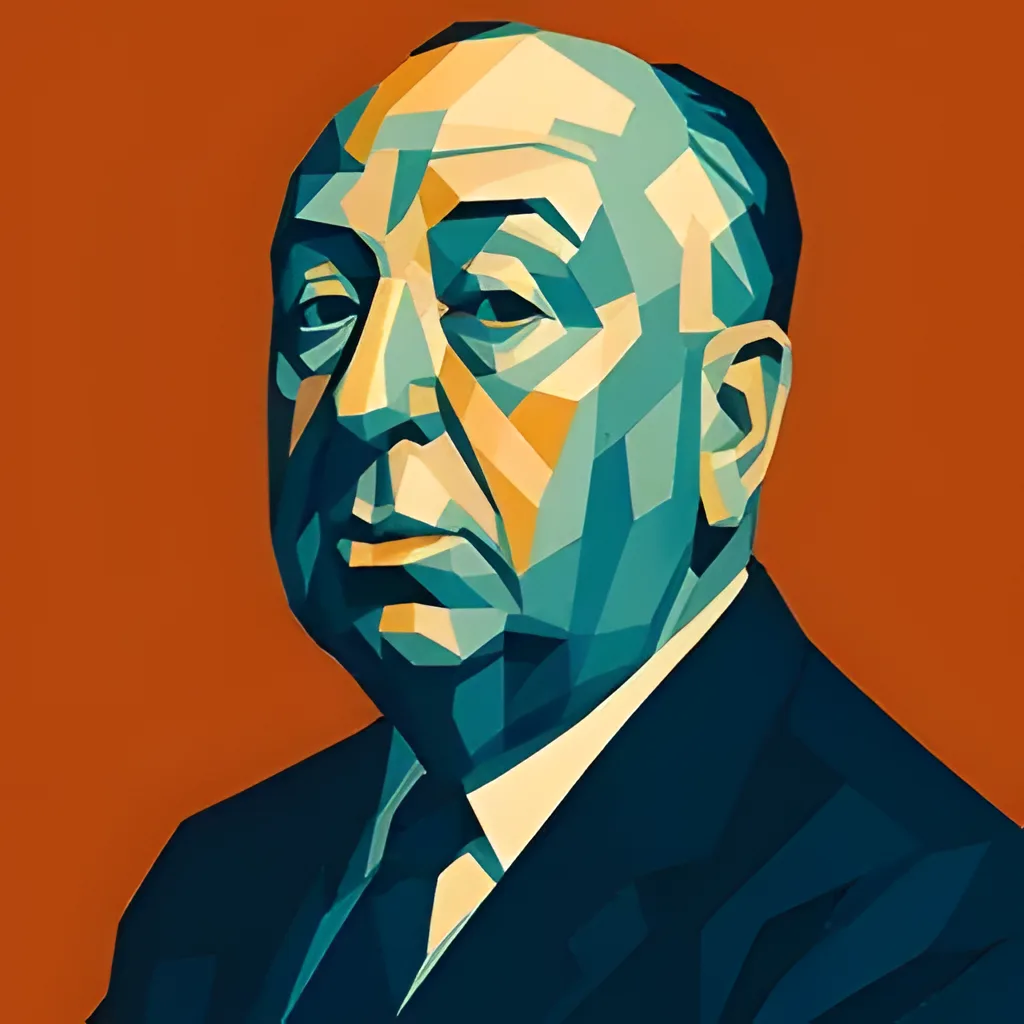
A life in brief
Alfred Hitchcock: life and timeline.
Alfred Hitchcock left school at fourteen and went to work as a technical clerk, spending his evenings in cinemas studying how films were made. He entered the industry designing title cards for silent pictures. Over fifty years he built a body of work — The Lodger, Notorious, Rear Window, Vertigo, Psycho — on a single insight: surprise lasts only a moment, but suspense can be sustained indefinitely. He storyboarded every shot before filming, leaving nothing to chance. He was nominated five times for Best Director and never won.
- 1899
Born in Leytonstone
Born 13 August in a London suburb, youngest of three children of a greengrocer and poultry dealer, into strict Catholic discipline. As a boy he collected maps, timetables and technical diagrams — an early taste for precision and planning.
- 1920
Title cards
At twenty-one he joins Famous Players-Lasky, the British branch of Paramount, designing title cards for silent films. The job teaches him exactly how words and images work together to tell a story.
- 1926
The Lodger, and Alma
After a first film in 1925, The Pleasure Garden, he makes his first true success and the first he considers authentically his own: an innocent man wrongly accused, a blonde in danger, carefully built suspense. The same year he marries Alma Reville, the editor and script supervisor who will work on nearly every film he makes.
- 1929
Blackmail
His first sound film treats sound as a storytelling tool rather than decoration. In one scene the word 'knife' echoes in a woman's mind, growing louder and more distorted as her guilt intensifies.
- 1935
The Thirty-Nine Steps
He perfects the formula of an innocent man on the run, falsely accused. With The Man Who Knew Too Much (1934) and The Lady Vanishes (1938), it makes him Britain's leading director.
- 1940
Rebecca, and Hollywood
He signs with producer David O. Selznick and moves to America. His first US film wins the Academy Award for Best Picture — and he is not nominated for Best Director.
- 1946
Notorious
Cary Grant and Ingrid Bergman in romance, espionage and psychological complexity. Its kiss evades Hollywood's censorship code by having the couple separate and reconnect their lips across a single long take.
- 1954
Rear Window
James Stewart as a photographer convinced he has witnessed a murder from his apartment window. The film is about voyeurism, which is to say about cinema itself: the audience watching private moments unfold.
- 1958
Vertigo
Mixed reviews on release; now widely regarded as his greatest achievement and one of the finest films ever made. Obsession, identity and the male gaze, with a haunting Bernard Herrmann score.
- 1960
Psycho
Made cheaply and quickly with his television crew. It kills its apparent protagonist halfway through and handles violence and sexual themes as mainstream cinema never had. Some critics call it sensationalism; it seeds both the slasher genre and psychological horror.
- 1963
The Birds
His most ambitious technical challenge: hundreds of shots of attacking birds requiring effects at the edge of the possible. It drops a traditional score entirely, using electronically generated bird sounds to build unease.
- 1980
Knighted, then death
Knighted by Queen Elizabeth II, months before he dies at his home in Bel Air, California, on 29 April, aged eighty.
Major achievements
Alfred Hitchcock: major achievements.
- 01
Pure cinema
He told stories through images rather than dialogue, and storyboarded every shot before filming began — preparation that let him work fast on set while keeping complete creative control.
- 02
Vertigo
Received mixed reviews in 1958 and is now widely regarded as one of the finest films ever made. Its complex structure, innovative camera work and Herrmann score created a dreamlike quality that influenced countless later filmmakers.
- 03
Psycho
Broke the conventions he had spent thirty years mastering, and was enormously successful doing it. Ahead of its time, it shaped the development of both the slasher genre and psychological horror.
- 04
Alfred Hitchcock Presents
From 1955 to 1962, and revived as The Alfred Hitchcock Hour to 1965, his droll introductions made him a household name — and let him mentor young directors and experiment with storytelling.
- 05
Elevating the thriller
He proved a popular film could also be serious art. Camera movement for psychological effect, editing rhythm to build suspense, sound and music as storytelling tools: all now standard, and all pioneered by him.
Turning points
Alfred Hitchcock: defining moments.
- 1913–1925
In through the title cards
He left school at fourteen for a clerk's job at a telegraph works, studied engineering and navigation at night, took art courses, and spent his evenings in cinemas studying how early filmmakers worked. At twenty-one he got in as a title card designer — a seemingly minor role that proved crucial. Within a few years he was an assistant director, set designer and writer, and by 1925 he was directing.
- 1926–1980
Alma
He married Alma Reville, a film editor and script supervisor who had worked with him since his early days in the industry. For fifty-four years, until his death, she worked on nearly every film he made, shaping scripts, editing and story. She was often called the only person who could tell Hitchcock he was wrong and get away with it.
- 1938–1940
To Hollywood
Already Britain's leading director, he signed with David O. Selznick and left for an industry with more scale. Rebecca won Best Picture. He was not nominated for Best Director — the start of a pattern that ran the length of his career.
- 1960
Breaking his own rules
Psycho was made cheaply and fast with his television crew, and it violated numerous conventions: killing its apparent protagonist halfway through, showing what mainstream cinema did not show. It cost him standing with critics who thought he had descended into sensationalism. It turned out he was ahead of them.
What you’ll take away
Lessons from Alfred Hitchcock’s life.
- 01
Suspense is not surprise
Surprise lasts only a moment; suspense can be sustained indefinitely. He built a career on the difference — make the audience identify with someone, then put that person in danger and make everyone wait.
- 02
Decide before you arrive
He storyboarded every shot before a camera rolled. The preparation was not fussiness. It was what let him work quickly during production and keep complete control of the result.
- 03
The awards are not the work
Five Best Director nominations, no wins. Rebecca won Best Picture with no nomination for its director. Vertigo opened to mixed reviews and is now called one of the finest films ever made. The verdict took decades to arrive.
Did you know
Facts about Alfred Hitchcock.
- 01
Did you know that legendary director Alfred Hitchcock made cameo appearances in 39 of his 52 surviving major films?
- 02
Did you know that Hitchcock had a severe phobia of eggs, known as ovophobia, stating that he found the yolk of an egg revolting?
- 03
Did you know that despite directing some of the most famous suspense films in history and receiving five Best Director nominations, Hitchcock never won a competitive Academy Award?
If you liked Alfred Hitchcock…
Browse all →
FAQ
Frequently asked questions about Alfred Hitchcock.
How did Alfred Hitchcock get his start?
Designing title cards for silent films. In 1920 he joined the London studio of Famous Players-Lasky, moved up through art direction and screenwriting, and directed his first film, The Pleasure Garden, in 1925. The Lodger (1926) was his first real thriller.
What was Alfred Hitchcock's full name?
Alfred Joseph Hitchcock. He was born on 13 August 1899 in Leytonstone, then on the edge of London, the youngest of three children of William Hitchcock, a greengrocer and poulterer, and Emma Jane Hitchcock.
How did Alfred Hitchcock die?
Of kidney failure, at his home in Bel Air, Los Angeles, on 29 April 1980, aged eighty. He had been knighted by Queen Elizabeth II only four months earlier.
Why is Alfred Hitchcock called the Master of Suspense?
Because he treated suspense as a precise craft rather than a mood. He distinguished it from surprise — surprise lasts only a moment, suspense can be sustained indefinitely — and knew how to lead viewers to identify with a character and then place that character in danger.
Did Hitchcock ever win an Academy Award for Best Director?
No. He received five nominations and never won. His first American film, Rebecca, won Best Picture in 1940 without a Best Director nomination for him. He did receive the Irving G. Thalberg Memorial Award in 1968, the AFI Life Achievement Award in 1979, and a knighthood in 1980.
What is a MacGuffin?
An object or goal that drives the plot but ultimately proves unimportant. Hitchcock popularised the idea during his run of British thrillers in the 1930s.
Why does Hitchcock appear in his own films?
The wry cameo became a near-regular tradition from The Lodger onward and enhanced his public persona. Between the cameos, his distinctive silhouette and his television introductions, he made himself as recognisable as his films.
Which of his own films was Hitchcock's favourite?
He often called Shadow of a Doubt (1943) his favourite — a film about the darkness lurking beneath small-town American life.
Published by Lyfestori, from Duck Pond Ventures Oy. About us and how to report a correction.
15 min · one sitting