Nikola Tesla
The Visionary Inventor Who Electrified the World
Born on 10 July 1856 in Smiljan, in today's Croatia, to Serbian parents, Nikola Tesla emigrated to New York in 1884 and invented the induction motor and the polyphase alternating-current system that power the modern grid — then died alone and in debt in a Manhattan hotel room in 1943.
- 18 min listen
- Alternating current
- Inventor
- War of the Currents
Nikola Tesla’s full 18 min audio biography, The Visionary Inventor Who Electrified the World, is available on Lyfestori for iOS. Listen to a free preview below.
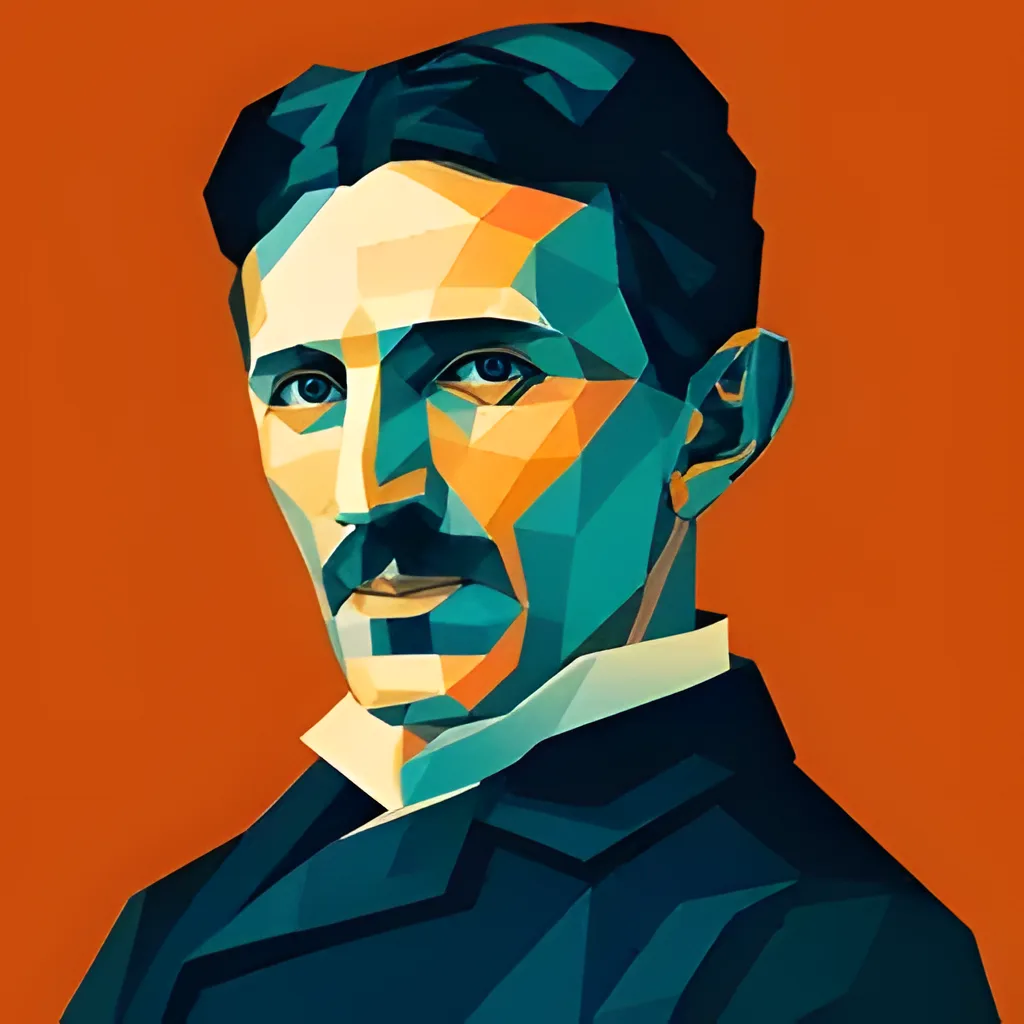
A life in brief
Nikola Tesla: life and timeline.
His professor in Graz called it impractical and impossible. Nikola Tesla had noticed the classroom dynamo sparking, and thought the commutator causing it could simply be removed — if you used alternating current. Years later, reciting poetry in a Budapest park, he saw the rotating magnetic field and sketched an induction motor in the sand. It became the electrical grid. He sold the patents to Westinghouse, won the War of the Currents, and died alone and in debt in a Manhattan hotel.
- 1856
Born in Smiljan
Born 10 July in the Austrian Empire, now Croatia, to Serbian Orthodox parents. His father Milutin was a priest and scholar; his mother Đuka Mandić invented household tools and machines, and he credited her ingenuity for his own.
- 1873
Graz Polytechnic
Enrols after secondary school and works relentlessly — every lecture, long hours in the library, constant experiment. He learns German, French and English, and becomes fluent in Italian.
- 1878
A collapse and a teaching job
He fails his third year and moves to Ljubljana, working briefly as a mathematics teacher. His father dies in 1880, leaving him without financial support; a few weeks at Prague end for lack of money.
- 1881
The park in Budapest
Working as a draftsman at the Budapest Telephone Exchange, he is walking with the chief engineer Szigeti, reciting poetry, when the rotating magnetic field comes to him. He sketches the induction motor in the sand.
- 1882
Paris
Joins the Continental Edison Company installing incandescent lighting, rises to supervise new lighting stations across Europe, and takes out his first patents for AC dynamos and motors.
- 1884
New York
Arrives with a letter of recommendation from Edison's European associates, a few cents, and little else. Edison sees his talent but will not touch alternating current. Tesla resigns and digs ditches for a time.
- 1887
His own company
Investors back him and he founds the Tesla Electric Light & Manufacturing Company, and later the Tesla Electric Company.
- 1888
The AC patents and Westinghouse
He patents the AC induction motor and a full AC distribution system. George Westinghouse buys the motor and transformer patents for a significant sum and hires him as a consultant.
- 1893
The Chicago World's Fair
Westinghouse lights the fair with Tesla's system, showing AC to millions. Winning the contract to harness Niagara Falls settles the War of the Currents.
- 1899
Colorado Springs
He builds the Tesla coil, generating millions of volts and artificial lightning up to 130 feet long, records radio waves coming from the Earth, and finds that the planet itself resonates electrically.
- 1906
Wardenclyffe halted
J. P. Morgan withdraws funding from the Long Island tower meant to send power and messages worldwide. Construction stops. The tower is dismantled and sold for scrap in 1917.
- 1943
Death at the New Yorker
He dies on 7 January, aged eighty-six, alone and in debt in his Manhattan hotel room.
Major achievements
Nikola Tesla: major achievements.
- 01
The AC system
Alternating current could travel hundreds of miles with little loss, using transformers to step voltage up and down. Edison's DC needed a power station roughly every mile. Tesla's system is still the backbone of the electrical grid.
- 02
The rotating magnetic field and the induction motor
The idea that came to him in a Budapest park removed the commutator — the sparking part he had objected to as a student — and made AC power practical.
- 03
The Tesla coil
The high-voltage transformer built at Colorado Springs, capable of throwing 130-foot arcs. It is still used in radio technology and medical imaging.
- 04
Radio and remote control
He demonstrated a radio-controlled boat in 1898 and developed radio communication systems, winning a patent dispute with Marconi over the invention of radio — recognised by the U.S. Supreme Court after his death.
- 05
Wireless transmission
At Colorado Springs he showed electricity could move through the air and the earth itself, and built a theory of Earth resonance transmission. The dream was never funded to completion; the research it inspired continues.
Turning points
Nikola Tesla: defining moments.
- 1870s
The sparking dynamo
A student watched the classroom dynamo throw sparks and said the commutator causing it could be removed altogether if you used alternating current. His professor called the idea impractical and impossible. He kept it for a decade.
- 1881
The sand in the park
The whole AC revolution starts with a walk. Reciting poetry with Szigeti, he saw the rotating magnetic field — and drew the induction motor in the dirt with a stick. The severe eye pain that troubled him for the rest of his life also began in Budapest.
- After 1884
Breaking with Edison
Edison had reportedly promised him $50,000 to improve the DC dynamos. Tesla did the work; the story goes that Edison called the promise an American joke and told him he did not understand American humour. He resigned, and dug ditches rather than work on DC.
- 1888–1893
The War of the Currents
Westinghouse bought his patents and Edison's camp fought back with a smear campaign, electrocuting animals — including an elephant, Topsy — to prove AC was lethal. Tesla answered by running high-voltage AC through his own body in public. Chicago and Niagara ended the argument.
- 1906
Morgan walks away
Wardenclyffe was to send power and messages anywhere on Earth. Morgan reportedly grasped that it meant free energy, not just communication — and he financed conventional power companies. There was no profit in it. The money stopped and the work never recovered.
What you’ll take away
Lessons from Nikola Tesla’s life.
- 01
Keep the idea your teacher rejected
His professor dismissed alternating current as impossible. He carried the objection about the sparking commutator for years until he had the answer. Authority was confidently, expensively wrong.
- 02
Let the mind wander
The rotating magnetic field did not arrive at a desk. It came while he was walking in a park reciting poetry — after years of saturating himself in the problem.
- 03
Inventing is not the same as keeping
He sold his AC patents to Westinghouse, and the system electrified the world while he died in debt in a hotel room. The people who commercialise a thing and the people who conceive it are rarely the same, and rarely rewarded alike.
Did you know
Facts about Nikola Tesla.
- 01
Did you know that Nikola Tesla's "eureka" moment for the rotating magnetic field and induction motor happened while he was reciting poetry during a walk in a Budapest city park?
- 02
Did you know that Thomas Edison allegedly dismissed his promise of a $50,000 reward to Tesla as an "American joke", leading Tesla to resign and briefly work as a laborer digging ditches?
- 03
Did you know that Nikola Tesla had eccentric habits like a phobia of germs, insisting on exactly 18 clean napkins at every meal, and calculating the cube root of numbers to divide by three before beginning any task?
If you liked Nikola Tesla…
Browse all → Theoretical Physicist20 min
Albert Einstein
The Genius Who Changed Our Understanding of the Universe
 Physicist & Chemist19 min
Marie Curie
Pioneer of Science and Champion of Discovery
 Founding Father20 min
Benjamin Franklin
Lightning in a Bottle
 Tech CEO17 min
Jensen Huang
The Dishwasher Who Built the AI Empire
FAQ
Frequently asked questions about Nikola Tesla.
Did Nikola Tesla invent alternating current?
Not the current itself, but he made it practical. Alternating current was already known; Tesla invented the induction motor and the polyphase AC system that made long-distance power transmission work. His 1888 patents, licensed to George Westinghouse, won the War of the Currents against Edison's direct current and underpin the electrical grid today.
What did Nikola Tesla invent?
Above all the AC induction motor and polyphase power system. He also invented the Tesla coil, demonstrated a radio-controlled boat in 1898, and held around 300 patents worldwide covering motors, generators, lighting and wireless transmission.
How did Nikola Tesla die?
Of coronary thrombosis, alone in room 3327 of the Hotel New Yorker in Manhattan, on 7 January 1943. He was eighty-six and deeply in debt despite the value of his inventions.
What was the War of the Currents?
The fight between Tesla's alternating current, backed by George Westinghouse, and Thomas Edison's direct current. DC could only be transmitted efficiently for about a mile; AC could travel hundreds of miles using transformers. Edison's side ran a campaign claiming AC was lethal, electrocuting animals to prove it. Lighting the 1893 Chicago World's Fair and the Niagara Falls contract decided it for AC.
Why did Tesla and Edison fall out?
Edison saw Tesla's ability but refused to explore alternating current. Edison reportedly promised him $50,000 for improving the DC dynamos; when Tesla delivered and asked for it, Edison allegedly called it an American joke and said Tesla did not understand the humour. Tesla resigned, and for a time worked as a labourer digging ditches.
What was Wardenclyffe Tower?
A tower on Long Island, funded by J. P. Morgan, meant to transmit electricity, radio signals and images wirelessly across the world by tapping the Earth's natural electrical resonance. Morgan withdrew his backing — reportedly on learning it was intended for free energy transmission rather than just communication. Construction stopped in 1906 and it was scrapped in 1917.
Did Tesla invent radio?
He developed radio communication systems and won a patent dispute with Marconi over the invention of radio, though the U.S. Supreme Court recognition came after his death. He also demonstrated remote control with a radio-controlled boat in 1898, and in the First World War proposed radio-wave detection that foreshadowed radar.
Published by Lyfestori, from Duck Pond Ventures Oy. About us and how to report a correction.
18 min · one sitting