Benjamin Franklin
Lightning in a Bottle
Born on 17 January 1706 in Boston, the fifteenth of seventeen children of a candle-maker, Benjamin Franklin left school at ten, became a printer, writer, scientist and inventor, and helped draft the Declaration of Independence and win the French alliance that secured American independence.
- 20 min listen
- Founding Father
- Printer & inventor
- Electricity
Benjamin Franklin’s full 20 min audio biography, Lightning in a Bottle, is available on Lyfestori for iOS. Listen to a free preview below.
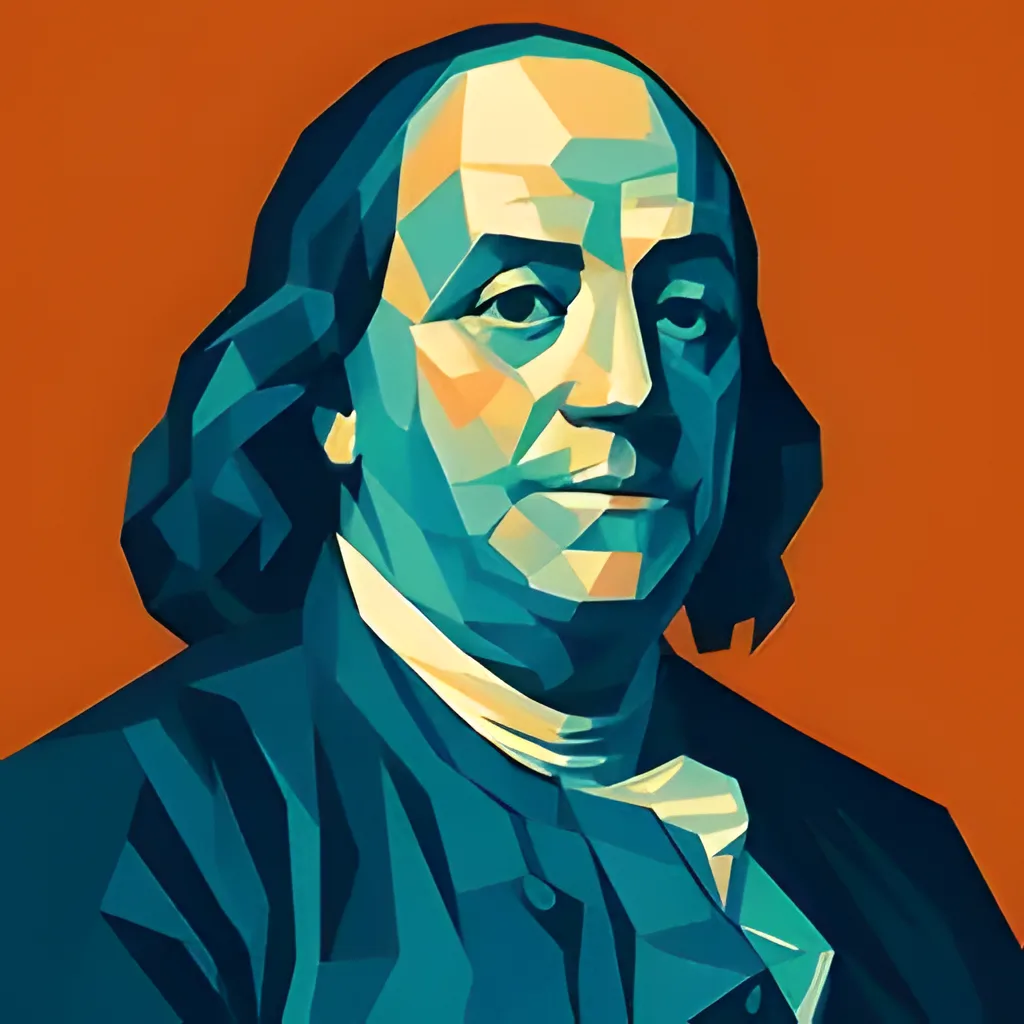
A life in brief
Benjamin Franklin: life and timeline.
Benjamin Franklin had two years of schooling, ending at ten. He was the fifteenth of seventeen children, apprenticed to a brother who beat him, and he broke the contract and ran. He arrived in Philadelphia at seventeen with three rolls under his arms and no money. He then built a printing fortune, proved lightning was electricity, invented the lightning rod and bifocals and patented none of it, and at seventy went to France and secured the alliance that won the Revolution.
- 1706
Born in Boston
Born 17 January, the fifteenth of seventeen children of Josiah Franklin, a candle and soap maker. Money is always tight. He reads early and loves books, but his father can afford only two years of school, from eight to ten.
- 1723
The runaway apprentice
Bound to his brother James's print shop until twenty-one and often beaten by him, he breaks the contract at seventeen and leaves Boston — an illegal act that could make him unemployable. He sells his books for passage, finds no work in New York, and reaches Philadelphia in October with three large rolls bought with his last coins. Deborah Read watches him walk past with them under his arms.
- 1724
Stranded in London
Governor William Keith promises to help him get credit for his own shop, so at eighteen he sails to buy printing supplies. The letters of credit never come. He spends nearly two years in London print shops learning advanced technique, studying, and swimming in the Thames.
- 1730
His own shop, and a wife
He buys out his partner Hugh Meredith to become sole owner, two years after starting the business — and the year before he had bought the struggling Pennsylvania Gazette and made it one of the most successful papers in the colonies. The same year he and Deborah Read enter a common-law marriage, seven years after the rolls.
- 1732
Poor Richard's Almanack
He takes a standard format — calendars, weather, useful information — and fills it with wit and practical advice. It sells thousands of copies a year and makes him wealthy.
- 1752
The kite
He flies a kite with a metal key attached to the string during a thunderstorm. The charge runs down the wet string to the key, proving lightning and laboratory electricity are the same thing. The lightning rod follows.
- 1757
Agent in London
He begins eighteen years representing Pennsylvania and other colonies before the British government, hoping to find peaceful solutions and keep America inside an empire whose culture he admires.
- 1774
The Privy Council
Blamed for passing the Massachusetts governor's private letters to friends in America, he is subjected to a vicious verbal attack before a crowded room of officials and spectators. He concludes that reconciliation is impossible.
- 1776
Declaration, then France
Nearly seventy, he serves on the committee that drafts the Declaration of Independence, suggesting important changes to Jefferson's text. In late 1776 Congress sends him to France to seek the aid without which America cannot win.
- 1778
The French alliance
France agrees to provide military aid and to recognise American independence officially. French money, ships and soldiers prove essential — the British defeat at Yorktown in 1781 comes with the help of French naval forces his diplomacy secured.
- 1787
The Constitution
By far the oldest delegate at the Constitutional Convention. When disagreements threaten to break it up, his diplomacy finds the compromises that hold it together. On 17 September he urges every delegate to sign despite their doubts.
- 1790
Death in Philadelphia
He dies 17 April, aged eighty-four, having spent one of his last public acts writing a petition to Congress calling for the abolition of slavery. Over twenty thousand people attend the funeral, and ships in the harbour lower their flags.
Major achievements
Benjamin Franklin: major achievements.
- 01
Proving lightning is electricity
The 1752 kite experiment showed that lightning and laboratory electricity were the same force. It led directly to the lightning rod, which saved countless buildings from fire and is still on roofs today.
- 02
Inventions he refused to own
The Franklin stove, bifocal glasses, a flexible catheter built for his brother's bladder stones, swim fins. He patented none of them — he had benefited from other people's inventions, so he gave his own away.
- 03
Poor Richard's Almanack
From 1732, an almanac filled with witty sayings and practical advice rather than just calendars and weather predictions. Thousands of copies a year, and the foundation of his fortune.
- 04
The French alliance
Sent to France in late 1776, he charmed a court in a plain brown suit and fur cap while the diplomats wore wigs, and by 1778 had secured military aid and formal recognition of American independence.
- 05
Institutions for Philadelphia
The first volunteer fire company, Pennsylvania's first hospital, the Library Company — one of America's first public libraries — an academy that became the University of Pennsylvania, and a colonial postal system with the first regular routes.
- 06
Founding documents
He served on the committee that drafted the Declaration of Independence, and at eighty-one was the oldest delegate to the Constitutional Convention, where his standing brokered the compromises that kept it alive.
Turning points
Benjamin Franklin: defining moments.
- 1723
Breaking the contract
He was legally bound to his brother until twenty-one, and being beaten. At seventeen he ran anyway — illegal, and a fast route to being unemployable. He sold his books to pay for the ship, found nothing in New York, and arrived in Philadelphia hungry, broke, and carrying three rolls. It was the best decision he ever made.
- 1724–1726
The governor's worthless promise
Pennsylvania's governor promised him letters of credit to set up his own shop, so at eighteen he sailed to London to buy equipment. The letters never came and he was stranded with no money and no way home. He spent two years in London print shops learning techniques he could not have learned in Philadelphia. The betrayal was an education.
- 1774
Humiliated into a revolution
He had spent seventeen years in London trying to keep the colonies British, and he admired British culture. Then he was hauled before the Privy Council and verbally savaged in front of a packed room over the leaked letters. He sailed home in 1775 convinced peaceful reconciliation was finished — a revolutionary at sixty-nine.
- 1776–1785
The plain man at Versailles
At seventy, Congress sent him to ask an absolute monarchy to fund a republican revolt. He understood the assignment was partly theatre: he wore a simple brown suit and a fur cap among the wigs and let the French see him as the natural goodness and wisdom of America. It bought the ships that won the war.
The good men may do separately is small compared with what they may do collectively.
Benjamin Franklin, on civic life
What you’ll take away
Lessons from Benjamin Franklin’s life.
- 01
The trade was the education
Two years of school ended at ten. The print shop replaced it: he read every book and pamphlet that came through, and taught himself to write by copying the style of essays he admired — by candlelight, after long days of work.
- 02
Give the invention away
The lightning rod, bifocals, the stove: he patented none of them. He had benefited from other people's inventions and thought he owed the same back. He got rich from the printing press instead.
- 03
Change your mind out loud
He spent seventeen years arguing for reconciliation with Britain, then argued for independence. At the Constitutional Convention he told the delegates he had lived long enough to see his own opinions change when he learned new facts — and asked them to sign despite their doubts.
Did you know
Facts about Benjamin Franklin.
- 01
Did you know that Benjamin Franklin never patented any of his famous inventions, including the lightning rod and bifocals, believing they should be given freely to the public?
- 02
Did you know that Franklin was a highly accomplished swimmer and was posthumously inducted into the International Swimming Hall of Fame?
- 03
Did you know that despite being one of the most prominent Founding Fathers of the United States, Benjamin Franklin only had two years of formal schooling?
If you liked Benjamin Franklin…
Browse all → Economist17 min
Adam Smith
The Father of Modern Economics Who Shaped How We Think About Wealth and Society
 Philosopher15 min
John Locke
The Philosopher Who Shaped Modern Democracy
 European Commission President19 min
Ursula von der Leyen
From Doctor to Europe's Most Powerful Woman
 President of Finland17 min
Alexander Stubb
Navigating Power and Politics
FAQ
Frequently asked questions about Benjamin Franklin.
What did Benjamin Franklin invent?
The lightning rod, bifocal glasses, the Franklin stove, the glass armonica (a musical instrument) and an early flexible urinary catheter, among others. He refused to patent any of them, believing inventions should be shared freely.
Did Benjamin Franklin have a middle name?
No. Middle names were uncommon in colonial New England, and he was simply Benjamin Franklin, born in Boston on 17 January 1706 (6 January under the calendar then in use).
Did Benjamin Franklin really fly a kite in a thunderstorm?
Yes — in 1752, with a metal key attached to the string. The kite drew an electrical charge from the storm, and electricity travelled down the wet string to the key, proving that lightning and laboratory electricity were the same thing. The discovery led directly to his invention of the lightning rod.
How much schooling did Franklin have?
Two years, from age eight to ten — all his father, a candle and soap maker with seventeen children, could afford. He educated himself afterwards in his brother's printing shop, reading everything that passed through it and teaching himself to write by imitating essays he admired.
Why didn't Franklin patent his inventions?
He believed that since he had benefited from the inventions of others, he should freely share his own discoveries to help humanity. The Franklin stove, bifocals, the flexible catheter and swim fins were all given away.
What was Franklin's role in the American Revolution?
Mostly diplomatic, and decisive. He served on the committee that drafted the Declaration of Independence in 1776, but his crucial contribution came in France: sent in late 1776, he secured French military aid and official recognition of American independence in 1778. French money, ships and soldiers made victory possible.
Who was Silence Dogood?
A fictitious middle-aged widow invented by a sixteen-year-old Franklin so he could get published in his brother's newspaper, the New England Courant. The humorous essays about Boston life were very popular with readers — and when James discovered his younger brother had written them, their relationship got worse.
Published by Lyfestori, from Duck Pond Ventures Oy. About us and how to report a correction.
20 min · one sitting