Jensen Huang
The Dishwasher Who Built the AI Empire
Born Jen-Hsun Huang on 17 February 1963 in Tainan, Taiwan, Jensen Huang was sent to the United States as a child, washed dishes at Denny's as a teenager, and in 1993 co-founded NVIDIA — the graphics-chip company whose GPUs became the engine of the AI boom.
- 17 min listen
- NVIDIA co-founder
- GPUs
- AI infrastructure
Jensen Huang’s full 17 min audio biography, The Dishwasher Who Built the AI Empire, is available on Lyfestori for iOS. Listen to a free preview below.
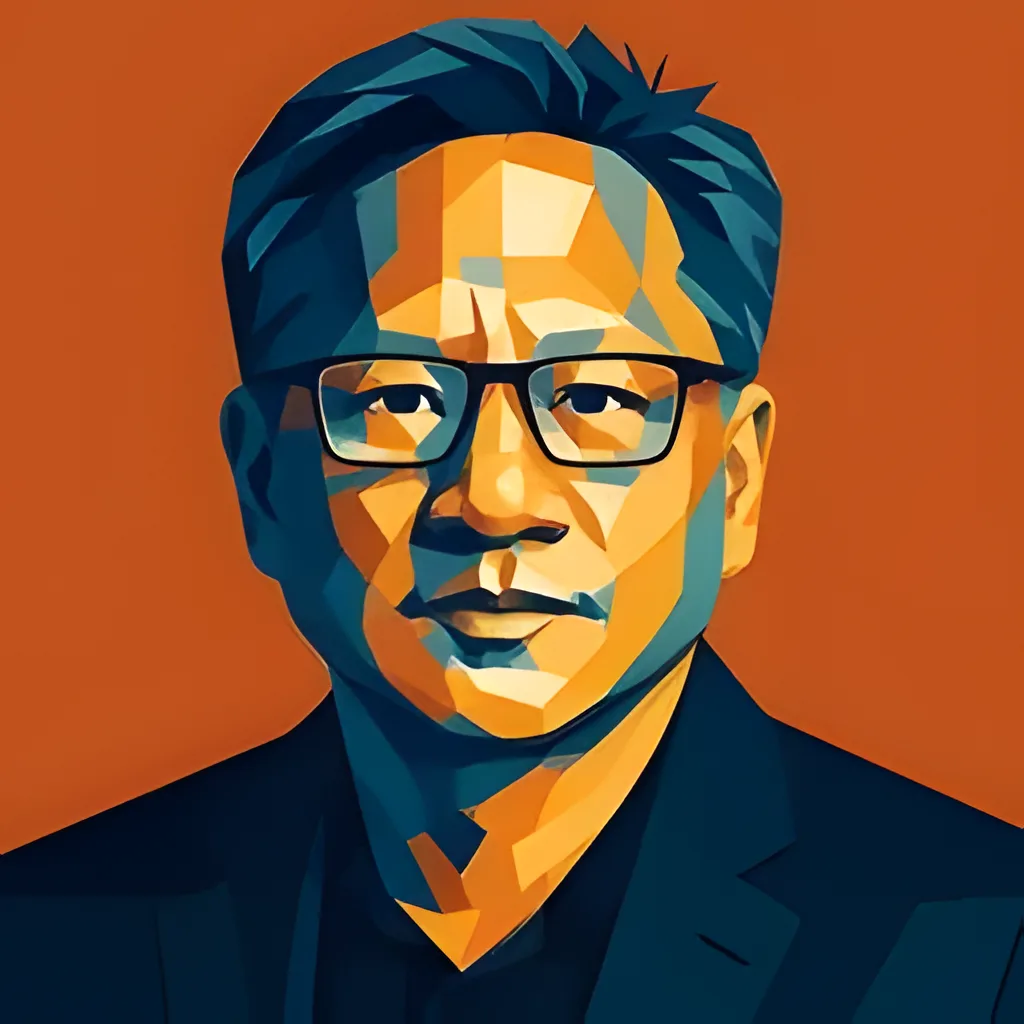
A life in brief
Jensen Huang: life and timeline.
At ten he cleaned toilets before breakfast at a Kentucky reform school — the place his family had enrolled him in by mistake, believing it a prestigious boarding academy. Jensen Huang washed dishes at Denny's at fifteen. At thirty he founded NVIDIA over breakfast at that same chain, with two friends and $600 between them. Then he spent a decade building CUDA while Wall Street valued it at zero. When ChatGPT arrived in 2022, every AI breakthrough ran on his chips.
- 1963
Born in Tainan
Born 17 February in Taiwan, younger son of a chemical engineer and a schoolteacher. Every day his mother picked ten words at random from the dictionary and made her sons memorise them.
- 1973
Sent to America alone
At nine, his parents sell nearly everything they own to send their sons to America. He cannot speak English. Relatives enrol the boys at the Oneida Baptist Institute in rural Kentucky — a reform school for troubled youth, not the academy his parents paid for.
- 1984
Oregon State to Silicon Valley
Earns his electrical engineering degree, having found his calling and his lab partner and future wife, Lori Mills. Moves to Silicon Valley to work at AMD, then LSI Logic, while completing a master's at Stanford.
- 1993
NVIDIA founded
In April, at thirty, he founds the company with Chris Malachowsky and Curtis Priem. A lawyer wanted $200 cash to incorporate it, so each founder put in $200. Starting capital: $600.
- 1995
Months from bankruptcy
The first product is a disaster — the chip doesn't work, customers hate it, the cash is going. Instead of pivoting to a safer market, he bets everything on a new approach: the world's first consumer graphics processing unit.
- 1999
The GeForce 256
Marketed as the world's first GPU: one chip processing 10 million polygons per second, doing work that had needed multiple components and heavy CPU power. Gaming explodes; digital content creation democratises.
- 2000
Xbox and the IPO
NVIDIA becomes the exclusive graphics provider for Microsoft's first Xbox, and the company goes public. The three friends from Denny's have built something that matters.
- 2006
CUDA
He releases a software platform letting NVIDIA's graphics chips handle general computing, not just graphics. Wall Street asks why for the next ten years, and values it at $0 in the market cap.
- 2016
The bet lands
A decade after CUDA, the field understands it is a dramatically different way of writing programs. NVIDIA had donated servers to universities, funded AI research, and delivered its first DGX system to a little-known lab called OpenAI.
- 2022
ChatGPT
OpenAI releases it in November and the world changes overnight. ChatGPT was trained on 10,000 NVIDIA chips, and every major AI company depends on the company's technology.
- 2024
The $3 trillion company
Revenue explodes 262% in early 2024; market capitalisation passes $3 trillion. In Taiwan, crowds and paparazzi follow him at Computex — the press calls it Jensanity — and children dress as mini-Jensen for Halloween.
Major achievements
Jensen Huang: major achievements.
- 01
The GPU
The GeForce 256 in 1999 was marketed as the world's first graphics processing unit. It didn't just succeed — personal computers could suddenly render complex 3D worlds in real time.
- 02
CUDA
In 2006 he made NVIDIA's graphics chips programmable for general computing. It is the decision that turned a games-hardware company into the substrate of machine learning.
- 03
The infrastructure of the AI boom
ChatGPT was trained on 10,000 NVIDIA chips. Every major AI company depends on the company's technology, and the race for artificial general intelligence runs through its roadmap.
- 04
The world's largest semiconductor company
Market capitalisation passed $3 trillion — larger than the GDP of most countries — with revenue up 262% in early 2024 and Blackwell GPUs sold out twelve months ahead.
- 05
Three decades as CEO
He has run NVIDIA since 1993, an almost unheard-of tenure in Silicon Valley, through an unusually flat structure where he communicates directly with employees at every level.
Turning points
Jensen Huang: defining moments.
- 1973–1975
The Kentucky reform school
Enrolled by mistake, he cleaned toilets before breakfast, attended classes as the only Asian student, and endured relentless bullying, ethnic slurs and sometimes knife threats. His brother worked tobacco farms. Two years later his parents arrived, discovered the situation and pulled them out. He came back with a perspective other kids did not have.
- 1993
$600 at a Denny's booth
Breakfast meetings with Chris Malachowsky and Curtis Priem at the same Denny's where he had bussed tables turned into a company. Everyone said affordable 3D graphics on personal computers couldn't be done and the market didn't exist. Both co-founders — older, more experienced — deferred to him as CEO on day one.
- 1995
Doubling down instead of retreating
The first chip didn't work and the company was months from bankruptcy. The safe move was a smaller market and less risk. He convinced his co-founders and investors to bet everything on the world's first consumer GPU instead. His heart rate drops when the stakes are highest — a skill he credits to rush hours at Denny's.
- 2006–2016
Ten years of being wrong in public
CUDA had almost no users and Wall Street valued it at zero for a decade. He kept funding it anyway — donating servers to universities, backing AI research, personally delivering the first DGX to OpenAI — until deep learning researchers discovered the architecture was perfect for them.
Building NVIDIA turned out to have been a million times harder than we expected. If we had known the pain and suffering involved, we probably wouldn't have done it.
Jensen Huang
What you’ll take away
Lessons from Jensen Huang’s life.
- 01
No task is beneath you
He cleaned toilets at ten and washed dishes at fifteen, and still tells employees so. The Denny's habits — work under pressure, never waste a motion, treat every task as important — became the operating style of a trillion-dollar company.
- 02
Be early enough to look wrong
CUDA had no users and a $0 valuation for ten years. Conviction only gets tested in the stretch where you cannot prove it yet, and that stretch is where the advantage compounds.
- 03
Hardship is not wasted material
Discrimination in Thailand, abandonment in Kentucky, near-bankruptcy in 1995. He didn't merely survive them; he treats them as where character comes from, and built the optimism they produced into how the company decides.
Did you know
Facts about Jensen Huang.
- 01
Did you know that Jensen Huang co-founded NVIDIA in 1993 during a meeting at a Denny's diner in San Jose, California?
- 02
Did you know that Huang actually worked at that same Denny's as a waiter and busboy when he was a teenager to help overcome his extreme shyness?
- 03
Did you know that Jensen Huang has a large tattoo of the NVIDIA company logo on his upper arm, which he got to fulfill a promise to his employees when their stock hit $100?
If you liked Jensen Huang…
Browse all →
FAQ
Frequently asked questions about Jensen Huang.
What did Jensen Huang do before NVIDIA?
He was a chip designer. After graduating from Oregon State University in 1984 he worked at AMD and then LSI Logic, while studying part-time for a master's degree in electrical engineering at Stanford. As a teenager he had worked as a dishwasher and busboy at Denny's — the chain where NVIDIA was later planned over breakfast.
Where did Jensen Huang go to college?
Oregon State University, where he earned a bachelor's degree in electrical engineering in 1984, followed by a master's in electrical engineering from Stanford University in 1992.
What is Jensen Huang's real name?
Jen-Hsun Huang. He was born in Tainan, Taiwan, on 17 February 1963, and has gone by Jensen since moving to the United States.
Why was Jensen Huang sent to a reform school?
By mistake. His parents sold nearly everything to send him and his brother to America in 1973, believing they were paying tuition at a prestigious boarding school. Relatives in Washington state accidentally enrolled the boys at the Oneida Baptist Institute in Kentucky, a religious reform school for troubled youth.
How was NVIDIA founded?
Over breakfast meetings at a San Jose Denny's starting in 1992, with fellow engineers Chris Malachowsky and Curtis Priem. They incorporated in April 1993. A lawyer demanded $200 in cash, so each founder put in $200 — NVIDIA's starting capital was $600.
Where does the name NVIDIA come from?
They first chose NVision, then discovered a toilet paper company already had it. Jensen suggested NVIDIA, from the Latin invidia, meaning envy — he wanted competitors to turn green with envy.
What is CUDA and why did it matter?
A software platform released in 2006 that let NVIDIA's graphics chips handle general computing rather than just graphics. Wall Street valued it at $0 for a decade. It made the company's hardware the natural home for deep learning when the field finally arrived.
Does Jensen Huang really have an NVIDIA tattoo?
Yes — he got the company logo on his left shoulder when NVIDIA's stock hit $100 a share. He has said he probably wouldn't get another one, but that the moment felt worth marking permanently.
Published by Lyfestori, from Duck Pond Ventures Oy. About us and how to report a correction.
17 min · one sitting