Albert Einstein
The Genius Who Changed Our Understanding of the Universe
Born on 14 March 1879 in Ulm, Germany, Albert Einstein left school without a diploma, worked as a patent clerk in Bern, and in 1905 published the papers on relativity, light quanta and E = mc² that remade physics — winning the 1921 Nobel Prize and becoming the most famous scientist of the twentieth century.
- 20 min listen
- Nobel Laureate
- Theoretical physics
- Relativity
Albert Einstein’s full 20 min audio biography, The Genius Who Changed Our Understanding of the Universe, is available on Lyfestori for iOS. Listen to a free preview below.
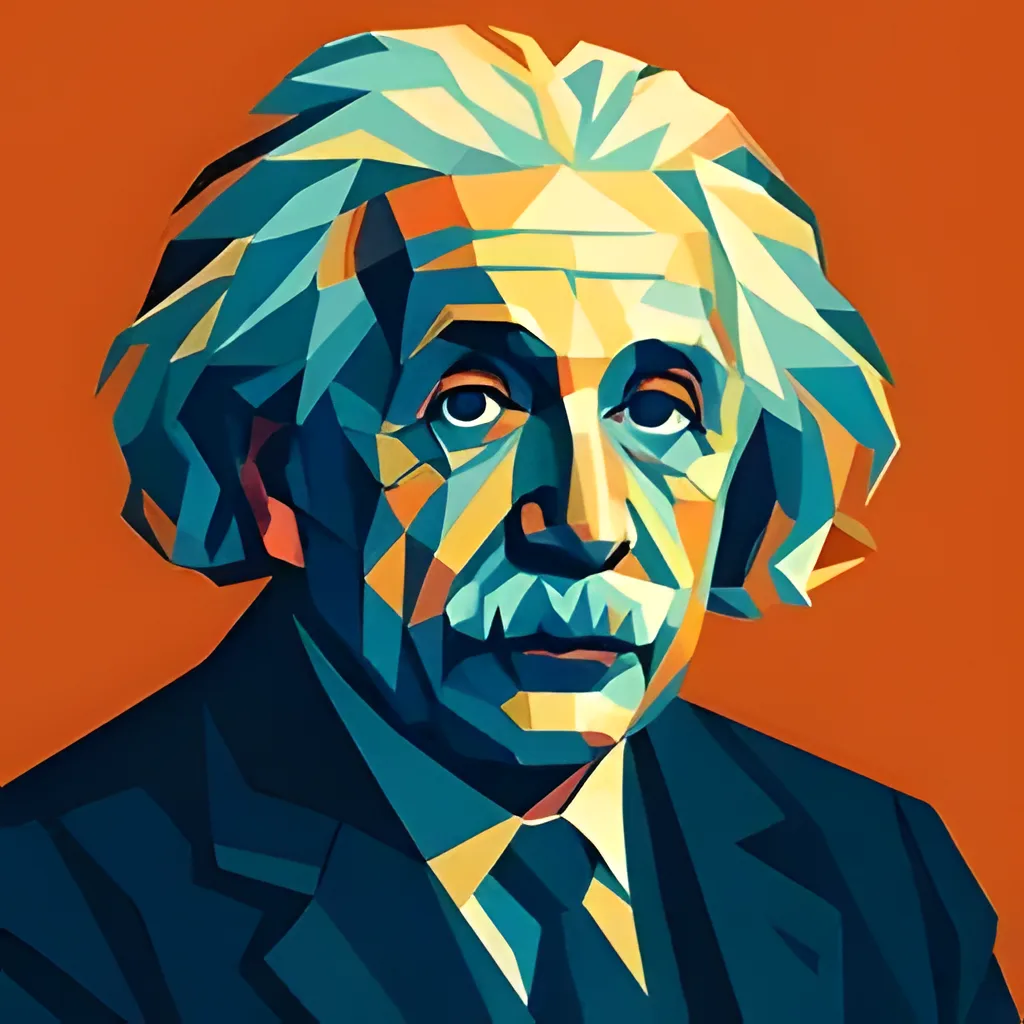
A life in brief
Albert Einstein: life and timeline.
He was a quiet child who did not speak until he was three, and a graduate so at odds with his professors that none would recommend him for a university post. Albert Einstein worked out the shape of space and time from a desk in a Swiss patent office, hiding his calculations when his supervisor walked past. Within a decade he had recast gravity itself — and spent the rest of his life insisting that knowledge carries responsibility.
- 1879
Born in Ulm
Born 14 March in Ulm, southern Germany, to Hermann and Pauline Einstein.
- 1884
The compass
A compass from his father fascinates him: an invisible force moves the needle. It sparks a lifelong curiosity about the hidden forces governing nature.
- 1895
Leaves school, fails half an exam
Quits the Munich gymnasium to join his family in Italy, then sits the Swiss Federal Polytechnic entrance exam — brilliant in maths and physics, failing languages, history and biology.
- 1896
Enters the Polytechnic
Admitted to study physics and mathematics in Zurich after a year in Aarau, where he first imagines riding alongside a beam of light.
- 1902
The patent office
Takes a job examining patent applications in Bern. The work is clear-headed but undemanding, leaving his mind free for physics.
- 1905
The miracle year
Publishes five papers: the photoelectric effect, two on Brownian motion, special relativity, and E=mc². Any one would have made him famous.
- 1915
General relativity
After nearly ten years, describes gravity not as a force but as the curvature of spacetime caused by mass and energy.
- 1919
The eclipse
British astronomers confirm starlight bends around the sun, exactly as predicted. He becomes world-famous overnight.
- 1933
Flight from Germany
With Hitler in power, he renounces his German citizenship and takes a post at the Institute for Advanced Study in Princeton.
- 1939
The letter to Roosevelt
Co-signs a letter drafted by Leó Szilárd warning that E=mc² makes nuclear weapons possible — helping prompt the Manhattan Project.
- 1955
Death in Princeton
Dies 18 April, aged seventy-six, still working on equations for a unified field theory.
Major achievements
Albert Einstein: major achievements.
- 01
Special relativity
Showed space and time are not separate but woven into spacetime, that nothing outruns light, and that time slows at high speed.
- 02
E=mc²
Established that mass and energy are the same thing in different forms — a sliver of mass holds enormous energy.
- 03
The photoelectric effect
Proposed that light arrives in packets called photons, helping found quantum theory. This, not relativity, won him the Nobel Prize.
- 04
Proof that atoms are real
His analysis of Brownian motion showed the jitter of suspended particles comes from molecules striking them — hard evidence for atoms, which some scientists still doubted.
- 05
General relativity
Recast gravity as the bending of spacetime, predicting light deflection, gravitational time dilation, and a universe that expands or contracts.
Turning points
Albert Einstein: defining moments.
- 1895
Walking away from school
Miserable under German school discipline and separated from his family, he left the gymnasium without a diploma — risking his prospects entirely — and taught himself physics for the Polytechnic exam.
- 1902–1909
The desk that freed his mind
Rejected for every academic post, he examined patents in Bern. The job asked him to think clearly about how things worked without draining him, and gave him the security to marry. The miracle year happened at that desk.
- 1919
An eclipse makes him a celebrity
When starlight bent exactly as he had predicted, he was proclaimed the greatest genius since Newton. The attention never suited a man who preferred quiet contemplation.
- 1933
Exile
German physicists had already attacked relativity as 'Jewish physics'. With Hitler in power he was abroad, and never went back — settling on Mercer Street in Princeton for the rest of his life.
God does not play dice with the universe.
Albert Einstein, on his discomfort with quantum mechanics
What you’ll take away
Lessons from Albert Einstein’s life.
- 01
Ask why, not what
He clashed with teachers who wanted memorisation and obedience. He wanted the reason behind the rule — and that habit, not raw talent, is what found relativity.
- 02
Protect the thinking time
The patent office looks like a detour and was actually the point: undemanding work, a steady wage, and a mind left with enough energy to wonder.
- 03
Knowledge brings responsibility
He used his fame against racism and war, refusing to speak at universities that discriminated. He believed science should serve humanity, not the reverse.
Did you know
Facts about Albert Einstein.
- 01
Did you know that Albert Einstein couldn't find an academic job after graduating and spent seven years working as an assistant examiner at the Swiss Patent Office?
- 02
Did you know that when the first President of Israel, Chaim Weizmann, died in 1952, the Israeli government offered Einstein the position of President, which he politely declined?
- 03
Did you know that Einstein's brain was removed without his family's permission during his autopsy by pathologist Thomas Harvey, who kept it in jars for decades for scientific study?
If you liked Albert Einstein…
Browse all →


FAQ
Frequently asked questions about Albert Einstein.
Did Albert Einstein have a middle name?
No. He was simply Albert Einstein, born on 14 March 1879 in Ulm, in the Kingdom of Württemberg, to Hermann and Pauline Einstein.
What did Albert Einstein invent?
Mostly ideas rather than devices: special and general relativity, the equation E = mc², and the explanation of the photoelectric effect that helped found quantum theory. He did hold patents too — most famously, with Leo Szilard, a refrigerator with no moving parts.
How did Albert Einstein die?
Of a ruptured abdominal aortic aneurysm, in Princeton Hospital on 18 April 1955, aged seventy-six. He declined surgery, saying he had done his share and it was time to go.
Did Einstein fail his university entrance exam?
Partly. Sitting the Swiss Federal Polytechnic exam at sixteen, he did brilliantly in mathematics and physics but failed the languages, history and biology sections. He spent a year at a school in Aarau and passed in 1896.
What did Einstein win the Nobel Prize for?
The photoelectric effect — his idea that light travels in packets of energy called photons — not for relativity, the work he is most famous for.
Did Einstein build the atomic bomb?
No. In 1939 he co-signed a letter drafted by physicist Leó Szilárd warning Roosevelt that Germany might build nuclear weapons. That letter helped prompt the Manhattan Project, but he did not work on the bomb.
Was Einstein really slow as a child?
He did not speak his first words until he was three, which worried his parents, and some thought he had learning difficulties. He was a strong student — he simply took his time, and taught himself geometry and algebra at twelve.
Further reading
Published by Lyfestori, from Duck Pond Ventures Oy. About us and how to report a correction.
20 min · one sitting