Nicolaus Copernicus
The Man Who Moved The Earth
Born Mikołaj Kopernik on 19 February 1473 in Toruń, Poland, Nicolaus Copernicus studied astronomy, law and medicine across Poland and Italy, served as a cathedral canon, and in De revolutionibus — published as he lay dying in 1543 — put the Sun, not the Earth, at the centre of the universe.
- 19 min listen
- Heliocentrism
- Renaissance astronomy
- De Revolutionibus
Nicolaus Copernicus’s full 19 min audio biography, The Man Who Moved The Earth, is available on Lyfestori for iOS. Listen to a free preview below.
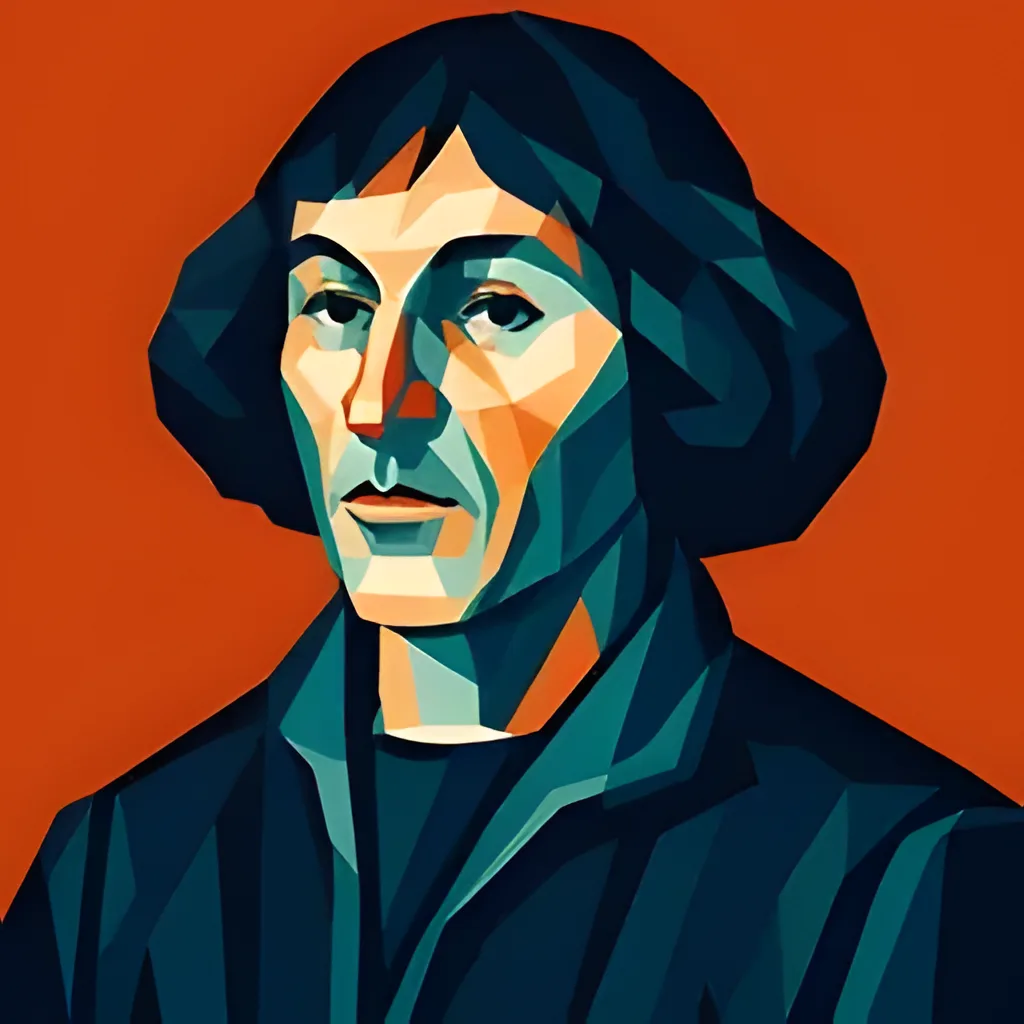
A life in brief
Nicolaus Copernicus: life and timeline.
He spent his working life collecting rents. Nicolaus Copernicus was a canon at Frombork Cathedral — a church administrator with a comfortable income and, more usefully, free evenings. He climbed his tower at night with viewing tubes and measuring rods, no telescope, and worked out that Earth is not the centre of anything. He circulated the idea quietly around 1514, then spent twenty-five years checking it. The finished book reached him in 1543, reportedly hours before he died.
- 1473
Born in Toruń
Born 19 February as Mikołaj Kopernik, later latinised, into a prosperous family. His father was a copper trader; his mother, Barbara Watzenrode, came from wealthy merchants.
- 1491
University of Kraków
Enrols at eighteen under the guidance of his uncle Lucas Watzenrode, studying grammar, rhetoric, arithmetic, geometry, astronomy and music. He leaves after four years without a degree — normal at the time.
- 1496
Bologna
Goes to Italy to study church law, and lodges in the house of Domenico Maria Novara, the university's astronomy professor, who questions parts of Ptolemy. They observe together.
- 1497
Canon at Frombork
Appointed a canon of Frombork Cathedral in Warmia — the post that will fund and shelter the rest of his life's work.
- 1500
Lectures in Rome
Travels to Rome for the Jubilee Year and gives lectures on astronomy.
- 1501
Medicine at Padua
Studies medicine until 1503. Astronomy and medicine were linked: physicians believed celestial positions influenced health.
- 1503
Doctorate and return
Takes a doctorate in church law at Ferrara and returns to Poland, serving as his uncle's secretary and physician alongside his duties as canon.
- 1514
The Commentariolus
Circulates a short manuscript among friends — the 'Little Commentary' — proposing that the sun, not Earth, sits at the centre, and that Earth spins daily and orbits yearly.
- 1539
Rheticus arrives
The young German mathematician Georg Joachim Rheticus comes to Frombork to learn the system, and publishes the first clear public account of it, the 'Narratio Prima'.
- 1543
De Revolutionibus
'On the Revolutions of the Heavenly Spheres' appears in six books, dedicated to Pope Paul III. He argues that mathematics, not popular opinion, should settle questions in astronomy.
- 1543
Death at Frombork
After a stroke earlier in the year, he dies on 24 May at seventy — reportedly just hours after the first printed copy reached his hands.
- 1616
The Church objects
Seventy-three years after his death, as astronomers begin arguing the model is literally true rather than a calculating device, the Church suspends the book until corrected. Mandated corrections were issued in 1620, after which it was allowed.
Major achievements
Nicolaus Copernicus: major achievements.
- 01
The heliocentric model
He put the sun at the centre and made Earth an ordinary planet, spinning on its axis once a day and orbiting once a year. It explained the nightly wheel of the stars as Earth's rotation, not the sky's.
- 02
De Revolutionibus Orbium Coelestium
Six books published in 1543 giving the full mathematics: the principles, spherical astronomy, the precession of the equinoxes, the moon's motion, and detailed planetary theory.
- 03
The right order of the planets
He worked out the relative sizes and periods of the orbits and placed the planets correctly — Mercury, Venus, Earth, Mars, Jupiter, Saturn — calculating Saturn's year at roughly thirty of ours.
- 04
Simplicity as an argument
Retrograde motion needed elaborate epicycles under Ptolemy. In his system it fell out naturally: Earth overtakes the slower outer planets. Planetary brightness worked the same way — nearer means brighter.
- 05
A working life outside astronomy
He practised as a physician around Frombork, wrote on monetary theory and argued for Polish currency reform, and translated Greek prose letters into Latin.
Turning points
Nicolaus Copernicus: defining moments.
- 1496–1500
Lodging with an astronomer
Sent to Bologna to study church law, he ended up living in Domenico Maria Novara's house. Novara doubted parts of Ptolemy and observed the sky methodically. Copernicus went to Italy to become a canon lawyer and came back a practical astronomer.
- 1503
The day job
The canonry at Frombork was not a detour from the work — it was what made the work possible. Managing properties and collecting rents paid him a comfortable income and left his nights entirely his own for forty years.
- c. 1514
The Little Commentary
He put the idea on paper and passed it to friends rather than printers. It let him test a heresy in private. He was a perfectionist who wanted certainty before going public, and he knew the theory would collide with both scholarship and doctrine.
- 1539–1543
Someone else forces the issue
After twenty-five years of refining, it took an outsider to get the book out. Rheticus arrived to learn the system, published his own account of it first, and joined the friends pressing Copernicus to print. He agreed, and died the year it appeared.
What you’ll take away
Lessons from Nicolaus Copernicus’s life.
- 01
Buy your own time
The rent-collecting canon had what most thinkers of his age lacked: money he did not have to chase and evenings nobody claimed. The tower at Frombork was bought with paperwork.
- 02
Simpler is evidence
He did not have better instruments than Ptolemy's followers — he had no telescope at all. What he had was a model that explained the same sky without the scaffolding, and he trusted that.
- 03
Being partly wrong is how it works
He kept the ancient Greek insistence that heavenly motion must be perfectly circular, so he still needed epicycles. Kepler found the ellipses; Newton found the reason. Getting the centre right was enough to start everything else.
If you liked Nicolaus Copernicus…
Browse all →
FAQ
Frequently asked questions about Nicolaus Copernicus.
What did Copernicus discover?
That the planetary motions astronomers observed could be explained far more simply if the Earth and the other planets orbit the Sun, and the Earth spins daily on its axis. His heliocentric model, set out in De revolutionibus orbium coelestium (1543), began the Scientific Revolution.
What was Copernicus's real name?
Mikołaj Kopernik in Polish; Nicolaus Copernicus is the Latin form he used as a scholar. He was born in Toruń, in Royal Prussia under the Polish crown, to a family of German-speaking merchants.
What religion was Copernicus?
Catholic. He spent most of his adult life as a canon of the cathedral chapter at Frombork, in Warmia, and dedicated De revolutionibus to Pope Paul III. The Church did not condemn his book until 1616, seventy-three years after his death.
Was Copernicus persecuted by the Church for his ideas?
No. He was a faithful Catholic and a church canon all his life, and he died the year his book was published. The Church initially tolerated Copernican astronomy as a useful mathematical tool. Opposition grew only later, as astronomers began arguing it was literally true — the book was suspended in 1616 and permitted again after corrections issued in 1620.
Did Copernicus use a telescope?
No — it had not been invented yet. He observed with the naked eye from a tower at Frombork Cathedral, aided only by simple viewing tubes and measuring devices, and checked his results against astronomical records going back to ancient times.
Was Copernicus's model correct?
The central claim was: Earth orbits the sun, and he got the planetary order and relative periods roughly right. But he still believed celestial motion must be perfectly circular, so he needed epicycles for the details. Johannes Kepler later showed the orbits are elliptical, and Isaac Newton explained why.
Why did it take him so long to publish?
He first circulated the idea privately around 1514 and then spent about twenty-five years refining it. He was a perfectionist who wanted certainty before going public, and he understood the theory would be attacked as contrary to both scientific orthodoxy and religious doctrine. He only agreed to print in 1543, under pressure from friends and from Rheticus.
Published by Lyfestori, from Duck Pond Ventures Oy. About us and how to report a correction.
19 min · one sitting