Ludwig van Beethoven
The Sound He Could Not Hear
Born in Bonn in December 1770 and baptised on 17 December, Ludwig van Beethoven became the composer who carried Western music from the Classical era into the Romantic — writing nine symphonies, including the Fifth and the choral Ninth, while gradually losing his hearing.
- 20 min listen
- Composer
- Pianist
- Classical to Romantic
Ludwig van Beethoven’s full 20 min audio biography, The Sound He Could Not Hear, is available on Lyfestori for iOS. Listen to a free preview below.
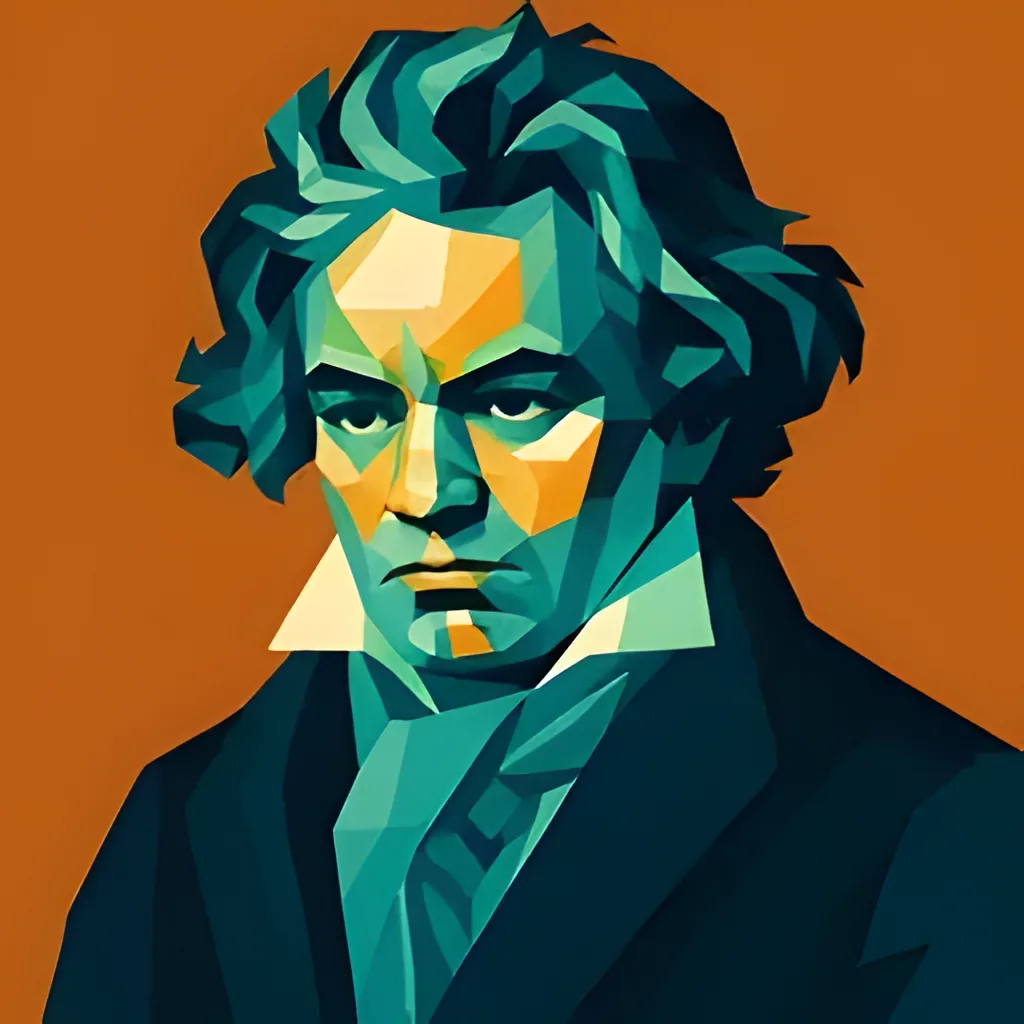
A life in brief
Ludwig van Beethoven: life and timeline.
His father, a court tenor who drank, advertised him at seven as a six-year-old prodigy in the hope of a second Mozart. Ludwig van Beethoven was supporting his family by his late teens, left Bonn for Vienna at twenty-one and dazzled its aristocracy as a pianist. Then, in his late twenties, the ringing in his ears began. He wrote the Eroica, the Fifth and the Ninth while his hearing failed, and at the Ninth's premiere a soloist had to turn him round to see the applause.
- 1770
Born in Bonn
Born in Bonn, in the Electorate of Cologne, and baptised on 17 December; his exact birth date was never recorded. His grandfather and namesake, from Mechelen in today's Belgium, is Kapellmeister at the court.
- 1778
A prodigy for sale
In March his father, Johann, presents him in a concert in Cologne and advertises him as six when he is seven — an attempt to market him as the next Mozart after years of harsh lessons.
- 1783
Neefe's prediction
His teacher Christian Gottlob Neefe, the court organist, has introduced him to Bach's Well-Tempered Clavier. Neefe writes in a music magazine that the boy will become a second Mozart if he continues as he has begun.
- 1787
His mother dies
Maria Magdalena dies of tuberculosis in July, when he is sixteen. As his father's drinking worsens, he becomes the practical head of the family, and in 1789 petitions to have part of his father's salary paid to him.
- 1792
To Vienna
Leaves Bonn in November to study with Haydn. His patron Count Waldstein writes that he will receive Mozart's spirit from Haydn's hands. Vienna's aristocracy soon prizes him as a pianist and improviser.
- 1802
The Heiligenstadt Testament
With his hearing failing since the late 1790s, he writes a letter to his brothers in the village of Heiligenstadt admitting he had thought of ending his life, and that only his art held him back. He never sends it.
- 1804
Eroica
Completes his Third Symphony, longer and more ambitious than any symphony before it. He had linked it to Napoleon, but on hearing Napoleon had made himself Emperor he scratched the name from the title page so hard it tore the paper.
- 1808
The Fifth and the Pastoral
The Fifth Symphony, with its four-note opening, and the Sixth, the Pastoral, are premiered together at a marathon concert in Vienna on 22 December.
- 1814
Fidelio and the end of performing
The final version of his only opera, Fidelio, succeeds in Vienna. Around the same time his deafness ends his career as a public pianist; by about 1818 friends communicate with him through conversation books.
- 1815
The fight for Karl
After his brother Caspar Karl dies, he begins years of legal battles with his sister-in-law Johanna for custody of his nephew Karl. The pressure he puts on the boy ends in Karl's suicide attempt in 1826, which he survives.
- 1824
The Ninth Symphony
On 7 May the Ninth is premiered at the Theater am Kärntnertor, its finale setting Schiller's 'Ode to Joy' for soloists and chorus. Unable to hear the ovation, he is turned to face the audience by the contralto Caroline Unger.
- 1827
Death in Vienna
Dies on 26 March, aged fifty-six, after months of illness with jaundice and liver disease. Thousands line the streets for his funeral; Franz Schubert is among the torchbearers.
Major achievements
Ludwig van Beethoven: major achievements.
- 01
Nine symphonies that changed the form
The Eroica stretched the symphony's scale, the Fifth turned four notes into a drama of struggle and triumph, and the Ninth brought voices into a symphony's finale. Composers from Brahms to Wagner measured themselves against them.
- 02
The piano sonatas
Thirty-two sonatas, from the Pathétique of 1798–99 to the 'Moonlight' of 1801 and the late works, transformed what the piano could express.
- 03
The late quartets
Written after the Ninth, when he was fully deaf, the late string quartets puzzled many contemporaries and are now counted among the most searching chamber music ever composed.
- 04
Europe's anthem
The 'Ode to Joy' melody was adopted by the Council of Europe in 1972 and by the European Communities in 1985. Leonard Bernstein conducted the Ninth in Berlin on Christmas Day 1989, weeks after the Wall fell.
- 05
The composer as independent artist
He still relied on patrons such as Prince Lichnowsky, but he came to embody a new idea: the composer whose own inner necessity mattered as much as any employer's command.
Turning points
Ludwig van Beethoven: defining moments.
- 1787
Losing his mother
Her death at the age of forty left him, at sixteen, effectively running a household with an alcoholic father and two younger brothers. He later called her his best friend.
- 1792
Leaving Bonn for Vienna
Vienna gave him Haydn as a teacher, princes as patrons and a public that adored his improvising. The move made him a professional composer in the city where Mozart had died a year earlier.
- 1802
Heiligenstadt
Sent to the countryside on medical advice, he confronted the likelihood that his deafness was permanent. The unsent letter he wrote there records a decision to live for his work, and a 'heroic' decade of composition followed.
- 1818–1827
The music of total deafness
Communicating through conversation books and increasingly isolated, he turned inward. The Missa Solemnis, the Ninth Symphony and the late quartets came from this final decade.
I will seize Fate by the throat; it shall certainly never wholly overcome me.
Letter to Franz Gerhard Wegeler, 16 November 1801 (English translation)
What you’ll take away
Lessons from Ludwig van Beethoven’s life.
- 01
Work does not wait for ideal conditions
His greatest music was written as the sense he depended on most disappeared. He composed what he could only hear in his imagination.
- 02
A private crisis can become a turning point
The Heiligenstadt letter is a document of despair, but it ends in a decision. What followed was the most productive decade of his life.
- 03
Genius is not the same as kindness
The man who wrote the 'Ode to Joy' smothered his nephew with control and expectation. His life shows how greatness and failure can share the same household.
If you liked Ludwig van Beethoven…
Browse all → Composer18 min
Wolfgang Amadeus Mozart
The Child Prodigy Who Became Music's Greatest Genius
 Composer16 min
Johann Sebastian Bach
The Master Who Shaped Western Classical Music
 French Emperor18 min
Napoleon Bonaparte
The Emperor Who Dominated Continental Europe and Changed History Forever
 Fashion Designer16 min
Coco Chanel
The Revolutionary Designer Who Liberated Women's Fashion
FAQ
Frequently asked questions about Ludwig van Beethoven.
When was Ludwig van Beethoven born?
In December 1770, in Bonn. His exact birth date was not recorded; he was baptised on 17 December 1770, and 16 December is often given as the likely birthday.
Was Beethoven German?
Yes. He was born in Bonn, in the German-speaking Electorate of Cologne within the Holy Roman Empire, though his paternal family came from Mechelen in today's Belgium. He lived in Vienna from 1792 until his death.
How did Beethoven go deaf?
No one knows for certain. His hearing began to fail in his late twenties, around 1796 to 1798, starting with ringing and buzzing in his ears, and he was profoundly deaf by his final decade. Proposed causes range from otosclerosis to illness, and recent analyses of hair samples have found high lead levels, but none is proven.
How did Beethoven die?
Of a long illness involving liver disease. He died in Vienna on 26 March 1827, aged fifty-six, after months of jaundice and abdominal swelling; his autopsy found a cirrhotic liver. A 2023 DNA study of his hair suggested a genetic risk of liver disease and a hepatitis B infection.
What are Beethoven's most famous works?
The Fifth and Ninth Symphonies, the 'Moonlight' Sonata and Für Elise are the best known. The Ninth's finale, the 'Ode to Joy', is now Europe's anthem; Für Elise, a short piano piece from about 1810, was only published decades after his death.
Was Beethoven ever married?
No. He fell in love repeatedly, often with women of higher rank, but never married and had no children. A passionate letter to an unnamed 'Immortal Beloved', found after his death, has never been conclusively traced.
Did Beethoven meet Mozart?
Possibly, but there is no reliable evidence. He travelled to Vienna in 1787, perhaps hoping to study with Mozart, but had to return to Bonn when his mother fell ill; accounts of a meeting are anecdotal.
Where is Beethoven buried?
In Vienna's Central Cemetery (Zentralfriedhof). He was first buried at Währing cemetery in 1827, and his remains were moved to the Zentralfriedhof in 1888.
Published by Lyfestori, from Duck Pond Ventures Oy. About us and how to report a correction.
20 min · one sitting