Napoleon Bonaparte
The Emperor Who Dominated Continental Europe and Changed History Forever
Born Napoleone di Buonaparte on 15 August 1769 in Ajaccio, Corsica, Napoleon rose from artillery officer to Emperor of the French in 1804, conquered much of Europe and left behind the Napoleonic Code — before defeat at Waterloo and exile on St. Helena, where he died in 1821.
- 18 min listen
- Emperor of the French
- Military strategy
- Napoleonic Code
Napoleon Bonaparte’s full 18 min audio biography, The Emperor Who Dominated Continental Europe and Changed History Forever, is available on Lyfestori for iOS. Listen to a free preview below.
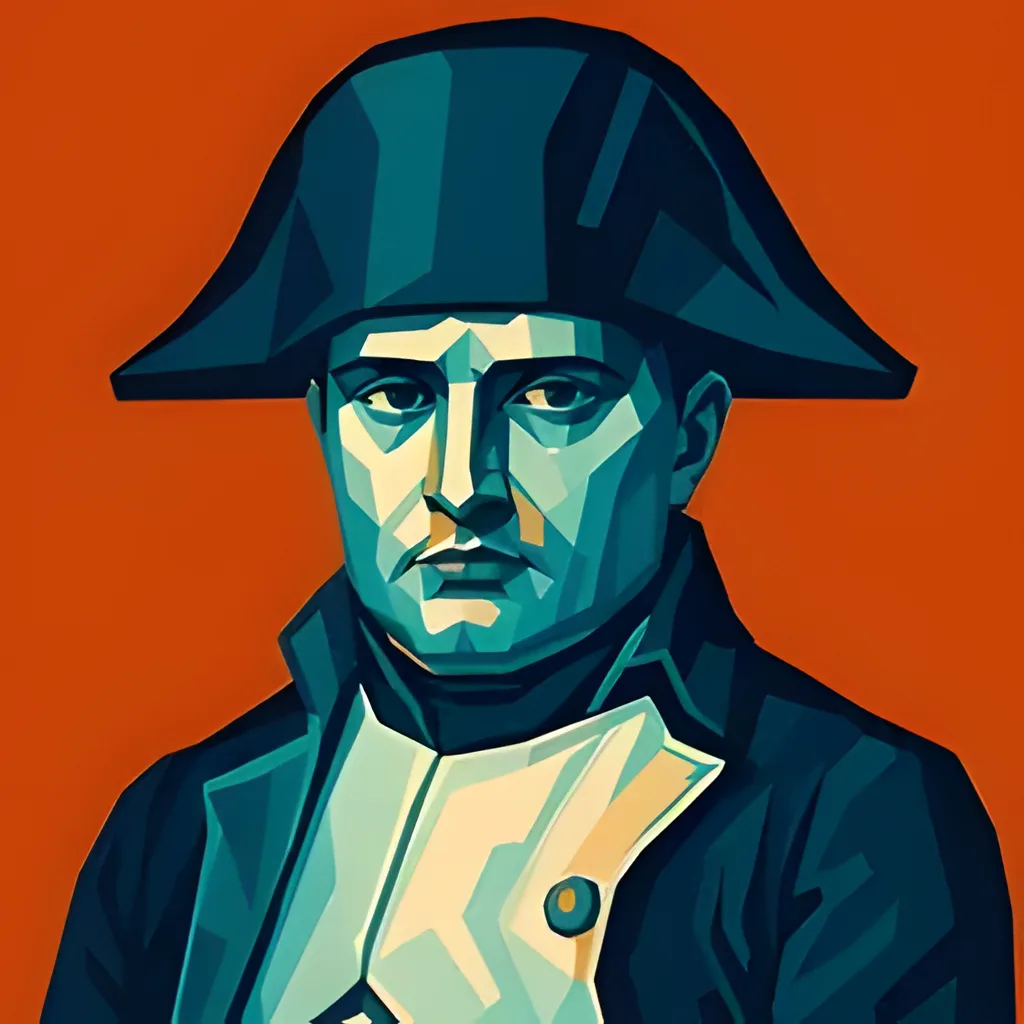
A life in brief
Napoleon Bonaparte: life and timeline.
He was mocked at military school in France for his Corsican accent, and struggled with French — Corsican Italian was his first language. Napoleon Bonaparte was a second lieutenant at sixteen, a brigadier general at twenty-four after breaking the siege of Toulon with artillery, and Emperor of the French by 1804. At the coronation he took the crown from Pope Pius VII and placed it on his own head. His Civil Code is still the basis of law in many countries.
- 1769
Born in Ajaccio
Born 15 August in Ajaccio, Corsica, the second of eight children, a year after Genoa ceded the island to France. His father Charles was a lawyer; his mother Letizia came from minor nobility.
- 1793
The siege of Toulon
At twenty-four he devises the artillery plan that forces British and Spanish forces out of the port. It earns him promotion to brigadier general.
- 1795
General Vendémiaire
He breaks a royalist uprising in Paris with artillery, saving the revolutionary government and earning a nickname from the month in the revolutionary calendar.
- 1796
Army of Italy
Given command against Austrian and Piedmontese armies. Outnumbered and poorly supplied, he wins on speed, concentration of force and surprise.
- 1798
Egypt
An expedition aimed at British interests in India. The military results are mixed, but the scholars he brings along uncover the Rosetta Stone, and the campaign builds his mystique.
- 1799
18 Brumaire
He returns from Egypt and joins the coup that overthrows the Directory. He enters as one of three consuls and manoeuvres to become First Consul at thirty, with virtually unlimited authority.
- 1804
Emperor of the French
At Notre Dame he takes the crown from Pope Pius VII and puts it on his own head — authority claimed from his own record and popular support, not from the Church.
- 1805
Austerlitz
The Grande Armée crushes a combined Austrian and Russian army. It is often counted his greatest tactical masterpiece.
- 1812
Russia
He marches an army estimated in the hundreds of thousands into Russia. The Russians refuse battle and burn the country behind them; winter finishes the retreat. Fewer than 100,000 come out.
- 1814
Abdication and Elba
Russia, Prussia, Austria and Britain combine against him. In April, facing inevitable defeat, he abdicates and is exiled to Elba.
- 1815
Waterloo
He escapes Elba in March and the army rallies to him. On 18 June, Wellington and Blücher beat him in a day-long battle. He abdicates again and is sent to St. Helena.
- 1821
Death on St. Helena
He dies on 5 May, aged fifty-one, after six years dictating his memoirs on a remote South Atlantic island. Modern medical analysis points to stomach cancer.
Major achievements
Napoleon Bonaparte: major achievements.
- 01
The Napoleonic Code
A uniform civil law guaranteeing equality before the law and protecting property rights — while restricting women's legal rights. It was adopted well beyond France and remains the basis of law in many countries today.
- 02
A state education system
Centralised, merit-based schooling: the Université impériale in 1808 to oversee every level, an expanded network of lycées, strengthened Grandes Écoles such as the École Polytechnique, and reorganised medical faculties.
- 03
Financial stabilisation
The Bank of France in 1800, the franc germinal in 1803, and heavy investment in roads and canals steadied the economy and made trade and communication work across the country.
- 04
A new way of making war
Speed, concentration of force and surprise, built around innovative use of artillery. Military academies around the world still study his campaigns.
- 05
Exporting the Revolution
His armies carried popular sovereignty, legal equality and merit-based advancement across Europe, and abolished feudal privileges in territories under French control — spreading the nationalism that would dominate the next two centuries.
Turning points
Napoleon Bonaparte: defining moments.
- 1793
Toulon
The French government was desperate to retake a port held by British and Spanish forces. An unknown twenty-four-year-old worked out the artillery strategy that forced them out. The promotion to brigadier general skipped years of ordinary progression and put him in front of the men who ran Paris.
- 1794
The patron dies
Augustin Robespierre was executed in the Thermidorian Reaction, and Napoleon — his protégé — was imprisoned and removed from active duty. His career should have ended there. He was too talented to waste, and was recalled.
- 1799
From general to government
He left his army in Egypt, returned to a Paris in disorder, and joined the conspiracy that overthrew the Directory in the coup of 18 Brumaire. He entered as one of three consuls and quickly made himself First Consul with almost unlimited power.
- 1812
Russia
The fatal wound was self-inflicted. The Russians would not give him the decisive battle his method required; they retreated and burned. The winter did the rest, and the scale of the loss invited every enemy he had to combine against him.
- 1815
The Hundred Days
Eleven months on Elba, then he walked back into France and the army came over to him. Europe declared war immediately. Waterloo ended it in a single day, and this time the British put him in the South Atlantic.
What you’ll take away
Lessons from Napoleon Bonaparte’s life.
- 01
Merit needs an opening
His talent was real, but so was his timing. The Revolution swept away aristocratic privilege and made promotion possible by ability rather than birth. A Corsican outsider could not have risen this way a decade earlier.
- 02
Study the people who did it first
As a teenage lieutenant he spent his time reading military history — the campaigns of Alexander the Great and Julius Caesar. The tactics that stunned Europe in Italy were built on that reading.
- 03
The strength becomes the weakness
The ambition that carried him from Ajaccio to Notre Dame had no off switch. The Continental System hurt his own allies, Spain bled him with guerrilla war, and Russia destroyed him.
Did you know
Facts about Napoleon Bonaparte.
- 01
Did you know that Napoleon Bonaparte wasn't actually short by the standards of his time, standing at an average 5 feet 6 inches, and the rumor of his height was largely British propaganda?
- 02
Did you know that Napoleon wrote a romance novella titled 'Clisson et Eugénie' just before he met and married Josephine?
- 03
Did you know that Napoleon was famously terrified of cats, a condition known as ailurophobia, despite his reputation as a fearless military commander?
If you liked Napoleon Bonaparte…
Browse all → Roman Statesman15 min
Julius Caesar
The Roman General Who Conquered Gaul and Changed History Forever
 King & Conqueror15 min
Alexander the Great
The Young Conqueror Who Built the Ancient World’s Greatest Empire
 European Commission President19 min
Ursula von der Leyen
From Doctor to Europe's Most Powerful Woman
 President of Finland17 min
Alexander Stubb
Navigating Power and Politics
FAQ
Frequently asked questions about Napoleon Bonaparte.
What was Napoleon's real name?
Napoleone di Buonaparte. He was born in Corsica into a family of Italian origin, a year after the island passed to France, and adopted the French spelling Napoléon Bonaparte in the 1790s as he rose through the French army.
How long was Napoleon emperor?
About ten years. The French Senate proclaimed him Emperor of the French in May 1804, a plebiscite confirmed it, and he was crowned that December. He abdicated in April 1814, then returned for the Hundred Days in 1815 before his final defeat at Waterloo.
Did Napoleon crown himself Emperor?
Yes. At the 1804 coronation in Notre Dame, rather than let Pope Pius VII crown him, he took the crown and placed it on his own head — a deliberate signal that his authority came from his own accomplishments and the support of the people, not from the Church or divine right.
What is the Napoleonic Code?
The Civil Code he introduced as First Consul: a uniform legal system guaranteeing equality before the law and protecting property rights, though it also restricted women's legal rights. Many countries adopted it, and it remains the basis of law in much of the world today.
Why did the invasion of Russia destroy Napoleon's empire?
He assembled a vast multinational army, commonly estimated in the hundreds of thousands, but Russian forces avoided a decisive battle and used scorched-earth tactics. The winter devastated the retreat. Fewer than 100,000 made it out, and only a much smaller fraction were still combat-effective.
How did Napoleon die?
He died on 5 May 1821 on St. Helena, aged fifty-one, after six years of exile. The cause is still debated — theories range from stomach cancer to poisoning — but modern medical analysis suggests stomach cancer was most likely.
Published by Lyfestori, from Duck Pond Ventures Oy. About us and how to report a correction.
18 min · one sitting