Genghis Khan
The Conqueror Who Built the World's Largest Land Empire
Born Temüjin around 1162 on the Mongolian steppe, Genghis Khan survived an outcast childhood to unite the Mongol tribes in 1206 and launch the conquests that created the largest contiguous land empire in history, stretching at its height from Korea to Eastern Europe.
- 17 min listen
- Mongol Empire
- Military strategy
- Pax Mongolica
Genghis Khan’s full 17 min audio biography, The Conqueror Who Built the World's Largest Land Empire, is available on Lyfestori for iOS. Listen to a free preview below.
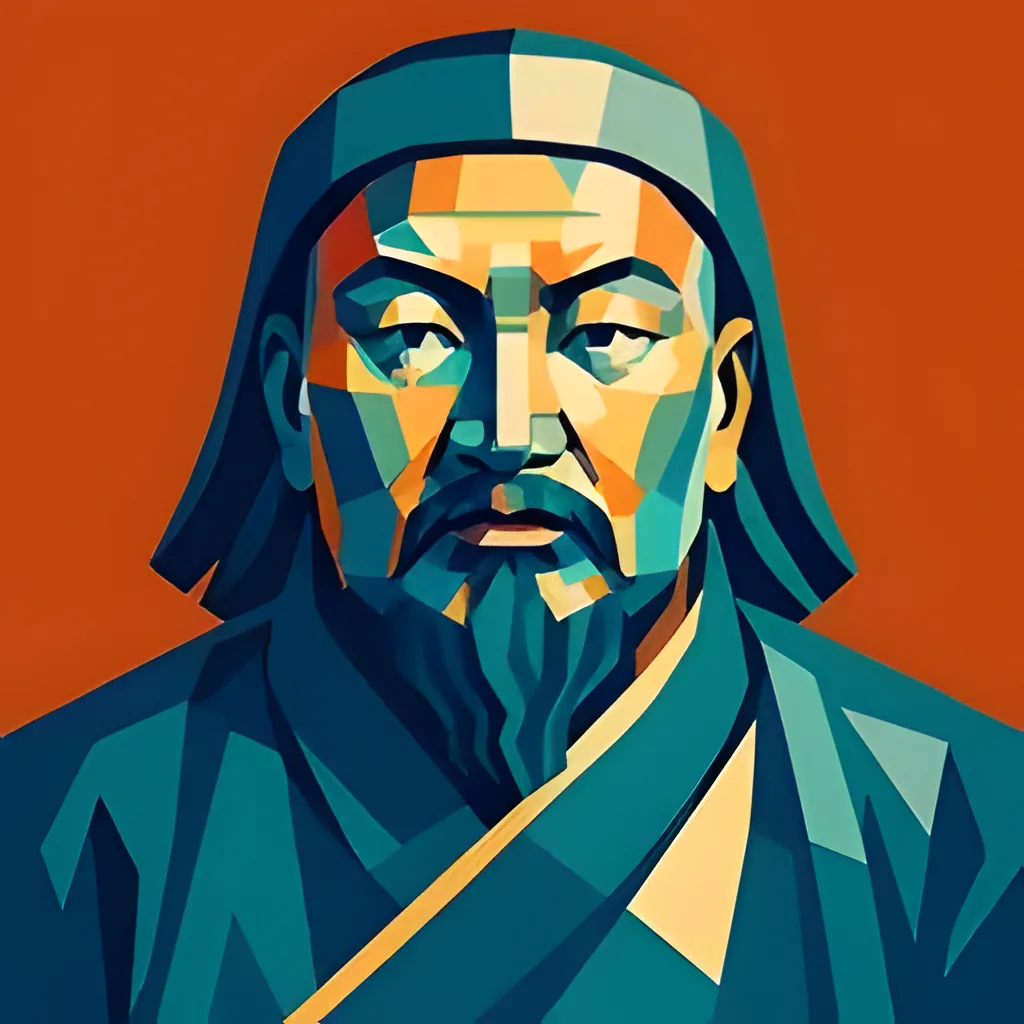
A life in brief
Genghis Khan: life and timeline.
His father was poisoned when he was nine, and the clan abandoned the family rather than follow a child. His mother Hoelun kept them alive on roots, fish and small game; he killed his half-brother over hunting spoils. Temüjin was a boy with no tribe. By 1206 a great assembly proclaimed him Genghis Khan, and he had rebuilt Mongol society around an idea his rivals found unthinkable: that ability, not birth, should decide who leads. The empire that followed was the largest contiguous land empire in history.
- 1162
Born on the steppe
Born around 1162 to Yesügei, a minor chief of the Borjigin clan, and named Temüjin — a name linked to the word for iron, though its precise meaning is debated. Legend says he was born clutching a blood clot, which shamans read as a sign of greatness.
- 1178
Marriage and abduction
Around 1178–1179 he marries Börte, the girl his father had betrothed him to. She is soon kidnapped by the Merkits. The rescue, aided by Toghril and Jamukha, cements his alliances and his reputation as a fighter.
- 1190
Building a following
Through the 1190s he expands his power base — sharing spoils generously, promoting on proven competence rather than birth, and forming a personal guard of elite warriors.
- 1201
The break with Jamukha
His blood brother is elected gurkhan by his opponents. The two men stand for rival visions: Jamukha for aristocratic birthright, Temüjin for a system where talent and loyalty outrank bloodline.
- 1204
The Naiman broken
Defeating the rival confederations leaves Temüjin the dominant power among the steppe tribes.
- 1206
Proclaimed Genghis Khan
A kurultai names him Chinggis Khan — a title often glossed as 'oceanic' or 'universal', though the meaning is disputed. Jamukha, betrayed by his own followers and offered clemency, asks instead for an honourable death and is granted it.
- 1209
Western Xia
Campaigns against the Western Xia kingdom in what is now northwestern China. The fighting pushes the Mongols to learn siege warfare, enlisting engineers from the peoples they conquer.
- 1227
Death on campaign
Dies in August during a final campaign against the Western Xia, possibly from a fall from his horse or from illness. His death is hidden until the army reaches Mongolia, and he is buried in an unmarked grave never found.
- 1234
The Jin fall
The northern Chinese dynasty he had ground down for years finally collapses under his successor Ögedei, seven years after his death.
- 1279
Greatest extent
Kublai's conquest of the Southern Song proves pivotal as the Mongol realms reach their widest reach — by now operating as semi-autonomous khanates.
Major achievements
Genghis Khan: major achievements.
- 01
Unification of the Mongol tribes
Dozens of tribes had spent generations fighting each other for pasture and plunder. By 1206 they answered to one man, and their energy pointed outward.
- 02
The decimal army
Units of ten, hundred, thousand and ten thousand — the tumen. It made the army flexible, and it deliberately cut across old clan lines so that loyalty ran to the unit and the Khan, not the tribal chief.
- 03
Promotion by merit
A radical break with steppe custom: ability decided rank, not noble birth. He gave commands to men of no standing and to former enemies who had proved themselves against him.
- 04
The Yam and the Silk Road
A relay postal system carried messages across enormous distances, and Mongol protection made long-distance trade safer and more profitable than it had been for centuries.
- 05
Religious tolerance
Rather than impose one faith, he consulted Christian, Muslim, Buddhist and Taoist leaders and let his subjects keep their religions — pragmatism that spared him the revolts persecution tends to produce.
Turning points
Genghis Khan: defining moments.
- Aged nine
The poisoning of his father
Tatars killed Yesügei on the road home from the betrothal ceremony, and the Borjigin refused to follow a child. Temüjin, Hoelun and the children were left on the steppe to survive on roots and small game. He came out of it self-reliant, cunning, and capable of killing his own half-brother over hunting spoils.
- c. 1178
Börte taken
The Merkits abducted his wife in revenge for an old grievance. Getting her back required calling in Toghril and Jamukha — and the campaign taught him that alliances, not individual strength, were what the steppe rewarded.
- 1201–1206
Killing his blood brother
Jamukha was his anda and his mirror image, and their split was ideological: birthright against merit. When Jamukha was finally handed over by his own men, Temüjin offered mercy and was asked for death instead. The steppe had only room for one vision.
- 1206
Rebuilding a society
Most conquerors stop at conquest. At the kurultai he immediately began dismantling the tribal structure that had produced him — reorganising the army by tens, promoting on ability, and binding men to units instead of clans. The reforms, not the victories, are why the empire outlived him.
What you’ll take away
Lessons from Genghis Khan’s life.
- 01
Take talent wherever it is
Birth decided everything on the steppe until he decided it wouldn't. He handed commands to nobodies and to enemies who had fought him well — and got an officer corps his rivals could not match.
- 02
Break the loyalties you inherited
The decimal units were an administrative trick with a political purpose: they cut across clan lines, so a soldier's allegiance ran to his ten, his thousand, and the Khan — never back to a tribal chief.
- 03
Borrow shamelessly
He did not export Mongol custom everywhere he went. He took siege engineers, technologies and administrative practice from the people he beat, which is how horse archers learned to crack walled cities.
Did you know
Facts about Genghis Khan.
- 01
Did you know that Genghis Khan established one of the first international postal systems, known as the Yam, which used a network of relay stations and horses across the empire?
- 02
Did you know that despite his reputation for brutal conquests, Genghis Khan decreed religious freedom throughout his empire, allowing Buddhists, Muslims, and Christians to practice openly?
- 03
Did you know that the location of Genghis Khan's tomb remains one of history's greatest unsolved mysteries, as legend says the soldiers who buried him were killed to keep it a secret?
If you liked Genghis Khan…
Browse all → King & Conqueror15 min
Alexander the Great
The Young Conqueror Who Built the Ancient World’s Greatest Empire
 Roman Statesman15 min
Julius Caesar
The Roman General Who Conquered Gaul and Changed History Forever
 French Emperor18 min
Napoleon Bonaparte
The Emperor Who Dominated Continental Europe and Changed History Forever
 European Commission President19 min
Ursula von der Leyen
From Doctor to Europe's Most Powerful Woman
FAQ
Frequently asked questions about Genghis Khan.
How did Genghis Khan succeed as a conqueror?
By organisation as much as force. He broke up old tribal loyalties and reorganised his army into units of ten, a hundred, a thousand and ten thousand, promoted commanders on merit, and fought with fast mounted archers supplied with spare horses. He used spies and messengers to plan campaigns, recruited engineers from conquered peoples to take walled cities, and offered cities a choice between surrender and destruction.
Where was Genghis Khan born?
On the steppe near the Onon River, in what is now north-eastern Mongolia, around 1162. He was named Temüjin and was the son of Yesügei, a minor chief of the Borjigin clan.
Was Genghis Khan his real name?
No. He was born Temüjin, reportedly named after a Tatar captive — a name associated with the word for iron, though its precise meaning is debated. 'Chinggis' (Genghis) Khan was the title given to him at the kurultai of 1206, often glossed as 'oceanic' or 'universal'.
How did Genghis Khan die, and where is he buried?
He died in August 1227 while campaigning against the Western Xia, possibly from injuries after a fall from his horse or from illness. His death was kept secret until the army returned to Mongolia. He was buried in an unmarked grave whose location is still unknown.
Are millions of people really descended from him?
Genetic studies have found a Y-chromosome lineage that expanded rapidly from the 13th century across regions once under Mongol rule, which suggests millions of living descendants. Tying that lineage specifically to Genghis Khan himself, however, remains unproven.
What was the Great Yassa?
A body of law credited to him, emphasising personal responsibility, loyalty to the Khan, and harsh punishment for theft and adultery. Later writers describe a single fixed code, but there is no firm evidence one existed — more likely a developing set of commands and norms that gave diverse subjects predictable rules.
Why did cities surrender to the Mongols without fighting?
Because he made terror do the work of siege engines. Reprisals against cities that resisted were allowed — even encouraged — to be reported ahead of the army, while those who submitted without resistance were offered mercy. The choice was deliberate, and it was often taken.
Published by Lyfestori, from Duck Pond Ventures Oy. About us and how to report a correction.
17 min · one sitting