Aristotle
The Master of Those Who Know
Born in Stagira in northern Greece in 384 BC, the son of a royal physician, Aristotle studied under Plato for twenty years, tutored the young Alexander the Great and founded the Lyceum in Athens — writing foundational works on logic, biology, ethics, politics and poetics.
- 22 min listen
- Founder of logic
- Father of biology
- The Lyceum
Aristotle’s full 22 min audio biography, The Master of Those Who Know, is available on Lyfestori for iOS. Listen to a free preview below.
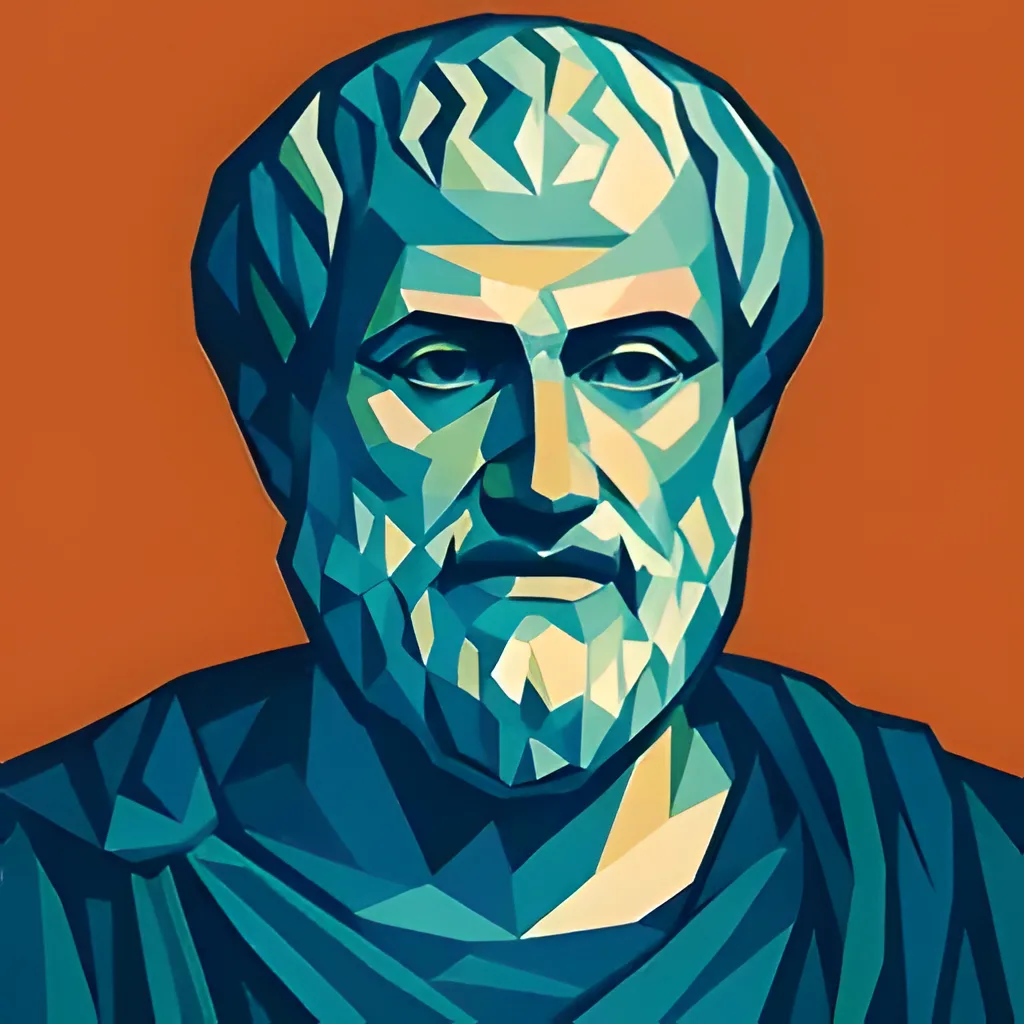
A life in brief
Aristotle: life and timeline.
Aristotle was a doctor's son who spent twenty years at Plato's Academy and concluded his teacher had it backwards: the essence of a horse is in the horse, not in some perfect Form elsewhere. So he went and looked. He dissected animals on Lesbos, described chick embryos correctly, worked out that dolphins are not fish, and had his students collect 158 constitutions. He invented formal logic along the way, tutored Alexander the Great, and left Athens rather than let it kill a second philosopher.
- 384
Born in Stagira (384 BC)
Born in a Greek city near the coast of Chalcidice. His father Nicomachus was personal doctor to King Amyntas III of Macedonia, so he grew up around medicine, bodies, plants and the habit of careful observation. Both parents died while he was young, and a guardian named Proxenus raised him and saw that he was educated.
- 347
Plato dies, and Aristotle leaves
After twenty years at the Academy, first as student and then as teacher, the leadership passes to Plato's nephew rather than to him. With anti-Macedonian feeling rising in Athens he goes to Assos, where Hermias invites him and where he marries Pythias, and then to Lesbos — dissecting sea creatures and building the systematic biology that becomes his greatest scientific work.
- 343
Tutor to Alexander
Philip II of Macedonia asks him to teach his thirteen-year-old son. He prepares a special edition of Homer's Iliad, which Alexander carries throughout his later conquests. What else he taught is unclear — no detailed records of the lessons survive.
- 336
Philip is assassinated
Alexander becomes king and turns to military conquest. The tutoring ends, and Aristotle is free to return to Athens and build the school he wants.
- 335
The Lyceum
He founds his school in a grove sacred to Apollo Lyceus. Where Plato's Academy focused on mathematics and abstraction, the Lyceum runs hands-on research across every field of knowledge, and keeps manuscripts, maps and biological specimens — one of the world's first research institutions.
- 323
Alexander dies; Athens turns
Anti-Macedonian sentiment sweeps Greece. As a Macedonian and Alexander's former tutor, he is charged with impiety — the same charge brought against Socrates seventy-six years earlier. He leaves rather than stand trial, retiring to Chalcis.
- 322
Death in Chalcis
He dies on the island of Euboea, where his mother's family had property, aged sixty-two. The cause is uncertain, though it may have been a stomach ailment that had troubled him for some time.
Major achievements
Aristotle: major achievements.
- 01
Formal logic
Before him people reasoned intuitively, with no rules for telling a valid argument from an invalid one. He built the first comprehensive system — the syllogism, the valid forms, and the fallacies to avoid. It remained the standard treatment of the subject for over two thousand years.
- 02
The father of biology
He studied over five hundred animal species and dissected many of them, making observations not improved upon for centuries: the development of chick embryos, the connection between mother and fetus in sharks, and the fact that whales and dolphins are mammals rather than fish.
- 03
The Lyceum
A school built for hands-on research across biology, physics, astronomy, weather, psychology, politics, ethics, rhetoric and poetry, holding collections of manuscripts, maps and specimens. It outlived him by centuries.
- 04
The study of constitutions
He and his students collected and analysed the constitutions of 158 states to work out what makes a government succeed or fail. He classified regimes by who rules and in whose interest, and argued humans are political animals who need a community to reach their potential.
- 05
Virtue as a skill
The good life means developing virtue through practice — you become a good person the way you become a good musician. Virtue usually sits between extremes: courage between cowardice and recklessness, generosity between stinginess and waste.
- 06
A method for inquiry
Collect everything known on a topic, including what previous thinkers said; find the problems and contradictions; then reason out your own solution. Respect for tradition combined with critical analysis became the model for scholarly research.
Turning points
Aristotle: defining moments.
- Twenty years at the Academy
Disagreeing with Plato
He arrived at seventeen and stayed two decades, student and then teacher. Plato taught that the world we see is a shadow of perfect Forms, and that true knowledge comes from pure reason rather than from the imperfect physical world. Aristotle concluded the essence of a thing is in the thing: a horse is a horse because it has what makes a horse, not because it copies a Form. That one disagreement is why he went out and looked — and it became the foundation of experimental science.
- 347 BC
Passed over
When Plato died, many expected Aristotle to take over the Academy. It went to Plato's nephew. The disappointment, with anti-Macedonian feeling in Athens, pushed him out of the city — into the travelling years at Assos and Lesbos, where he did the biological research that made his name. The rejection produced the work.
- 343–336 BC
The tutor and the conqueror
Philip II handed him a thirteen-year-old boy. Aristotle believed Greek culture superior and thought some people naturally suited to slavery; Alexander would go on to treat conquered peoples as equals and adopt their customs. The student rejected his teacher's politics and kept the respect — funding his research, and, several ancient writers report, sending back unusual plants and animals from the campaigns.
- 323 BC
Not twice against philosophy
Alexander's death turned Aristotle's Macedonian connections into a liability overnight. Charged with impiety — the charge that had killed Socrates seventy-six years before — he left rather than face trial. He reportedly said he would not allow the Athenians to sin twice against philosophy.
What you’ll take away
Lessons from Aristotle’s life.
- 01
Go and look
Plato reasoned from the armchair toward perfect Forms. Aristotle dissected five hundred species. The disagreement about where essence lives is what sent him to the shore at Lesbos — and that is where biology started.
- 02
Read your opponents first
His method began by collecting everything known on a subject, including the views of the thinkers he intended to refute, and then finding the contradictions. Respect for what came before, plus the willingness to break with it.
- 03
Method outlives conclusions
His physics was largely wrong and his defence of slavery was indefensible. Galileo's experiments demolished much of the rest. What survived twenty-four centuries was not his answers but how he asked: observe, classify, reason, revise.
Did you know
Facts about Aristotle.
- 01
Did you know that Aristotle was hired by King Philip II of Macedon to tutor his son, the future Alexander the Great?
- 02
Did you know that Aristotle's school in Athens, the Lyceum, had a famous 'Peripatetic' tradition where he would walk through the groves while teaching his students?
- 03
Did you know that Aristotle is considered the founder of formal logic and significantly shaped Western scientific thought for nearly two millennia?
If you liked Aristotle…
Browse all →
FAQ
Frequently asked questions about Aristotle.
Who was Aristotle's teacher?
Plato. Aristotle joined Plato's Academy in Athens at about seventeen and stayed for twenty years, until Plato's death in 347 BC. He went on to reject his teacher's theory of Forms, arguing that the essence of a thing is found in the thing itself.
Why is Aristotle called the father of biology?
Because he was the first to study living things systematically by observing them. On the island of Lesbos he dissected animals, described hundreds of species, followed the development of chick embryos and classified animals into groups — work that remained the foundation of biology for nearly two thousand years.
How did Aristotle die?
Of an illness, probably a stomach complaint, in 322 BC at Chalcis on the island of Euboea, aged about sixty-two. He had left Athens the year before, after Alexander's death turned the city against anyone with Macedonian ties.
Did Aristotle really teach Alexander the Great?
Yes. Philip II invited him in 343 BC to tutor his thirteen-year-old son, and he taught him for several years. No detailed records of the lessons survive. We do know he prepared a special edition of Homer's Iliad that Alexander carried throughout his conquests, and he likely taught politics, ethics, literature and natural philosophy.
How did Aristotle disagree with Plato?
About where reality lives. Plato held that the physical world is a shadow of eternal, perfect Forms knowable only through pure reason. Aristotle argued that the essence of a thing exists within the thing itself — a horse is a horse because it possesses the characteristics that make it one. That is why he studied the physical world so closely, and it became the foundation of experimental science.
What is a syllogism?
Aristotle's form of reasoning: two premises and a conclusion. If the premises are true and the reasoning follows a valid form, the conclusion must be true as well. He identified which forms were valid and studied fallacies so people could spot errors in reasoning. His logic stood as the standard treatment for over two thousand years.
What is the golden mean?
Aristotle's idea that virtue usually lies between two extremes. Courage is the mean between cowardice and recklessness; generosity lies between stinginess and wasteful spending. He treated virtue not as something you have or lack but as a skill developed through practice.
Why did Aristotle leave Athens at the end of his life?
Alexander's death in 323 BC set off anti-Macedonian feeling across Greece, and as a Macedonian and Alexander's former tutor he became a target of suspicion. Charged with impiety — the same charge brought against Socrates seventy-six years earlier — he chose to leave rather than face trial, retiring to Chalcis, where he died the following year.
Published by Lyfestori, from Duck Pond Ventures Oy. About us and how to report a correction.
22 min · one sitting