Plato
The Philosopher Who Shaped Western Thought
Born into an aristocratic Athenian family around 428 BC, Plato became Socrates' most famous student, founded the Academy — often called the first university in the Western world — and wrote dialogues such as the Republic that set the agenda for Western philosophy.
- 15 min listen
- The Academy
- Theory of Forms
- Ancient Greek philosophy
Plato’s full 15 min audio biography, The Philosopher Who Shaped Western Thought, is available on Lyfestori for iOS. Listen to a free preview below.
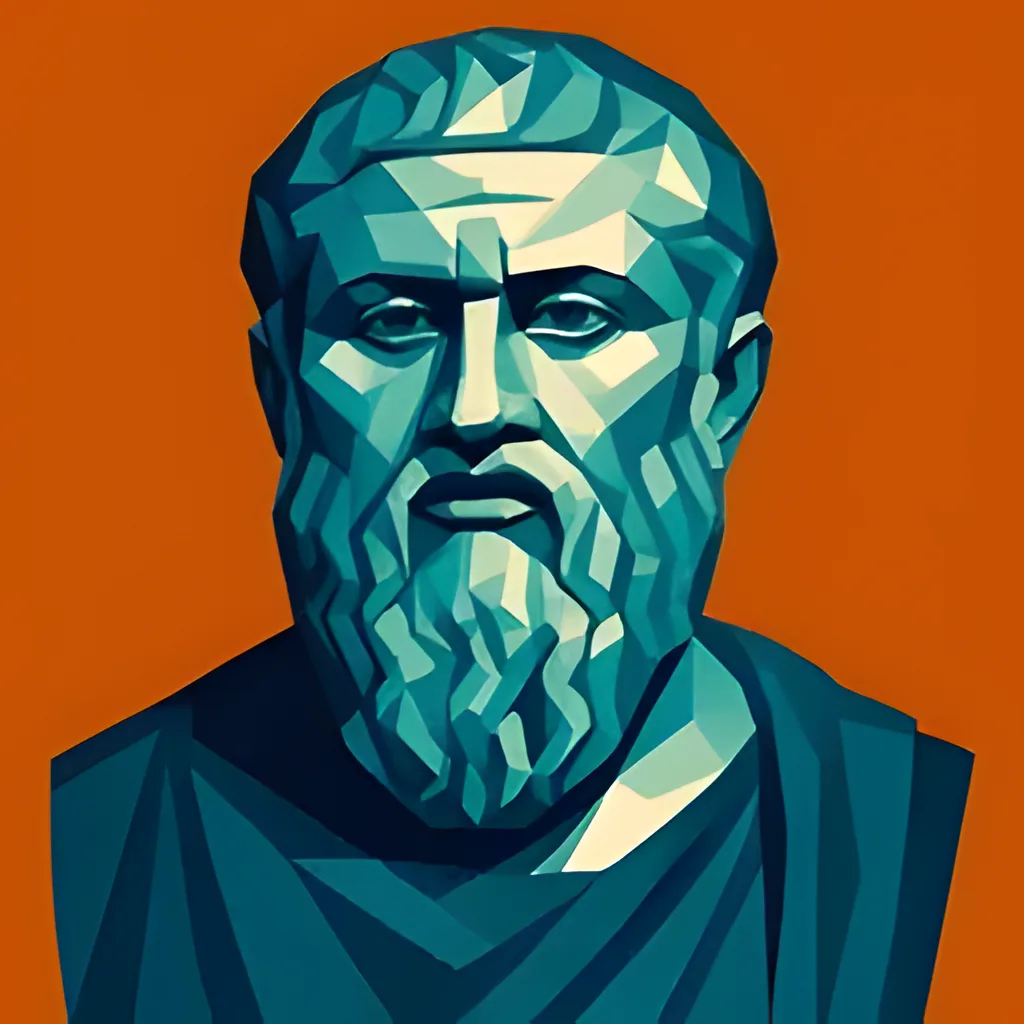
A life in brief
Plato: life and timeline.
An Athenian aristocrat, groomed for politics, watched his city vote to execute the wisest man in it. Plato never entered public life. Instead he spent decades asking what a just society would actually look like, and answered in dialogues where Socrates does the talking and nobody is simply told what to think. Around 387 BC he founded the Academy in a grove sacred to the hero Akademos. His student Aristotle stayed twenty years, then rejected his central theory.
- 428
Born in Athens (c. 428 BC)
Born in the early years of the Peloponnesian War into one of the city's most prominent families. His father Ariston was said to claim descent from the early kings of Athens; his mother Perictione was traditionally linked to Solon the lawgiver. His given name may have been Aristocles — 'Plato' meant broad, though nobody is certain whether that referred to his build or his style.
- 399
The death of Socrates
Socrates is tried for corrupting the youth and for not acknowledging the city's gods while introducing new religious practices. Friends arrange his escape; he refuses it and drinks the hemlock. Plato had followed him around Athens for years, listening.
- 399
Leaving Athens
He goes abroad rather than into office. He certainly reaches Sicily more than once, and ancient sources place him in southern Italy, where he may have met the Pythagoreans and their rigorous moral and intellectual discipline. Reports of study with Egyptian priests are not securely documented.
- 387
The Academy
He returns to Athens and founds a school in a grove sacred to the hero Akademos. Not a university in the modern sense, but the leading centre of philosophy and mathematics in the Greek world, drawing figures like Eudoxus of Cnidus and Theaetetus.
- 348
Death in Athens (c. 348 BC)
He dies around 348 or 347 BC, probably in his early eighties and reportedly still working at the Academy. His last work, The Laws, is markedly more practical than The Republic — an old man still revising.
- 86
Sulla destroys the Academy
The Roman general razes Plato's original school more than 250 years after his death. A later Athenian Neoplatonic school, inspired by his tradition, survives until 529 AD.
Major achievements
Plato: major achievements.
- 01
The Theory of Forms
The claim that the physical world is a shadow of an eternal realm of perfect ideas — that a beautiful thing is beautiful only by participating in the Form of Beauty. It was his answer to how we can know universal concepts in a world where nothing stays still.
- 02
The Academy
Founded around 387 BC and the most important centre of learning in the Greek world, running for centuries until Sulla destroyed it in 86 BC. Its insistence on geometric proof and rigorous reasoning shaped how the ancient world taught mathematics and astronomy.
- 03
The dialogues
He wrote conversations, not treatises — the Apology on Socrates' defence, the Meno on whether virtue can be taught, the Phaedo on the soul, and The Republic on justice. The form lets several positions argue, and puts the reader inside the thinking instead of at the end of it.
- 04
The Republic
His account of a just state ruled by philosopher-kings trained from childhood to love wisdom over power, structured in three classes mirroring the three parts of the soul. The parallel between a just person and a just city is among the most influential ideas in political philosophy.
- 05
Teaching Aristotle
His most famous student spent twenty years at the Academy before founding the Lyceum and tutoring Alexander the Great — and before rejecting the Theory of Forms outright.
Turning points
Plato: defining moments.
- Late 5th century BC
Meeting Socrates
A young aristocrat headed for politics fell in with a man who questioned everyone claiming expertise and exposed the holes in what they said. Plato followed him for years, listening to him work on politicians, poets and craftsmen. It ended the political career before it started.
- 399 BC
The hemlock
Athens convicted his teacher and killed him, and Socrates would not take the escape his friends arranged. The question of how a city could execute its wisest citizen drove everything Plato wrote afterwards. He never sought office; he spent his life on what a just city would have looked like instead.
- After 399 BC
The years away
He left Athens and travelled the western Greek world, repeatedly to Sicily and reportedly to southern Italy. What he found among the Pythagoreans — a community organised around intellectual and moral discipline — fed directly into his later writing about ideal societies and philosopher-kings.
- c. 387 BC
Founding the Academy
Coming home, he built the institution instead of joining the city. It made philosophy a discipline with a place to be practised, and taught mathematics as the training ground: geometry accustoms the mind to eternal, unchanging truths rather than the shifting evidence of the senses.
What you’ll take away
Lessons from Plato’s life.
- 01
Ask instead of assert
He could have written treatises. He wrote conversations, usually with Socrates asking the questions, precisely so the reader has to do the work. It is the difference between being told a conclusion and being walked into one.
- 02
Train the mind on hard, abstract things
The Academy ran on geometry and arithmetic not because philosophers need sums, but because mathematics is practice at thinking about what does not change — the bridge from the unreliable world of the senses to the world of ideas.
- 03
Your best student should disagree with you
Aristotle spent twenty years there and then rejected the Theory of Forms, the centre of his teacher's system. Plato's Academy produced the man who dismantled it. That is what a school for thinking looks like when it works.
Did you know
Facts about Plato.
- 01
Did you know that 'Plato' was actually a nickname meaning 'broad', referring either to his physical build as a wrestler or the breadth of his forehead, while his real birth name was Aristocles?
- 02
Did you know that Plato founded the Academy in Athens around 387 BC, which is widely considered the very first university in the Western world?
- 03
Did you know that almost all of Plato's philosophical works are written as dialogues, essentially acting as stage plays where his teacher Socrates usually plays the main character?
FAQ
Frequently asked questions about Plato.
What was Plato's real name?
According to the ancient biographer Diogenes Laërtius, his given name was Aristocles, after his grandfather, and “Plato” — from the Greek platon, “broad” — was a nickname, perhaps for his broad shoulders or broad forehead. Many modern scholars doubt the story, and Plato may simply have been his name.
Who was Plato to Socrates?
His student and devoted follower. Plato spent his twenties in Socrates' circle, was shaken by his teacher's trial and execution in 399 BC, and made Socrates the main speaker in most of his dialogues — which is why much of what we know about Socrates comes through Plato.
How did Plato die?
Peacefully, as far as anyone knows, in Athens around 348 BC, aged about eighty. Ancient accounts disagree on the details — one says he died at a wedding feast, another in his sleep while writing.
What is Plato's Theory of Forms?
The idea that the physical world we see is only a shadow of a perfect, eternal realm of pure forms. A beautiful object is beautiful because it participates in the Form of Beauty; a just act reflects the Form of Justice. It was his explanation of how we can have real knowledge of universals like beauty, justice and goodness while living in a world where everything changes and nothing is perfect.
What is a philosopher-king?
Plato's answer in The Republic to who should govern. He argued that most people are unfit to rule because they are driven by desire for pleasure, wealth or glory, and that only philosophers — trained from childhood to love wisdom over power, and able to tell appearance from reality — can govern wisely. In democratic Athens, where every citizen was expected to take part in politics, this was a genuinely radical claim.
What was Plato's Academy?
A school he founded around 387 BC in a grove sacred to the hero Akademos. It was not a university in the modern sense, but it became the Greek world's leading centre for philosophy, mathematics, astronomy, ethics and politics, and attracted figures like Eudoxus of Cnidus and Theaetetus. Sulla destroyed it in 86 BC.
Why was Plato suspicious of democracy?
Athens, a democracy, tried and executed Socrates — his teacher and, as he saw it, the city's wisest citizen. That drove his lasting doubt about rule by the unqualified. The argument survives in modern debates about expertise versus popular opinion.
Published by Lyfestori, from Duck Pond Ventures Oy. About us and how to report a correction.
15 min · one sitting