Maryna Viazovska
The 23 Pages That Stunned the Mathematical World
Born on 2 December 1984 in Kyiv, Ukraine, Maryna Viazovska is the mathematician who in 2016 solved the sphere-packing problem in eight dimensions, and with collaborators in twenty-four — work that made her, in 2022, only the second woman to win the Fields Medal.
- 18 min listen
- Fields medallist
- Sphere packing
- EPFL professor
Maryna Viazovska’s full 18 min audio biography, The 23 Pages That Stunned the Mathematical World, is available on Lyfestori for iOS. Listen to a free preview below.
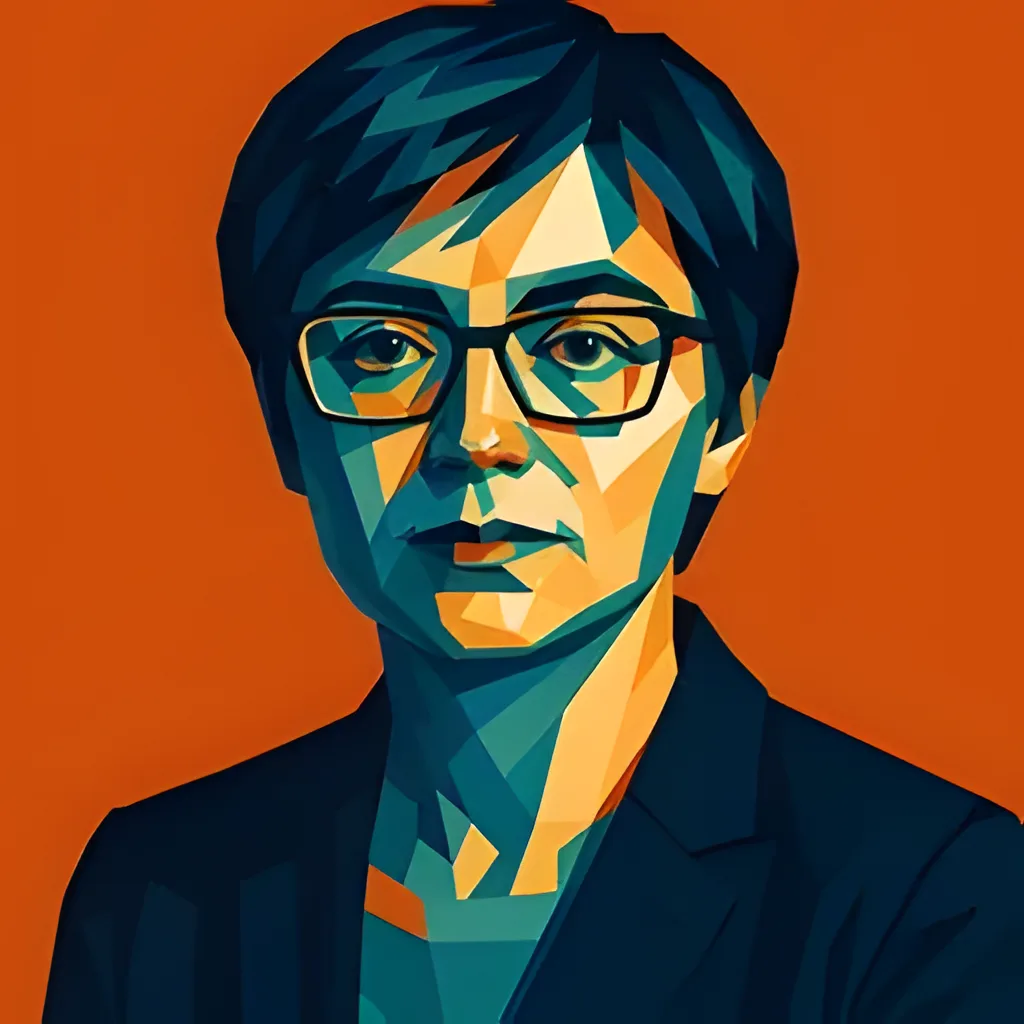
A life in brief
Maryna Viazovska: life and timeline.
She grew up in Kyiv in the 1990s, when the collapse of the Soviet Union left her mother's salary unable to buy a pair of shoes, and found in mathematics a place where things could be certain. Maryna Viazovska studied in Kyiv, Kaiserslautern and Bonn, where she learned the modular forms that became her tool. On 14 March 2016 she posted a twenty-three-page proof that the E8 lattice is the densest way to pack spheres in eight dimensions — a problem that had resisted everyone.
- 1984
Born in Kyiv
Born 2 December in Kyiv, then in the Soviet Union, the eldest of three sisters. Her father is a chemist at the Antonov aircraft factory and her mother an engineer.
- 1998
Lyceum No. 145
At thirteen enters the Kyiv Natural Science Lyceum No. 145, a specialist school for maths and science, where a former research mathematician, Andrii Knyazyuk, teaches beyond the curriculum.
- 2005
Degree in Kyiv
Graduates from Taras Shevchenko National University of Kyiv. As a student she competes four times at the International Mathematics Competition for University Students, winning first prizes in 2002 and 2005.
- 2007
Master's in Germany
Completes a master's degree at the University of Kaiserslautern, then returns to Kyiv for a doctorate at the Institute of Mathematics of the National Academy of Sciences of Ukraine, awarded in 2010.
- 2013
Doctorate in Bonn
Earns a second doctorate at the University of Bonn with a thesis on modular functions, supervised by Don Zagier and Werner Müller — the theory that would crack sphere packing.
- 2016
The eight-dimensional proof
On 14 March, Pi Day, she posts a twenty-three-page paper proving that the E8 lattice is the densest sphere packing in eight dimensions, using a 'magic function' built from modular forms.
- 2016
Twenty-four dimensions in a week
Days later, with Henry Cohn, Abhinav Kumar, Stephen D. Miller and Danylo Radchenko, she posts a proof that the Leech lattice is optimal in twenty-four dimensions. She wins the Salem Prize the same year.
- 2018
Professor at EPFL
Becomes a full professor and Chair of Number Theory at the École Polytechnique Fédérale de Lausanne in January, after a short tenure-track assistant professorship.
- 2019
Universal optimality
The same team of five shows that E8 and the Leech lattice minimise energy for a wide class of repelling forces — a stronger result, published in the Annals of Mathematics in 2022.
- 2022
Fields Medal
Weeks after Russia's full-scale invasion of Ukraine, she is awarded the Fields Medal at a ceremony moved from St Petersburg to Helsinki in July — the second woman to receive it, after Maryam Mirzakhani in 2014.
Major achievements
Maryna Viazovska: major achievements.
- 01
Sphere packing in eight dimensions
Her 2016 proof showed that E8, in which each sphere touches 240 others, is the densest packing possible in eight dimensions — finding the function Henry Cohn and Noam Elkies had described in 2003 but no one could construct.
- 02
Twenty-four dimensions
With four collaborators she extended the method to the Leech lattice within a week. Before 2016, the problem had been solved only in dimensions one, two and three.
- 03
Universal optimality
The 2022 Annals of Mathematics paper proved that E8 and the Leech lattice are the best arrangements of points for a broad range of physical interactions, not just for packing.
- 04
Major prizes
The Salem Prize (2016), Clay Research Award (2017), New Horizons in Mathematics Prize (2018), Fermat Prize (2019), EMS Prize (2020) and the Fields Medal (2022).
- 05
Supporting Ukrainian mathematics
Since the 2022 invasion she has used her profile to support Ukrainian mathematicians, including through the International Centre for Mathematics in Ukraine.
Turning points
Maryna Viazovska: defining moments.
- 1990s
Certainty in a time of collapse
Ukraine's economic crisis after 1991 made daily life unpredictable. She has described mathematics as a place where you can be sure of things, and her grandfather worked through problems with her for hours.
- 2007–2013
Learning modular forms
Doctoral work in Bonn under Don Zagier immersed her in modular forms, objects with built-in symmetry that most sphere-packing researchers had not thought to use.
- March 2016
Finding the magic function
Thomas Hales had needed a vast, computer-assisted proof for three dimensions. Her eight-dimensional argument was short enough for a skilled graduate student to follow, and experts confirmed it within days.
- 2022
A medal in wartime
The International Congress of Mathematicians was due to meet in St Petersburg. After Russia invaded Ukraine it moved online and the prize ceremony moved to Helsinki, where she received the medal as her country was under attack.
What you’ll take away
Lessons from Maryna Viazovska’s life.
- 01
Look where others haven't
The function sphere-packing experts had sought for more than a decade lay in modular forms — her own speciality, and a field few of them worked in.
- 02
Elegance is evidence of understanding
Twenty-three pages, no computer search, readable by a graduate student: the clarity of the proof was part of why it was accepted so quickly.
- 03
Collaboration multiplies a breakthrough
Saying yes to Henry Cohn's email the evening her paper appeared turned one solved dimension into two within a week.
If you liked Maryna Viazovska…
Browse all → Physicist & Chemist19 min
Marie Curie
Pioneer of Science and Champion of Discovery
 Computer Scientist16 min
Katie Bouman
The Computer Scientist Who Showed Us a Black Hole
 Theoretical Physicist21 min
Stephen Hawking
The Brilliant Mind That Unlocked the Secrets of the Universe
 Tech CEO17 min
Jensen Huang
The Dishwasher Who Built the AI Empire
FAQ
Frequently asked questions about Maryna Viazovska.
Who is Maryna Viazovska?
A Ukrainian mathematician and Fields medallist. She is a professor and Chair of Number Theory at EPFL in Lausanne, best known for solving the sphere-packing problem in eight dimensions in 2016.
When was Maryna Viazovska born?
On 2 December 1984, in Kyiv, Ukraine, then part of the Soviet Union. She is the eldest of three sisters.
What did Maryna Viazovska prove about sphere packing?
That the E8 lattice is the densest possible packing of identical spheres in eight dimensions. With four collaborators she then proved the same for the Leech lattice in twenty-four dimensions, using functions built from modular forms.
Why did Maryna Viazovska win the Fields Medal?
For her sphere-packing proofs and related work. The 2022 Fields Medal recognised her proof for dimension eight, her role in the twenty-four-dimensional proof, and further results in Fourier analysis.
What is Maryna Viazovska's education?
She studied at Taras Shevchenko National University of Kyiv (2005), took a master's at the University of Kaiserslautern (2007), a doctorate at the Institute of Mathematics in Kyiv (2010) and a second doctorate at the University of Bonn (2013).
Where does Maryna Viazovska work?
At EPFL, the École Polytechnique Fédérale de Lausanne in Switzerland. She has been a full professor there since January 2018.
Published by Lyfestori, from Duck Pond Ventures Oy. About us and how to report a correction.
18 min · one sitting