David Hume
The Scottish Philosopher Who Questioned Everything We Know
Born David Home on 26 April 1711 in Edinburgh, David Hume became the leading philosopher of the Scottish Enlightenment. His Treatise of Human Nature and Enquiries argued that reason is the slave of the passions and that our belief in cause and effect rests on habit — ideas that woke Kant from his “dogmatic slumber.”
- 16 min listen
- Scottish Enlightenment
- Empiricism
- Scepticism
David Hume’s full 16 min audio biography, The Scottish Philosopher Who Questioned Everything We Know, is available on Lyfestori for iOS. Listen to a free preview below.
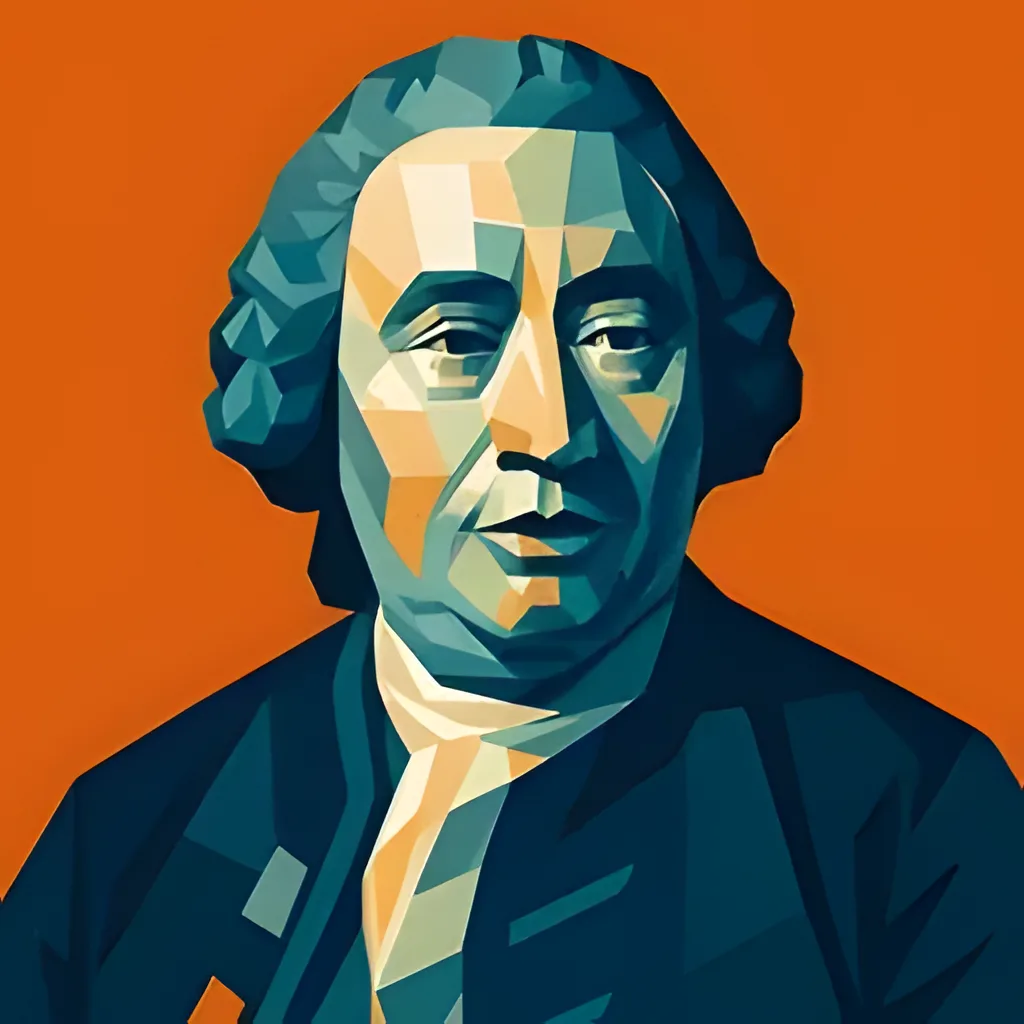
A life in brief
David Hume: life and timeline.
His father died when he was two. He entered the University of Edinburgh at eleven or twelve, left without a degree, tried a merchant's clerkship and hated it. At twenty-three he moved to France and spent three years writing A Treatise of Human Nature, which nobody read. Hume argued that we never actually observe causation — only one thing following another — and that our confidence the future will resemble the past has no rational basis. Twice rejected for professorships over his religious scepticism, he made his money writing history.
- 1711
Born in Edinburgh
Born 26 April into the minor Scottish nobility, the youngest of three. His father, Joseph Home of Ninewells, dies when David is two, leaving the family in modest circumstances. His devoutly religious mother raises the children in the strict Presbyterian tradition. As the youngest son, he will inherit nothing and must find his own way.
- 1726
Leaving university
Departs the University of Edinburgh around this year without taking a degree, having entered at about eleven or twelve. Dissatisfied with a curriculum he found reliant on old ideas and rigid methods, he read on his own instead — John Locke, and ancient sceptics like Sextus Empiricus.
- 1734
France
His family expected a lawyer; a merchant's clerkship in Bristol proved unbearable. At twenty-three he moves to La Flèche, the town whose Jesuit college Descartes had attended, and lives frugally on a small inheritance while he writes.
- 1739
A Treatise of Human Nature
Published across 1739 and 1740: an attempt to do for human nature what Newton did for physics, in three parts on understanding, emotions and morals. It is largely ignored — too dense, too difficult, too shocking in its conclusions.
- 1741
Essays, Moral and Political
Two volumes of shorter pieces in a more popular style. They succeed where the Treatise failed, establishing his reputation as a brilliant writer and thinker.
- 1746
Secretary to General St. Clair
After his post as tutor to the young Marquess of Annandale ends badly — the Marquess suffers a mental breakdown — he joins St. Clair's expedition against France at L'Orient. It achieves little militarily but gives him financial security and a view of the world.
- 1748
An Enquiry Concerning Human Understanding
Presents the Treatise's main arguments in clearer, more readable form. He also accompanies St. Clair on diplomatic missions to Vienna and Turin in 1748–1749.
- 1752
An Enquiry Concerning the Principles of Morals
The book he considered his best, written after moving back to Edinburgh to live with his sister Katherine. Moral judgements rest on sentiment rather than reason: we approve or disapprove by how actions make us feel.
- 1763
Paris
Serves as secretary to the British embassy for two years, later calling it among the happiest periods of his life. He is celebrated in the salons, befriends d'Alembert and Baron d'Holbach, and travels to Ferney to meet Voltaire.
- 1766
The Rousseau affair
He arranges for Rousseau, facing persecution, to come to Britain and accompanies him to England. Rousseau grows convinced Hume is part of a conspiracy against him. The public quarrel becomes one of the most famous intellectual controversies of the century.
- 1769
Retirement to Edinburgh
After a brief spell as Under-Secretary of State for the Northern Department, he returns to enjoy his fame and relative wealth, builds a house in the New Town, and becomes a central figure in the city's intellectual society.
- 1776
Death in Edinburgh
Dies 25 August, aged sixty-five, of an intestinal disorder he had met with composure. He is buried on Calton Hill in a mausoleum he arranged, under an inscription bearing only his name and dates.
Major achievements
David Hume: major achievements.
- 01
A Treatise of Human Nature
Written in France in his twenties: an attempt to do for human nature what Newton had done for physics, starting not from God or absolute truth but from careful observation of how the mind actually works. Ignored on publication, it is now among the most important books in philosophy.
- 02
The problem of induction
We expect the sun to rise because it always has. Hume showed we have no logical reason to believe the future will resemble the past — an argument that undermines much of what we take ourselves to know, and that remains foundational to the philosophy of science.
- 03
Dismantling causation
Watch one billiard ball strike another and you never see causation itself — only one event followed by another. Our belief in cause, he argued, comes from habit and custom rather than from logical reasoning.
- 04
History of England
The six-volume work of the 1750s that made him wealthy and famous throughout Europe — his most popular and financially successful publication in his lifetime, notable for its literary style and its attempt at impartiality between political and religious factions.
- 05
Morals founded on sentiment
In the 1752 Enquiry he argued that moral judgements are not derived from abstract logical principles at all. We approve and disapprove according to how actions make us feel. The idea went on to shape modern moral psychology and evolutionary approaches to ethics.
Turning points
David Hume: defining moments.
- 1734–1737
Leaving for France to write
His family expected him to take the traditional path for a younger son of the gentry and become a lawyer. He tried a mercantile clerkship in Bristol and found commerce — all practical detail and precedent — unsuited to a mind drawn to abstract questions about reality and knowledge. At twenty-three he left for La Flèche and spent three years on the Treatise.
- 1739–1748
Learning to be read
The book he had staked his twenties on was largely ignored; he complained it fell dead-born from the press. He did not blame the readers. He rewrote: the Essays of 1741 and 1742 in a popular style, then the Enquiry of 1748, which put the Treatise's arguments in clearer form. Those made his name.
- 1740s
The price of scepticism
He applied for professorships at Edinburgh and Glasgow and was rejected both times for his reputation as a religious sceptic. He never held an academic post, and supported himself as a tutor, a general's secretary and finally as a historian. His most devastating work on religion, the Dialogues Concerning Natural Religion, he decided not to publish while he was alive.
- 1763–1766
Paris, and then Rousseau
As embassy secretary he became a celebrity of the salons, befriended d'Alembert and d'Holbach, and went to Ferney to meet Voltaire — the happiest years of his life. Then he brought Rousseau to Britain to rescue him from persecution, and Rousseau decided Hume was conspiring against him. The quarrel became a European spectacle.
- 1776
Dying without a conversion
Many expected the famous sceptic to reach for Christianity at the end. He had an intestinal disorder, likely cancer, and met it with philosophical composure — Adam Smith, visiting, was struck by his cheerful resignation. He joked about what excuses he might give Charon for delaying the crossing. He died as he had argued, and it caused a sensation.
fell dead-born from the press
David Hume, on the reception of A Treatise of Human Nature
What you’ll take away
Lessons from David Hume’s life.
- 01
Follow the argument past where it gets expensive
He started from an almost obvious premise — knowledge comes through the senses — and pushed until it cost him causation, the external world, the self and God. Most people stop when the conclusion becomes uncomfortable. He did not, and it cost him two professorships.
- 02
If nobody reads it, that is your problem
The Treatise failed because it was dense and difficult. He did not blame the audience. He rewrote the same arguments as essays and an enquiry, and those made him famous across Europe.
- 03
Custom does the work we credit to reason
We believe the ball will move and the sun will rise not because we have proved anything, but because we have seen it often enough. Noticing how much of thinking is habit is the beginning of thinking carefully.
Did you know
Facts about David Hume.
- 01
Did you know that philosopher David Hume was denied a university professorship twice because of his reputation for being an atheist and skeptic?
- 02
Did you know that Hume worked as a librarian in Edinburgh, where the massive collection allowed him to write his monumental six-volume 'History of England'?
- 03
Did you know that near the end of his life, Hume calmly joked with friends about how he would negotiate with Charon, the mythical ferryman of the underworld, to delay his crossing?
If you liked David Hume…
Browse all → Philosopher15 min
John Locke
The Philosopher Who Shaped Modern Democracy
 Economist17 min
Adam Smith
The Father of Modern Economics Who Shaped How We Think About Wealth and Society
 Philosopher & Mathematician18 min
René Descartes
The Philosopher Who Taught the World to Think
 Pre-Socratic Philosopher22 min
Anaximander
The First Scientist
FAQ
Frequently asked questions about David Hume.
What is David Hume known for?
Radical empiricism and scepticism. He argued that all our ideas come from experience, that we can never observe causation — only one event regularly following another — and that morality is rooted in feeling rather than reason. He was also a celebrated historian: his six-volume History of England made his name in his lifetime.
What was David Hume's real name?
David Home. He changed the spelling to Hume in 1734, at twenty-three, because English speakers kept mispronouncing the Scottish surname, which was pronounced the same way.
How did David Hume die?
Of a long abdominal illness, probably cancer, at his home in Edinburgh on 25 August 1776, aged sixty-five. Visitors were struck by how cheerful he remained; James Boswell came hoping to see the famous sceptic waver at the end and found him calmly unbelieving.
What is Hume's problem of induction?
We constantly predict the future from the past — the sun will rise tomorrow because it has risen every day of our lives. Hume showed we have no logical reason to believe the future must resemble the past. The expectation comes from habit and custom, not from reasoning. Taken seriously, it undermines much of what we think we know about the world.
What did Hume say about causation?
That we never actually see it. Watching one billiard ball strike another and the second move, we observe only one event followed by another — never causation itself. Our belief that the first caused the second comes from having seen similar sequences many times, which is habit rather than rational justification.
What did Hume think about religion?
He argued we have no rational evidence for the existence of God or for miracles. In 'Of Miracles' he reasoned that since a miracle is by definition a violation of natural law, and our belief in natural laws rests on overwhelming experience, it is always more likely that a report of a miracle is false than that it occurred. His most devastating critique, the Dialogues Concerning Natural Religion, he chose not to publish in his lifetime. The reputation cost him professorships at both Edinburgh and Glasgow.
Did the Treatise make him famous?
No — it was largely ignored, and he complained that it fell dead-born from the press. It was dense and difficult, and its conclusions shocked readers. His fame came instead from the Essays of 1741 and 1742, the Enquiry of 1748, and above all the six-volume History of England, which made him wealthy and known throughout Europe.
How did Hume influence Kant?
Kant said that reading Hume awakened him from his 'dogmatic slumber' and inspired his own revolutionary philosophy. He spent years developing new theories specifically to answer Hume's sceptical challenges. In the twentieth century Hume's work also shaped logical positivism and analytic philosophy, and his analyses of causation and induction remain foundational to the philosophy of science.
Published by Lyfestori, from Duck Pond Ventures Oy. About us and how to report a correction.
16 min · one sitting