George Washington
The Man Who Could Have Been King
Born on 22 February 1732 at Pope's Creek in Westmoreland County, Virginia, George Washington led the Continental Army to victory in the American Revolution, presided over the Constitutional Convention and served as the first US president — and twice gave up power when he could have kept it, setting the precedent of civilian rule and peaceful transfer.
- 18 min listen
- Founding Father
- Commander in chief
- First US president
George Washington’s full 18 min audio biography, The Man Who Could Have Been King, is available on Lyfestori for iOS. Listen to a free preview below.
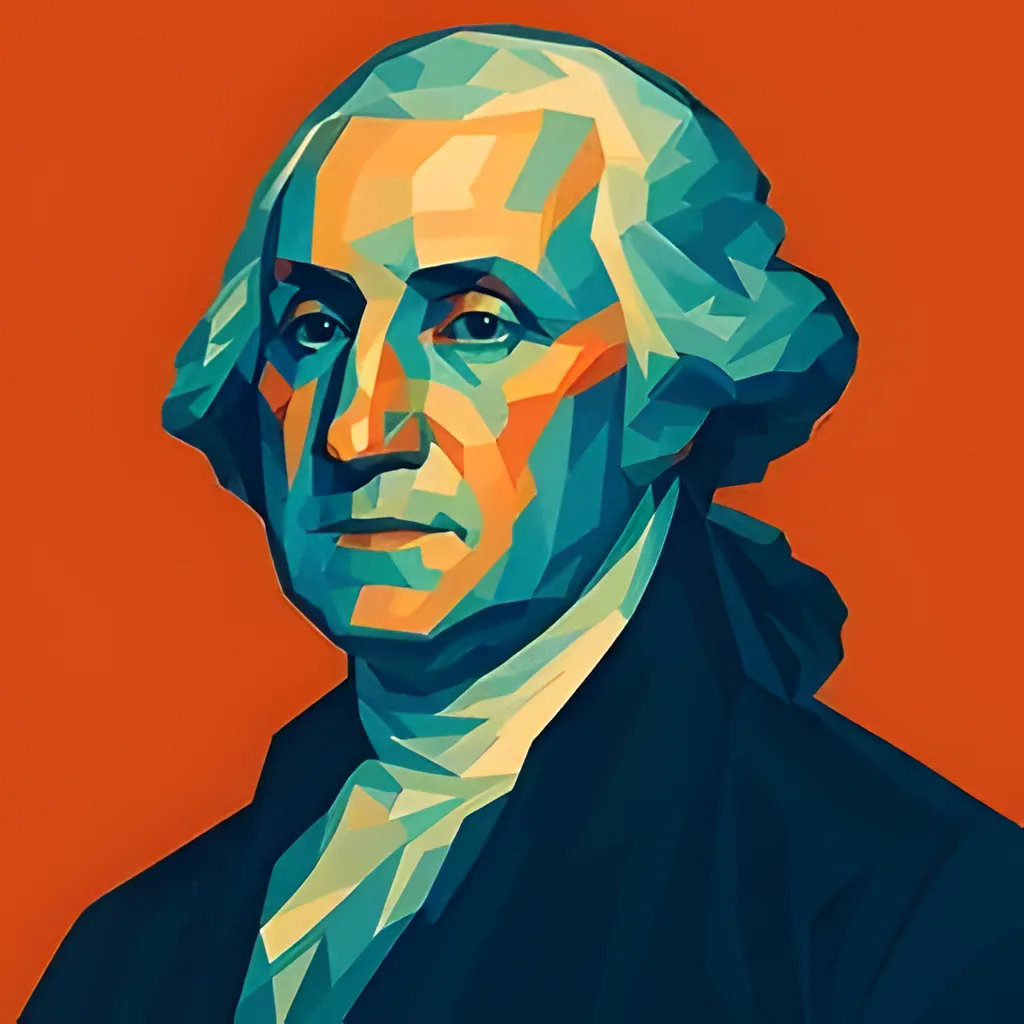
A life in brief
George Washington: life and timeline.
His father died when he was eleven, leaving no money for the English schooling his half-brothers had received. So George Washington learned surveying, and at seventeen was mapping Virginia's frontier for Lord Fairfax. At twenty-two he surrendered Fort Necessity. At twenty-three he rode through Braddock's defeat with two horses shot from under him. Twenty-eight years later, with a victorious army ready to defy Congress, he put on his spectacles at Newburgh and talked the officers down — then resigned his command and went home.
- 1732
Born at Pope's Creek
Born on 22 February in Westmoreland County, Virginia, to the planter Augustine Washington and Mary Ball Washington. Around six he moves with the family to Ferry Farm, near Fredericksburg.
- 1749
County surveyor at seventeen
After a surveying expedition into the Shenandoah Valley at sixteen for the Fairfax family, he is appointed surveyor of Culpeper County. Two years later, in Barbados, he survives smallpox — his only trip outside mainland North America.
- 1754
Jumonville Glen and Fort Necessity
His militia attacks a French detachment in the Ohio Country, an incident that helps ignite the French and Indian War. Weeks later he surrenders Fort Necessity — the only surrender of his military career.
- 1755
Braddock's defeat
At twenty-three he rides through heavy fire with two horses shot from under him and bullet holes through his coat, emerging unhurt. He is soon given command of Virginia's regiment.
- 1759
Marries Martha Custis
In January he marries Martha Dandridge Custis, a wealthy widow, and helps raise her children, Jacky and Patsy. For fifteen years he expands Mount Vernon, switches it from tobacco to wheat and sits in the House of Burgesses.
- 1775
Commander in chief
Proposed by John Adams, he is chosen unanimously by the Second Continental Congress to command the Continental Army. He declines a salary and asks only for expenses.
- 1776
Crossing the Delaware
On Christmas night, after disastrous defeats in New York, he leads his troops across the icy river and surprises the Hessian garrison at Trenton, taking nearly a thousand prisoners.
- 1781
Yorktown
With the French under Rochambeau he besieges Cornwallis, forcing the surrender of more than seven thousand British and German troops in October. His stepson Jacky dies of camp fever weeks later.
- 1783
Newburgh and resignation
In March he defuses the officers' revolt at Newburgh. On 23 December he resigns his commission before Congress in Annapolis and is back at Mount Vernon by Christmas Eve.
- 1789
First president
After presiding over the Constitutional Convention in 1787, he is elected president unanimously, and again in 1792. He builds the cabinet system and chooses the plain title "Mr. President".
- 1796
Farewell Address
Published in September, it warns against parties, sectionalism and permanent foreign alliances. He steps down after two terms, a precedent that holds until the 1940s.
- 1799
Death at Mount Vernon
After riding his farms in sleet on 12 December, he develops a severe throat infection. Bled repeatedly by his doctors, he dies on 14 December, aged sixty-seven. His will frees the 123 people he enslaved after Martha's death.
Major achievements
George Washington: major achievements.
- 01
Winning the Revolution
He lost more battles than he won, but held a starving, under-supplied army together through Valley Forge and struck at the right moments — Trenton in 1776, Yorktown in 1781.
- 02
Civilian control of the military
He refused Lewis Nicola's 1782 suggestion of a monarchy, stopped the Newburgh revolt in 1783 and resigned his command to Congress. King George III reportedly said that if he gave up power he would be the greatest man in the world.
- 03
Inventing the presidency
With no playbook, he created the cabinet system, the title "Mr. President" and the practice of executive restraint. He remains the only president elected with every electoral vote.
- 04
Keeping the young republic out of war
His 1793 Neutrality Proclamation kept the United States out of the war between Britain and revolutionary France, despite fierce pressure from Jefferson's supporters.
- 05
The two-term precedent
Stepping down in 1797 set an informal limit that held for nearly a century and a half until it was written into the Constitution by the Twenty-Second Amendment in 1951.
Turning points
George Washington: defining moments.
- 1743
His father's death
Augustine Washington's sudden death ended any prospect of an English education. Washington's half-brother Lawrence became his mentor and brought him into the circle of the Fairfaxes, who controlled about five million acres of Virginia. Surveying their land gave him money, frontier knowledge and an appetite for land.
- 1754–1755
Learning war by losing
Jumonville Glen, Fort Necessity and Braddock's rout taught him that war is chaos and that endurance counts as much as courage. His published journal of the Ohio mission had already made his name in Britain and America.
- March 1783
The spectacles at Newburgh
With officers furious over unpaid wages and anonymous letters hinting at defiance of Congress, his speech alone did not win the room. Struggling to read a letter, he put on his glasses and apologised for having grown grey and almost blind in service. Many officers wept, and the movement collapsed.
- 1796
Choosing to leave
He could have served for life. Instead he published the Farewell Address and handed the presidency to John Adams — the first peaceful transfer of executive power under the Constitution.
Gentlemen, you will permit me to put on my spectacles, for I have not only grown gray but almost blind in the service of my country.
George Washington at Newburgh, New York, 15 March 1783
What you’ll take away
Lessons from George Washington’s life.
- 01
Power proves itself by being returned
Washington's lasting authority came less from what he won than from what he handed back — his commission in 1783 and the presidency in 1797.
- 02
Endurance beats brilliance
He was not a great tactician. He kept an army from dissolving for eight years, and that turned out to be what victory required.
- 03
Private doubts are not public action
In letters he hoped for gradual abolition. In practice he rotated enslaved workers out of Pennsylvania to avoid its freedom law, hunted Ona Judge after she escaped and freed people only in his will.
- 04
Small gestures carry weight
At Newburgh a pair of spectacles did what an argument could not. The quiet moment is often the one people remember.
If you liked George Washington…
Browse all → Founding Father20 min
Benjamin Franklin
Lightning in a Bottle
 US President18 min
Abraham Lincoln
The Frontier Self-Made Man Who Saved a Nation
 French Emperor18 min
Napoleon Bonaparte
The Emperor Who Dominated Continental Europe and Changed History Forever
 European Commission President19 min
Ursula von der Leyen
From Doctor to Europe's Most Powerful Woman
FAQ
Frequently asked questions about George Washington.
Did George Washington have a middle name?
No. He was simply George Washington — middle names were uncommon among Virginians of his generation.
Where did George Washington grow up?
Mostly at Ferry Farm, on the Rappahannock River opposite Fredericksburg, Virginia. He was born at Pope's Creek in Westmoreland County and moved to Ferry Farm at about six; he later inherited Mount Vernon after his half-brother Lawrence's death.
How did George Washington die?
From a severe throat infection, now usually identified as acute epiglottitis, on 14 December 1799, aged sixty-seven. After riding in sleet two days earlier he struggled to breathe, and his doctors' repeated bleeding — perhaps 35 to 40 per cent of his blood — likely hastened his death.
Did George Washington have wooden teeth?
No. His dentures were made from ivory, human and animal teeth and metal. By his inauguration in 1789 he had one natural tooth left; the wooden myth probably came from the stained look of aged ivory.
Did George Washington own slaves?
Yes. At his death 317 enslaved people lived at Mount Vernon, 123 of them owned by him. His will freed those 123 after Martha's death; she freed them in 1801. The Custis dower slaves remained in bondage.
Did George Washington have children?
Not biologically. He raised Martha's children from her first marriage, Jacky and Patsy Custis, and later two of her grandchildren.
Why didn't George Washington sign the Declaration of Independence?
He was not in Congress. In July 1776 he was in New York commanding the Continental Army, preparing to defend the city against the British.
Did George Washington wear a wig?
No. He powdered his own reddish-brown hair and tied it back, following the fashion of the time.
Published by Lyfestori, from Duck Pond Ventures Oy. About us and how to report a correction.
18 min · one sitting