Friedrich Nietzsche
The Philosopher Who Declared God Dead
Born Friedrich Wilhelm Nietzsche on 15 October 1844 in Röcken, Prussian Saxony, Nietzsche was the philosopher who announced the death of God and asked what Europe would put in its place — with ideas such as the Übermensch, eternal recurrence and the will to power that shaped existentialism, psychology and modern thought.
- 19 min listen
- Philosopher
- Cultural critic
- Classical philologist
Friedrich Nietzsche’s full 19 min audio biography, The Philosopher Who Declared God Dead, is available on Lyfestori for iOS. Listen to a free preview below.
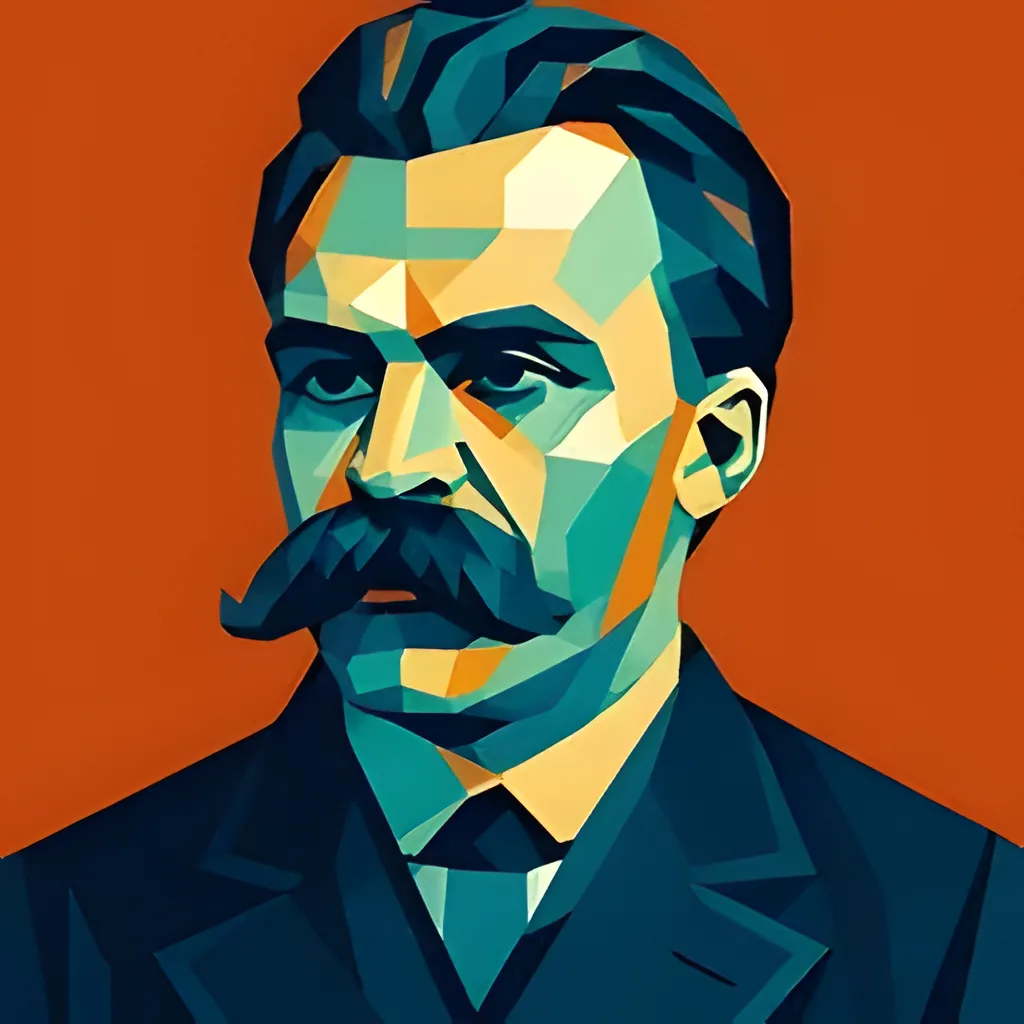
A life in brief
Friedrich Nietzsche: life and timeline.
The neighbours in Naumburg called him the little pastor: a solemn boy who recited Bible passages and played hymns, raised in a house of women after his father and baby brother died within six months of each other. At twenty-four he was a professor at Basel. At thirty-four, crippled by migraines, he resigned and spent a decade drifting between cheap rooms in Sils-Maria, Nice and Turin, writing books almost nobody bought. In January 1889 he collapsed in Turin. His sister then spent decades rewriting him.
- 1844
Born in Röcken
Born on 15 October, the birthday of King Friedrich Wilhelm IV of Prussia, after whom he is named. His father, Carl Ludwig, is the village's Lutheran pastor.
- 1849
His father dies
Carl Ludwig dies in July after months of neurological decline. Months later Friedrich's two-year-old brother, Joseph, also dies, and the family moves to Naumburg.
- 1858
Schulpforta
At fourteen he wins a place at the elite boarding school near Naumburg, steeping himself in Greek and Latin. As a student in Leipzig he later discovers Schopenhauer's The World as Will and Representation in a bookshop.
- 1868
Meets Richard Wagner
In November he meets the composer, thirty-one years his senior, in Leipzig. He becomes a regular guest at Tribschen, Wagner's home by Lake Lucerne.
- 1869
Professor at Basel
Appointed professor of classical philology at twenty-four, before completing a doctorate; Leipzig awards him one on the strength of his published work. He gives up his Prussian citizenship and never acquires Swiss.
- 1872
The Birth of Tragedy
His first book explains Greek tragedy as a clash of Apollonian order and Dionysian ecstasy, and hails Wagner as its rebirth. Ulrich von Wilamowitz-Moellendorff's attack, Future Philology!, damages his academic reputation.
- 1876
Bayreuth disillusion
The first Bayreuth Festival strikes him as pompous and nationalistic, and he leaves early. The notes he makes become Human, All Too Human, which effectively ends the friendship with Wagner.
- 1879
Leaves Basel
Migraines, vomiting and failing eyesight force his resignation at thirty-four. With a small pension he begins a decade of wandering — summers in Sils-Maria, winters in Genoa, Nice and Turin.
- 1882
Lou Salomé and The Gay Science
He proposes to the twenty-one-year-old Lou Salomé, who turns him down. The same year The Gay Science contains the madman's announcement that God is dead.
- 1883
Thus Spoke Zarathustra
Written in four bursts between 1883 and 1885, it introduces the Übermensch and develops eternal recurrence. The fourth part is privately printed in about forty copies.
- 1889
Collapse in Turin
On 3 January he breaks down in Turin. Franz Overbeck takes him to a Basel clinic; he moves on to Jena and then to his mother's care in Naumburg, never writing coherently again.
- 1900
Death in Weimar
Dies on 25 August, aged fifty-five, in the house where his sister Elisabeth has built the Nietzsche Archive. He is buried beside his father in Röcken.
Major achievements
Friedrich Nietzsche: major achievements.
- 01
The death of God
In The Gay Science (1882) he diagnosed Europe's loss of faith in the Christian picture underpinning its morality — and warned that keeping the morals without the God would lead to nihilism.
- 02
Thus Spoke Zarathustra
Part poem, part sermon, part philosophical drama, it introduced the Übermensch — the person who creates new values — and the test of eternal recurrence.
- 03
Genealogy of morals
He argued that moral values have histories and psychological origins, an approach that fed directly into Freud, Foucault and twentieth-century critiques of power.
- 04
The final burst of 1888
In his last productive year he wrote or completed The Case of Wagner, Twilight of the Idols, The Antichrist, Ecce Homo and Nietzsche contra Wagner.
- 05
A century of influence
Read and argued with by Freud, Jung, Thomas Mann, Camus, Sartre and Foucault, he became one of the unavoidable thinkers of existentialism and modern philosophy.
Turning points
Friedrich Nietzsche: defining moments.
- 1849–1850
Two deaths in Röcken
His father's slow neurological death, followed within months by his brother's, uprooted the family and left Friedrich in a household of women in Naumburg. In a childhood notebook he described dreaming that his father's grave opened and swallowed his little brother.
- 1876
Walking out of Bayreuth
The festival he had championed in print disgusted him with its nationalism and the anti-Semitism of Wagner's circle. His break with his surrogate father turned him from disciple into critic, and his style from rhapsody to sharp aphorism.
- August 1881
The rock by Lake Silvaplana
Walking near Sils-Maria, he said the thought of eternal recurrence came to him like a revelation: what if every moment of your life returned, exactly the same, forever? He noted it as "6000 feet beyond man and time" and built Zarathustra around the question.
- After 1889
Elisabeth takes the archive
Returned from the failed anti-Semitic colony Nueva Germania in Paraguay, his sister took control of his papers, edited and in places falsified letters, and assembled notebook fragments into The Will to Power. Her version helped the Nazis claim him, despite his repeated attacks on anti-Semites and German nationalism.
God is dead. God remains dead. And we have killed him.
Friedrich Nietzsche, The Gay Science (1882), §125, trans. Walter Kaufmann
What you’ll take away
Lessons from Friedrich Nietzsche’s life.
- 01
Removing a foundation has consequences
His point was not that God's death was a victory. It was that values built on a lost belief do not stand on their own, and someone has to do the work of building new ones.
- 02
Outgrow your heroes
Schopenhauer and Wagner made him; leaving them made his philosophy. His best work began when he turned against the man he had once called a second father.
- 03
Control of the archive is control of the person
For half a century, many readers met Elisabeth's Nietzsche rather than his own. It took Walter Kaufmann's 1950 study to separate the philosopher from the propaganda.
- 04
Write for readers who don't yet exist
Zarathustra's last part ran to about forty copies. Within decades of his death he was among the most read philosophers in the world.
If you liked Friedrich Nietzsche…
Browse all → Philosopher & Theologian18 min
Søren Kierkegaard
The Lonely Genius Who Invented the Modern Self
 Philosopher & Economist16 min
Karl Marx
The Revolutionary Thinker Who Reshaped Modern Society
 Philosopher15 min
Plato
The Philosopher Who Shaped Western Thought
 Philosopher16 min
Agnes Callard
The Philosopher Who Refuses to Stop Becoming
FAQ
Frequently asked questions about Friedrich Nietzsche.
What is Friedrich Nietzsche's full name?
Friedrich Wilhelm Nietzsche. He was named after King Friedrich Wilhelm IV of Prussia, who shared his birthday, 15 October.
Where was Friedrich Nietzsche born?
In Röcken, a village near Leipzig then in the Prussian Province of Saxony, now in Saxony-Anhalt, Germany. He grew up from the age of five in nearby Naumburg.
How did Friedrich Nietzsche die?
Of pneumonia, following a stroke, on 25 August 1900 in Weimar, aged fifty-five. He had been mentally incapacitated since his collapse in Turin in January 1889 and spent his last years cared for by his mother and then his sister.
Did Friedrich Nietzsche have syphilis?
It is not known. Syphilis was the standard diagnosis for decades, but it has never been proven, and modern researchers have proposed alternatives including a brain tumour, frontotemporal dementia and the hereditary stroke disorder CADASIL.
What did Friedrich Nietzsche mean by "God is dead"?
That belief in the Christian God had collapsed among educated Europeans, even if they had not yet faced the consequences. In The Gay Science the madman who announces it is frightened, not triumphant — he fears that morality, truth and meaning built on that belief will fall into nihilism.
Was Friedrich Nietzsche a Nazi?
No. He died in 1900 and repeatedly attacked anti-Semites and German nationalism. His sister Elisabeth, a nationalist and anti-Semite, edited his papers selectively and welcomed Hitler to the Nietzsche Archive in the 1930s.
Did Friedrich Nietzsche have children?
No. He never married. His one known proposal, to Lou Salomé in 1882, was turned down.
Was Friedrich Nietzsche German?
He was born a Prussian German, but legally stateless from 1869. He renounced his Prussian citizenship to take up his Basel professorship and never became a Swiss citizen.
Published by Lyfestori, from Duck Pond Ventures Oy. About us and how to report a correction.
19 min · one sitting