Søren Kierkegaard
The Lonely Genius Who Invented the Modern Self
Born Søren Aabye Kierkegaard on 5 May 1813 in Copenhagen, Søren Kierkegaard wrote Either/Or, Fear and Trembling and The Sickness Unto Death under a cast of pseudonyms. His analysis of anxiety, despair and individual choice shaped Heidegger, Sartre, Kafka and modern theology, earning him the title of father of existentialism.
- 18 min listen
- Philosopher
- Father of existentialism
- Religious writer
Søren Kierkegaard’s full 18 min audio biography, The Lonely Genius Who Invented the Modern Self, is available on Lyfestori for iOS. Listen to a free preview below.
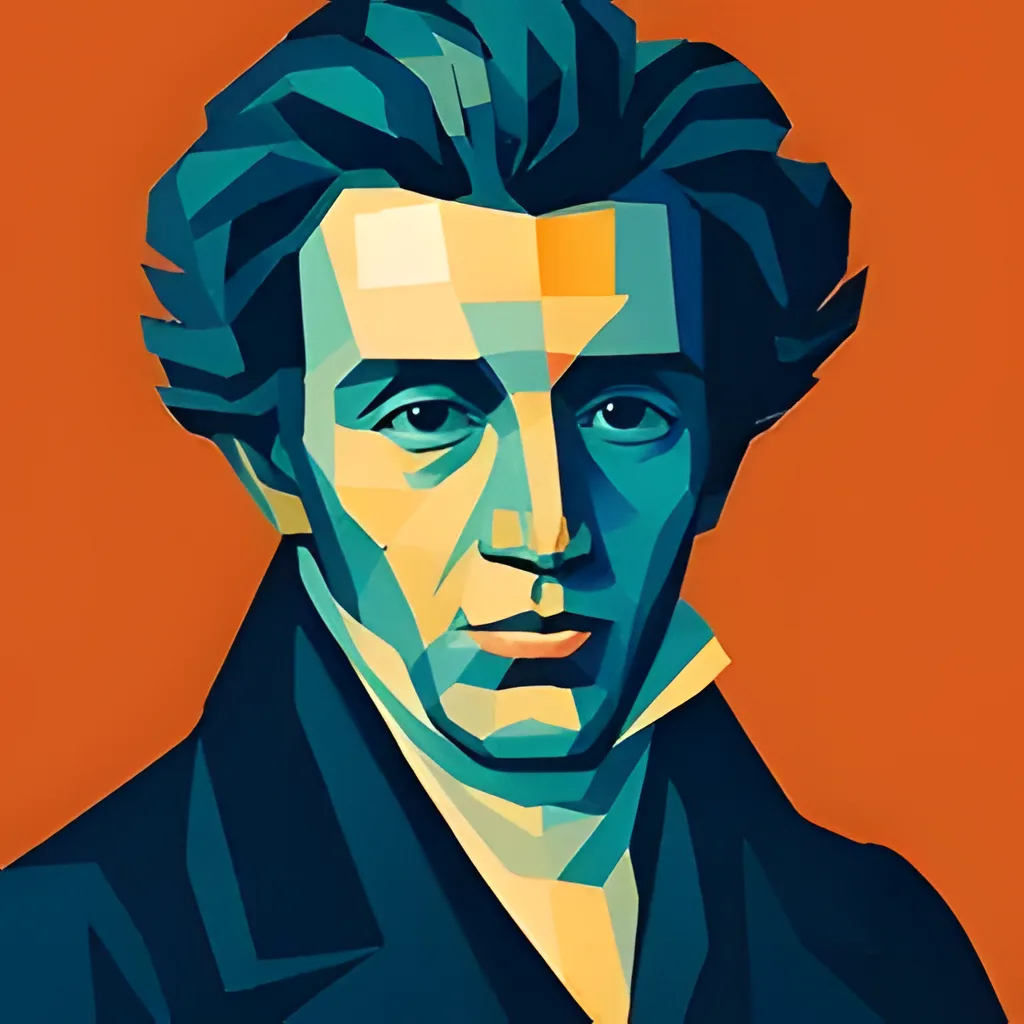
A life in brief
Søren Kierkegaard: life and timeline.
His father had cursed God on a Jutland heath as a hungry boy and spent the rest of his life waiting for the punishment. Søren Kierkegaard, the youngest of seven children, inherited the melancholy and a fortune that let him write without a profession. In 1841 he broke off his engagement to Regine Olsen, fled to Berlin and began writing at a furious pace under invented names. Mocked by a satirical paper, then at war with Denmark's church, he died at forty-two — and the twentieth century made him the father of existentialism.
- 1813
Born in Copenhagen
Born 5 May, the seventh and youngest child of Michael Pedersen Kierkegaard, a wealthy wool merchant haunted by religious guilt. His father trains him in imagination through long invented walks around the city, without leaving the room.
- 1830
University of Copenhagen
Enrols to study theology, then drifts into the cafés and salons of Copenhagen's literary Golden Age. He drinks, runs up debts his father quietly pays, and earns the nickname "the Fork" for his wit.
- 1838
His father dies
Michael Kierkegaard dies in August after Søren has drawn close to him again following the crisis he called the "great earthquake". The inheritance, roughly 31,000 rigsdaler, frees him to write for the rest of his life.
- 1841
Irony and a broken engagement
Defends his dissertation On the Concept of Irony with Continual Reference to Socrates on 29 September, written in Danish by special permission. Weeks later he breaks off his engagement to Regine Olsen and leaves for Berlin to hear Schelling lecture.
- 1843
Either/Or
Publishes the two-volume Either/Or under the editorship of the pseudonymous "Victor Eremita", including the notorious "Diary of a Seducer". Fear and Trembling and Repetition follow the same year.
- 1844
The Concept of Anxiety
Publishes Philosophical Fragments and The Concept of Anxiety, which treats anxiety not as illness but as something bound up with human freedom.
- 1846
The Corsair affair
After he dares the satirical weekly The Corsair to attack him, it lampoons his hair, voice and uneven trouser legs for months. The same year he publishes the massive Concluding Unscientific Postscript.
- 1847
Works of Love
Publishes Works of Love. In November, Regine Olsen marries Johan Frederik Schlegel; Kierkegaard later names her as heir in his will.
- 1849
The Sickness Unto Death
Under the pseudonym Anti-Climacus, defines despair as a misrelation of the self to itself — and argues the worst despair is the kind a person does not know they have.
- 1854
War on the church
After Bishop Mynster's death, his successor Hans Lassen Martensen praises him as a "witness to the truth". In December Kierkegaard begins a public attack on the established church in Fædrelandet, continued in his own periodical, The Moment.
- 1855
Death at forty-two
Collapses in the street on 2 October and dies at Frederiks Hospital on 11 November, having refused communion from a state-church pastor. At his burial in Assistens Cemetery, his nephew Henrik Lund protests that the church has no right to claim him.
Major achievements
Søren Kierkegaard: major achievements.
- 01
Founding existentialism
Long before the word existed, he argued that the decisive question is not what to think but how to live. Heidegger, Sartre and Camus all worked in territory he had opened.
- 02
A vocabulary for the inner life
Anxiety as the dizziness of freedom, despair as a failure to become oneself, the leap of faith. His terms still frame how psychologists, theologians and novelists talk about the self.
- 03
The pseudonymous method
Victor Eremita, Johannes de Silentio, Johannes Climacus — he wrote through invented authors with their own worldviews, letting readers inhabit the aesthetic, ethical and religious ways of existing rather than be lectured about them.
- 04
An astonishing output
Either/Or, Fear and Trembling, Repetition, Philosophical Fragments, The Concept of Anxiety, Stages on Life's Way and the Concluding Unscientific Postscript all appeared between 1843 and 1846.
- 05
Reshaping modern theology
His insistence on the infinite qualitative difference between God and humanity fed Karl Barth's dialectical theology, and his attack on comfortable "Christendom" stayed with Dietrich Bonhoeffer through his resistance to the Nazis.
Turning points
Søren Kierkegaard: defining moments.
- Late 1830s
The great earthquake
His journals record a shattering discovery about his father's guilt — perhaps the childhood curse against God, perhaps sexual guilt surrounding his second marriage. Scholars still debate what it was. It drove Søren back towards his father and towards serious study of theology.
- 1841
Giving back the ring
Just over a year into his engagement to Regine Olsen, he ended it, convinced his melancholy would make her unhappy. To help her move on he played the cad in public. The wound became the hidden centre of much of what he wrote next.
- 1846
Ridiculed by The Corsair
A feud with the critic P. L. Møller led him to dare The Corsair to attack him, and it did, for months. His daily walks through Copenhagen became an ordeal, and his plan to stop writing and become a country pastor was abandoned.
- 1854–1855
The attack on Christendom
When Martensen called the late Bishop Mynster a "witness to the truth", Kierkegaard waited almost a year, then went to war. In newspaper articles and The Moment, which he financed himself, he argued that Denmark's state church had replaced New Testament Christianity with social respectability.
The thing is to find a truth which is true for me, to find the idea for which I can live and die.
Journal entry, Gilleleje, 1 August 1835
What you’ll take away
Lessons from Søren Kierkegaard’s life.
- 01
The crowd cannot choose for you
Kierkegaard spent his life arguing that opinions borrowed from the public, the church or the newspapers are a way of hiding. The question that matters is who you are when you are alone with yourself.
- 02
Anxiety is a sign of freedom
He read the vertigo of having choices not as weakness but as evidence that our choices count. The discomfort is the price of being a responsible person.
- 03
Ridicule can sharpen a mind
Turned into a public joke by The Corsair, he went inward and wrote Works of Love and The Sickness Unto Death — books more penetrating than anything he had written before.
- 04
Influence can arrive late
He died with small print runs, no school and no disciples. His readers turned out to be a century away: Kafka, Heidegger, Sartre and Bonhoeffer.
If you liked Søren Kierkegaard…
Browse all →
FAQ
Frequently asked questions about Søren Kierkegaard.
What was Søren Kierkegaard's full name?
Søren Aabye Kierkegaard. He was born on 5 May 1813 in Copenhagen, the youngest of seven children of the wool merchant Michael Pedersen Kierkegaard and Ane Sørensdatter Lund.
How did Søren Kierkegaard die?
After a collapse in the street on 2 October 1855, he died at Frederiks Hospital in Copenhagen on 11 November, aged forty-two. No autopsy was performed; later suggestions include a form of spinal tuberculosis, but the cause has never been settled.
What nationality was Søren Kierkegaard?
Danish. He was born, lived and died in Copenhagen, and wrote in Danish — even obtaining permission to submit his doctoral dissertation in Danish rather than Latin.
Was Søren Kierkegaard a Christian?
Yes. He was a deeply religious Lutheran thinker, but a fierce critic of the Danish state church. In his final year he attacked what he called "Christendom" and refused communion from an established-church pastor on his deathbed.
Was Søren Kierkegaard ever married?
No. He was engaged to Regine Olsen but broke off the engagement in 1841, and he had no children. Regine married Johan Frederik Schlegel in 1847, and Kierkegaard named her as heir in his will.
Why is Søren Kierkegaard called the father of existentialism?
Because he put the individual's lived choices — anxiety, despair, commitment — at the centre of philosophy. Heidegger, Sartre and Camus later built on or argued with the questions he opened.
Where is Søren Kierkegaard buried?
In Assistens Cemetery in the Nørrebro district of Copenhagen. His burial on 18 November 1855 was interrupted by his nephew Henrik Lund, who protested that the church had no right to bury a man who had denounced it.
What is Søren Kierkegaard's best-known book?
Either/Or, published in 1843, made his name. Fear and Trembling, on Abraham's willingness to sacrifice Isaac, and The Sickness Unto Death are among the most widely read today.
Published by Lyfestori, from Duck Pond Ventures Oy. About us and how to report a correction.
18 min · one sitting