Yuval Noah Harari
The Monk Who Wrote the History of Everything
Born on 24 February 1976 in Kiryat Ata, Israel, Yuval Noah Harari is a historian at the Hebrew University of Jerusalem whose Sapiens retold the human story as one of shared fictions — gods, money and nations. Through Homo Deus, 21 Lessons for the 21st Century and Nexus, he has become a leading voice warning about artificial intelligence.
- 19 min listen
- Historian
- Author of Sapiens
- Public intellectual
Yuval Noah Harari’s full 19 min audio biography, The Monk Who Wrote the History of Everything, is available on Lyfestori for iOS. Listen to a free preview below.
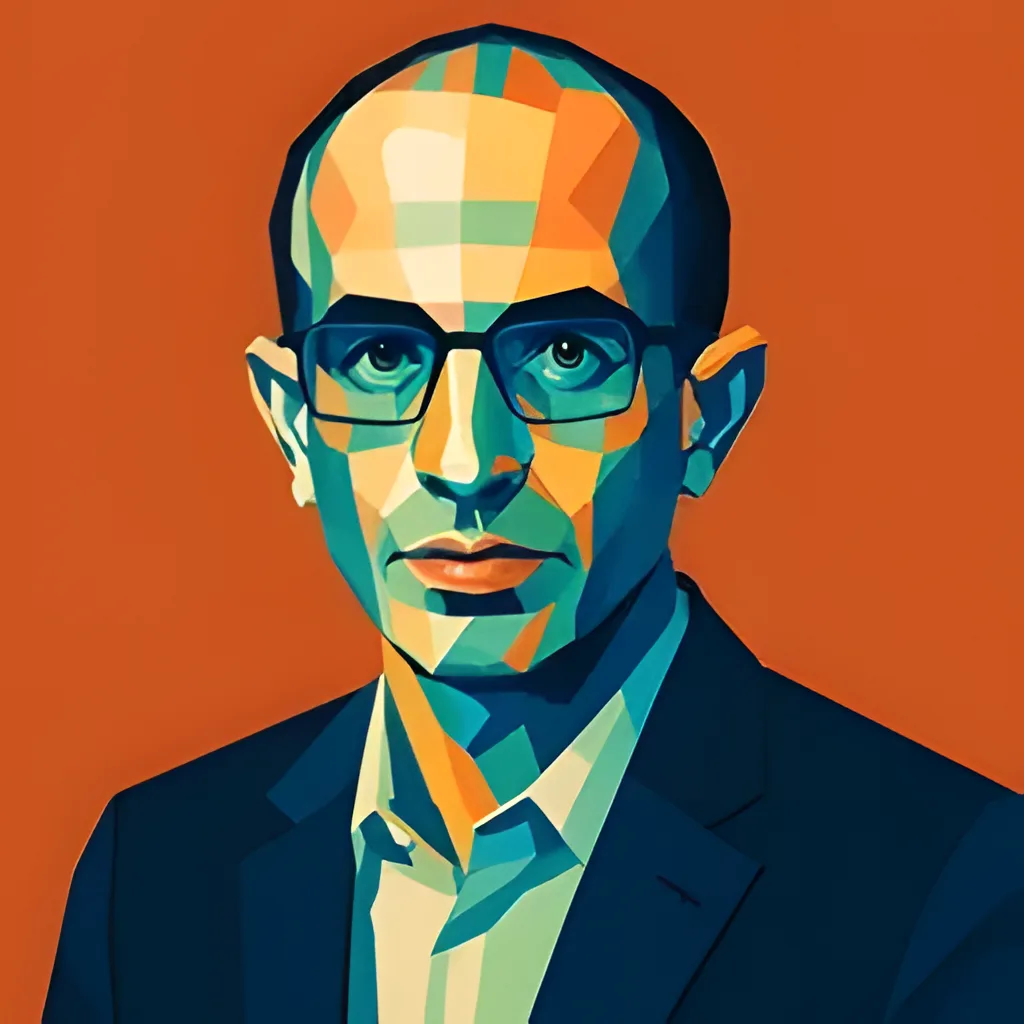
A life in brief
Yuval Noah Harari: life and timeline.
In 2000 an Oxford doctoral student writing about medieval soldiers' memoirs went reluctantly to a ten-day silent meditation retreat, expecting "New Age mumbo-jumbo". Yuval Noah Harari came back with a practice he has kept ever since: two hours a day and a month or more of silence every year. A decade later, the Hebrew University asked him to teach an introductory world-history course. The lectures became Sapiens, first in Hebrew, then in English — and in 2015 Mark Zuckerberg's book club turned a specialist in military history into a global bestselling author.
- 1976
Born in Kiryat Ata
Born 24 February near Haifa into a secular Jewish family. His father, Shlomo, is an armaments engineer; his mother, Pnina, an office administrator. He is a serious child who joins a programme for gifted children in Haifa.
- 1993
Hebrew University
Enters the Hebrew University of Jerusalem at seventeen on the Atuda track, which lets students study before military service. He specialises in medieval military history; he is later exempted from service on health grounds.
- 2000
The first retreat
While a doctoral student at Oxford, he attends a ten-day Vipassana course in England in the tradition of S. N. Goenka. Meditation becomes a daily practice and, he says, central to how he writes.
- 2002
Oxford doctorate
Completes his DPhil at Oxford under Steven Gunn, on soldiers' memoirs and war in the late medieval and early modern periods. The same year he meets Itzik Yahav, later his husband and manager.
- 2011
Sapiens in Hebrew
An introductory world-history course he has taught at the Hebrew University becomes a book, published in Hebrew under a title meaning A Brief History of Humankind. It becomes a bestseller in Israel.
- 2014
Sapiens in English
The English edition of Sapiens is published in Britain. In June 2015 Mark Zuckerberg picks it for his "A Year of Books" club, and Bill Gates and Barack Obama later praise it.
- 2016
Homo Deus
Publishes Homo Deus: A Brief History of Tomorrow, turning from humanity's past to its possible future as biotechnology and algorithms reshape what it means to be human.
- 2018
21 Lessons for the 21st Century
His third major book addresses present-day questions — fake news, work, terrorism and meaning — in a world being transformed by technology.
- 2020
Sapienship and the WHO
After the Trump administration halts US funding to the World Health Organization during the pandemic, he and Yahav announce a $1 million donation to the WHO through their company, Sapienship.
- 2024
Nexus
Publishes Nexus: A Brief History of Information Networks from the Stone Age to AI, arguing that artificial intelligence is the first technology that can make decisions and create ideas on its own.
Major achievements
Yuval Noah Harari: major achievements.
- 01
Sapiens
His history of humankind spent ninety-six consecutive weeks in the top three of the New York Times bestseller list and became one of the most widely read non-fiction books of the century.
- 02
The idea of shared fictions
His argument that money, nations, companies and human rights are "intersubjective" realities — real because millions believe in them — gave a general audience a new way to think about human cooperation.
- 03
A global readership
Across Sapiens, Homo Deus, 21 Lessons, Nexus, graphic adaptations and the children's series Unstoppable Us, his books have sold more than 45 million copies, according to his publishers.
- 04
Framing the AI debate
His warnings that AI could hack human emotions and generate the stories societies live by are cited by policymakers and technologists and shaped Nexus in 2024.
Turning points
Yuval Noah Harari: defining moments.
- 2000
Ten days of silence
A friend pushed him into a Vipassana retreat he expected to dislike. He left with a method for observing his own mind that he had not found in history or philosophy. He has meditated two hours a day since and now assists as a teacher in the same tradition.
- Late 2000s
The course no one wanted
Asked to teach an introductory world-history survey, the kind of course specialists avoid, he said yes. His lectures on why humans farm, believe in gods and trust money drew students from beyond the class and later spread online. Jared Diamond's Guns, Germs, and Steel had convinced him a scholar could ask questions that big.
- June 2015
Zuckerberg's book club
Mark Zuckerberg's choice of Sapiens for "A Year of Books" brought it to a vast American audience. A little-known Israeli historian of medieval warfare became, within months, one of the most quoted public intellectuals in the world.
The Agricultural Revolution was history's biggest fraud.
Sapiens: A Brief History of Humankind, 2014 English edition
What you’ll take away
Lessons from Yuval Noah Harari’s life.
- 01
Big questions are allowed
Harari trained as a narrow specialist. Taking on the survey course nobody wanted showed him that the largest questions were open to anyone willing to synthesise.
- 02
Attention is a discipline
Two hours of daily meditation and long silent retreats are, in his telling, how he learned to tell stories from reality — the distinction at the heart of everything he writes.
- 03
Sweeping stories invite scrutiny
The same breadth that made Sapiens a phenomenon drew sharp criticism from anthropologists and reviewers who accused it of oversimplification. Reach and rigour pull in different directions.
If you liked Yuval Noah Harari…
Browse all →

FAQ
Frequently asked questions about Yuval Noah Harari.
What is Yuval Noah Harari known for?
Sapiens: A Brief History of Humankind. First published in Hebrew in 2011 and in English in 2014, it made him one of the world's best-known historians; Homo Deus, 21 Lessons for the 21st Century and Nexus followed.
How did Yuval Noah Harari make his money?
Mainly from books. Sapiens, first published in Hebrew in 2011 and in English in 2014, became a global bestseller, and his official website says his books have sold 55 million copies in 65 languages, including Homo Deus, 21 Lessons for the 21st Century, Nexus and the children's series Unstoppable Us. He also lectures and co-founded the social-impact company Sapienship with his husband, Itzik Yahav.
Who is Yuval Noah Harari married to?
Itzik Yahav, whom he met in 2002. They married in a civil ceremony in Toronto, and Yahav is also his manager and co-founder of their company, Sapienship.
Did Yuval Noah Harari serve in the IDF?
No. He deferred service through the Atuda programme to study at the Hebrew University and was later exempted for health reasons.
Where did Yuval Noah Harari study?
The Hebrew University of Jerusalem, where he earned his BA in medieval and military history between 1993 and 1998, and the University of Oxford, where he completed a DPhil in 2002.
Is Yuval Noah Harari vegan?
Yes. He has said that researching the dairy industry for Sapiens, especially the separation of calves from their mothers, led him to stop eating animal products.
Is Yuval Noah Harari religious?
No. He grew up in a secular Jewish family and is not observant. He practises Vipassana meditation, which he describes as a method for observing the mind rather than a religious belief.
What is Yuval Noah Harari's latest book?
Nexus, published in 2024, is his latest major book for adults; it argues that AI is the first technology able to make decisions on its own. The third volume of his children's series Unstoppable Us appeared in 2026.
Where is Yuval Noah Harari from?
Israel. He was born in Kiryat Ata, near Haifa, on 24 February 1976, and is a professor of history at the Hebrew University of Jerusalem.
Published by Lyfestori, from Duck Pond Ventures Oy. About us and how to report a correction.
19 min · one sitting