Walter Schloss
Superinvestor
Born on 28 August 1916 in New York City, Walter Schloss started on Wall Street at eighteen as a runner, learned value investing in Benjamin Graham's night classes, and for nearly fifty years ran a tiny partnership that beat the market — earning Warren Buffett's label “superinvestor.”
- 17 min listen
- Value investing
- Graham disciple
- 47-year track record
Walter Schloss’s full 17 min audio biography, Superinvestor, is available on Lyfestori for iOS. Listen to a free preview below.
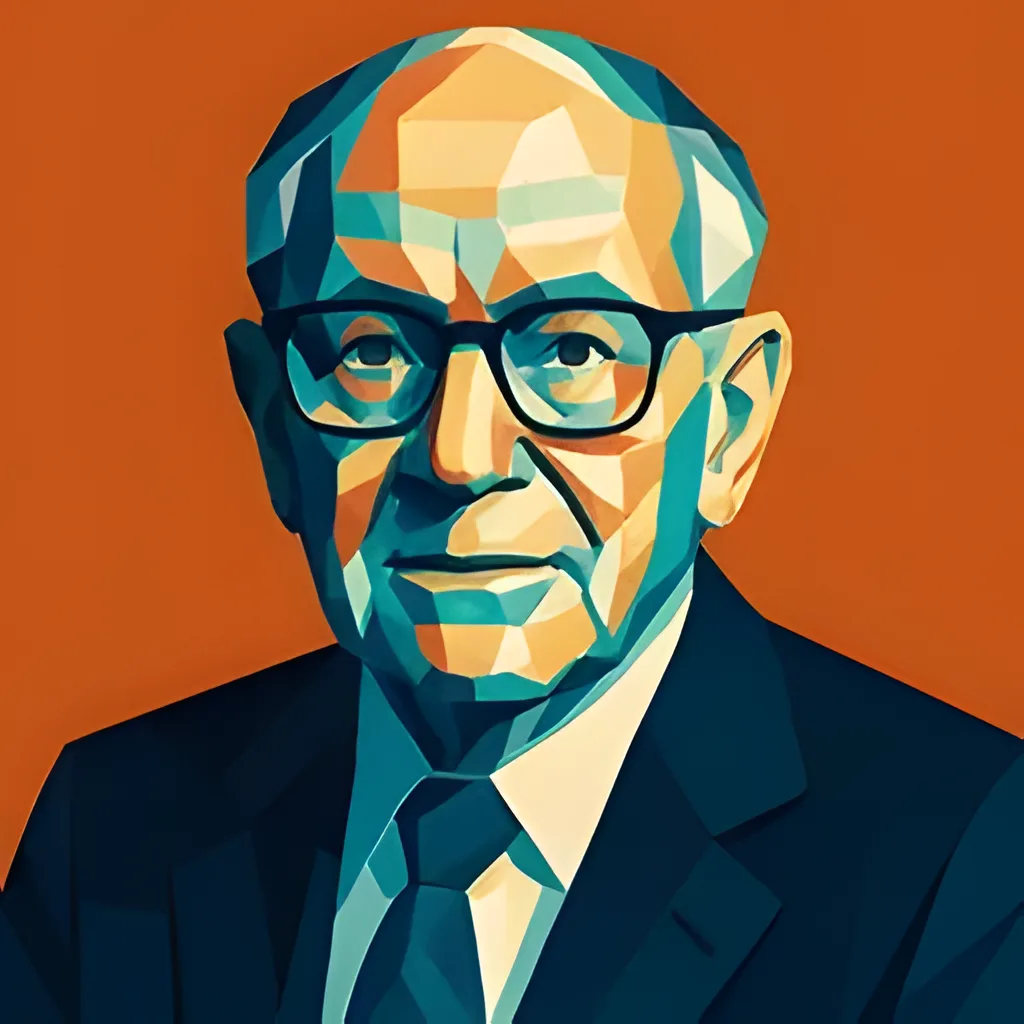
A life in brief
Walter Schloss: life and timeline.
He could not afford college, so in 1934 he took a job as a Wall Street runner for twelve dollars a week. A year later he spent fifteen of them — more than a week's pay — on an evening class taught by Benjamin Graham. Walter Schloss went on to run his partnership for forty-seven years from a small office with no computer and no research staff, reading annual reports and doing the arithmetic himself. He averaged over fifteen percent a year while the market managed ten.
- 1916
Born in New York City
Born 28 August into a middle-class Jewish family. His father is a stockbroker; the Depression teaches him how fast a fortune disappears, and he never stops planning for the worst case.
- 1934
Twelve dollars a week
He graduates high school unable to afford college and takes work as a runner, carrying messages between brokerage firms. He watches everything: what gets bought, what gets sold, how the market behaves.
- 1935
The fifteen-dollar course
At nineteen he enrols in Benjamin Graham's evening class at the New York Institute of Finance. The fee is more than a week's salary. Graham teaches that a stock is a share of a business, not a piece of paper.
- 1946
Graham-Newman
After finishing the course in 1939 and serving in the Army through the war, he joins Graham's firm as a junior analyst at forty-eight dollars a week — working for the man who taught him. A young analyst named Warren Buffett works there too.
- 1955
His own partnership
He launches with $100,000, including $25,000 of his own and small sums from relatives. No management fee: he takes 25% of profits above 6% a year, and earns nothing if his investors don't.
- 1956
On his own
Graham-Newman closes. Graham offers to help him find another job. He runs his own book instead, holding 100 to 200 stocks at a time, all research done by hand.
- 1973
Edwin joins
His son becomes a partner and the firm is renamed Walter & Edwin Schloss Associates. Two men and a secretary manage hundreds of millions of dollars.
- 1984
Superinvestor
Warren Buffett publishes "The Superinvestors of Graham-and-Doddsville" and features him prominently. It brings recognition he never sought — he thought publicity made undervalued stocks harder to find.
- 2000
The bubble he skipped
He had refused to buy technology stocks through the late 1990s because they failed his value tests. He missed the gains, and then he missed the collapse.
- 2002
Closing the partnership
At eighty-six he returns his investors' money while his performance is still strong. Final tally: 47 years averaging over 15% a year against the market's 10%.
- 2012
Death
He dies on 19 February at ninety-five, having spent over sixty years doing one thing the same way.
Major achievements
Walter Schloss: major achievements.
- 01
Forty-seven years of outperformance
His partnership averaged over fifteen percent annually against roughly ten percent for the market — through the 1960s boom, the 1970s crashes, and every cycle in between.
- 02
A thousand dollars into eight hundred thousand
An investment of $1,000 made with him in 1956 was worth over $800,000 when he closed the partnership in 2002.
- 03
A fee structure that cost nothing to be wrong about
He charged no management fee at all, taking 25% of profits above 6% a year. If his investors made nothing, neither did he.
- 04
One of Buffett's superinvestors
Buffett's 1984 essay "The Superinvestors of Graham-and-Doddsville" named him as proof that Graham's principles, not luck, produced sustained market-beating returns.
- 05
The annual letters
Plain-spoken, honest about mistakes, and never promising spectacular results. They are now studied as classics of investor communication.
Turning points
Walter Schloss: defining moments.
- 1934
No college, so Wall Street
He was not an exceptional student and there was no money for university. Being a runner at twelve dollars a week was the only door open — and it put him inside the market at eighteen, watching how it actually worked.
- 1935
Fifteen dollars on an evening class
More than a week's wages, spent on a course by a lecturer he had never heard of. Graham's argument — that a stock is a stake in a real business with a measurable value — settled his method for the next sixty-seven years.
- 1955–1956
Turning down the safe job
When Graham-Newman wound up, Graham offered to place him somewhere. He wanted to run the principles himself instead, on his own account and his friends'. He started with $100,000 and no staff.
- 1996–2000
Sitting out the bubble
Clients had questioned him during the 1960s growth boom and again in the 1980s over leverage. In the late 1990s the tech stocks failed his tests, so he didn't buy them. He looked wrong for years, then the bubble burst.
What you’ll take away
Lessons from Walter Schloss’s life.
- 01
Simple, repeated for decades, beats clever
Buy below book value, hold 100-200 names, wait. No computer, no staff, no forecasts. The method was plain enough for anyone to copy; almost nobody had the patience to.
- 02
Know exactly what you can't do
He never claimed to predict the future or time a market. He controlled the only two things he could — the price he paid and how many bets he spread it across — and let the rest happen.
- 03
Protect the downside and the upside handles itself
He lagged in the 1960s and looked foolish in the 1990s. He never had a year that destroyed him either, and steady compounding over 47 years turned a thousand dollars into eight hundred thousand.
Did you know
Facts about Walter Schloss.
- 01
Did you know that legendary investor Walter Schloss never went to college, instead beginning his Wall Street career at age 18 as a runner?
- 02
Did you know that Schloss shared an office space at Graham-Newman with Warren Buffett, who famously dubbed him a 'Superinvestor of Graham-and-Doddsville'?
- 03
Did you know that Walter Schloss operated his phenomenally successful investment fund for 45 years without ever owning a computer or using a stock ticker?
If you liked Walter Schloss…
Browse all →


FAQ
Frequently asked questions about Walter Schloss.
Who is Walter Schloss?
An American value investor who worked for Benjamin Graham and then ran his own partnership from 1955 to 2002, with no research staff and a single small office. Warren Buffett featured him in his 1984 essay “The Superinvestors of Graham-and-Doddsville” as proof that Graham's methods could beat the market.
How did Walter Schloss die?
Of leukaemia, at his home in Manhattan on 19 February 2012, aged ninety-five.
What were Walter Schloss's returns?
Over forty-seven years his partnership averaged more than fifteen percent annually, against about ten percent for the overall market. A $1,000 investment made in 1956 would have been worth over $800,000 by the time he closed the fund in 2002.
Did Walter Schloss go to college?
No. He graduated high school in 1934 and couldn't afford it, so he became a Wall Street runner at twelve dollars a week. His entire formal training in investing was an evening course taught by Benjamin Graham in 1935, which cost fifteen dollars.
How did his approach differ from Warren Buffett's?
They met as young analysts at Graham-Newman and both learned from Graham, but diverged. Buffett moved toward buying great companies at fair prices. Schloss stayed with Graham's original method: buying average companies at bargain prices, below book value, and waiting.
Why is he called a superinvestor?
From Warren Buffett's 1984 article "The Superinvestors of Graham-and-Doddsville," which highlighted investors who had consistently beaten the market using value principles. Schloss was featured prominently, though he remained largely unknown to the public and preferred it that way.
What tools did he use?
Annual reports, a calculator, and his own analysis. He had no computer, no research staff, and no special access. For most of the later years the firm was him, his son Edwin, and a secretary, managing hundreds of millions of dollars.
Published by Lyfestori, from Duck Pond Ventures Oy. About us and how to report a correction.
17 min · one sitting