Muhammad Ali
The Man Who Shook Up the World
Born Cassius Marcellus Clay Jr. on 17 January 1942 in Louisville, Kentucky, Muhammad Ali won Olympic gold at eighteen, became world heavyweight champion three times and gave up three and a half years of his prime by refusing the Vietnam draft — a stand the US Supreme Court vindicated in 1971.
- 15 min listen
- Heavyweight champion
- Olympic gold medallist
- Draft resister
Muhammad Ali’s full 15 min audio biography, The Man Who Shook Up the World, is available on Lyfestori for iOS. Listen to a free preview below.
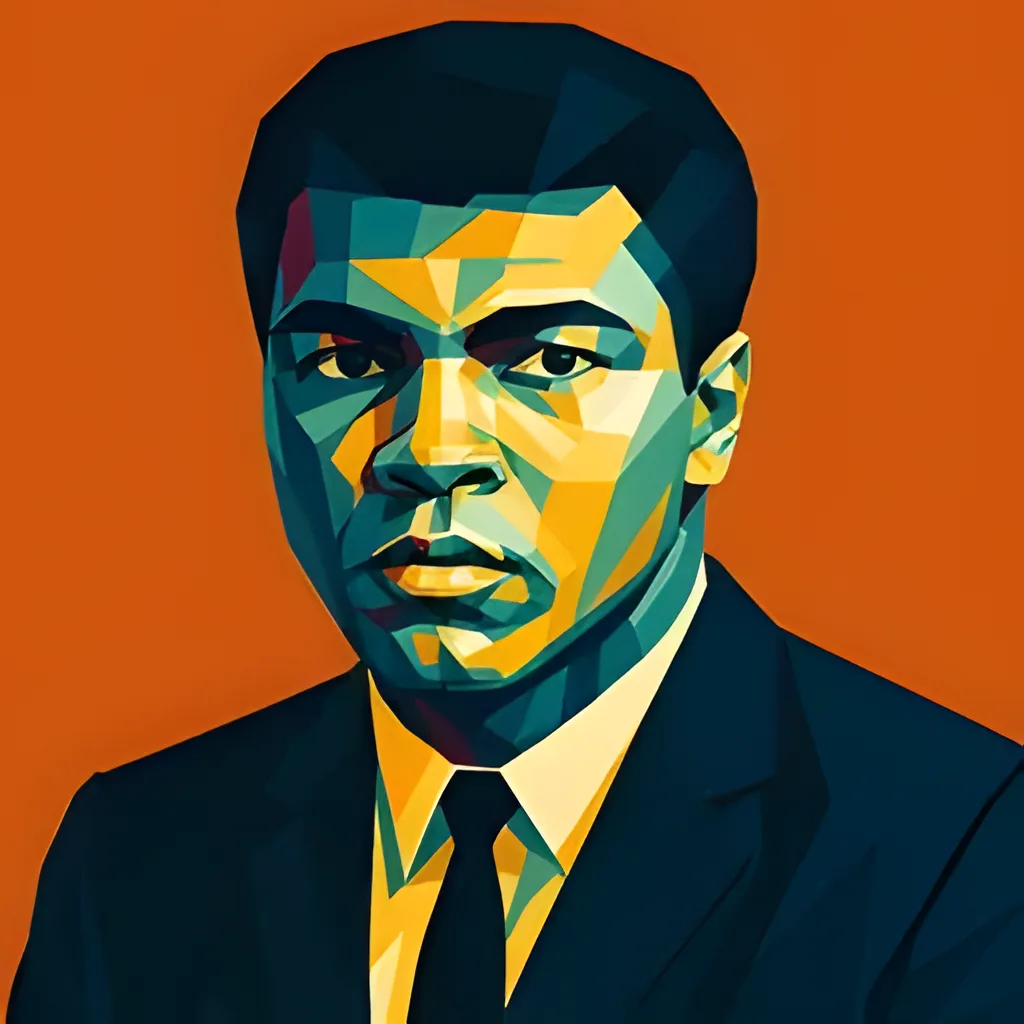
A life in brief
Muhammad Ali: life and timeline.
In October 1954 somebody stole a twelve-year-old's red Schwinn bicycle in Louisville, and the policeman he went to complain to ran a boxing gym in the basement. Six years later Cassius Clay won Olympic gold in Rome. At twenty-two he beat Sonny Liston and shouted that he had shaken up the world. Then he became Muhammad Ali, refused induction into the US Army in 1967 and lost three and a half years of his prime. He came back and won the heavyweight title twice more.
- 1942
Born in Louisville
Born Cassius Marcellus Clay Jr. on 17 January, the son of a sign painter and a domestic worker, Odessa. He grows up in a pink house on Grand Avenue in Louisville's segregated West End.
- 1954
The stolen bicycle
At twelve, furious that his bike has been stolen, he is sent to police officer Joe Martin, who tells him to learn to fight first. He starts training in Martin's basement gym almost immediately.
- 1960
Olympic gold in Rome
On 5 September he beats Poland's Zbigniew Pietrzykowski in the light heavyweight final. Weeks later he turns professional, backed by a group of Louisville businessmen and trained in Miami by Angelo Dundee.
- 1964
Champion at twenty-two
A heavy underdog, he outboxes Sonny Liston in Miami Beach until Liston fails to come out for the seventh round. Soon afterwards he confirms he has joined the Nation of Islam and takes the name Muhammad Ali.
- 1967
Refusing induction
On 28 April in Houston he does not step forward when his name is called. He is stripped of his title, loses his boxing licence and passport, and is convicted and sentenced to five years in prison and a $10,000 fine.
- 1971
Frazier and the Supreme Court
Back in the ring since October 1970, he suffers his first professional defeat to Joe Frazier in March. In June the Supreme Court overturns his conviction 8–0, with Thurgood Marshall not taking part.
- 1974
The Rumble in the Jungle
At four in the morning on 30 October in Kinshasa, Zaire, he leans on the ropes and lets the undefeated George Foreman punch himself out. In the eighth round he knocks Foreman down and regains the title.
- 1978
Three-time champion
He loses the title to Leon Spinks in February and wins it back in September, becoming the first man widely recognised as a three-time world heavyweight champion.
- 1981
The last fight
He loses to Trevor Berbick in December and retires with a professional record of fifty-six wins and five defeats.
- 1984
Parkinson's diagnosis
At forty-two he is diagnosed with a Parkinsonian syndrome. His hands begin to shake and the famous voice slows towards a whisper.
- 1996
Lighting the cauldron
Trembling, he lights the Olympic cauldron at the Atlanta Games in front of a vast global audience — honoured by the country that once tried to imprison him.
- 2016
Death in Scottsdale
He dies on 3 June in Scottsdale, Arizona, at seventy-four. His funeral is watched around the world and he is buried in Louisville.
Major achievements
Muhammad Ali: major achievements.
- 01
Three heavyweight titles
Champion in 1964, 1974 and 1978, he was the first man widely recognised as a three-time world heavyweight champion, fighting sixty-one times as a professional and winning fifty-six.
- 02
Olympic gold at eighteen
He won the light heavyweight gold medal at the 1960 Rome Olympics after six Kentucky Golden Gloves titles and two national Golden Gloves championships.
- 03
Rope-a-dope
Against George Foreman in Kinshasa he abandoned the plan to dance, lay on the ropes and let a younger, stronger champion exhaust himself — one of boxing's most famous tactical gambles.
- 04
Clay v. United States
His refusal of the draft on religious grounds cost him his title and licence. In 1971 the Supreme Court unanimously reversed his conviction because the government had not given a legally adequate reason for rejecting his conscientious objector claim.
- 05
Hostages home from Iraq
In November 1990, already visibly affected by Parkinson's, he flew to Baghdad, met Saddam Hussein and secured the release of fifteen American hostages.
Turning points
Muhammad Ali: defining moments.
- Age twelve
A bicycle and a boxing gym
The theft of his red Schwinn sent him to Joe Martin's gym, and he won his first amateur fight soon afterwards. Martin and trainer Fred Stoner gave a fast, cocky boy discipline and ring craft. Within six years he was an Olympic champion.
- Early 1960s
Learning the show
Watching the wrestler Gorgeous George, he saw how much money a loud, theatrical persona could draw — from fans who loved him and fans who paid to see him lose. He started rhyming, predicting rounds and calling himself The Greatest. Many sportswriters hated it, and it made him the biggest attraction in the sport.
- 1967–1970
The price of refusing
Refusing induction cost him his title, his licence, his passport and three and a half years at or near his physical peak. He lectured on college campuses and appeared briefly on Broadway to get by, and never said he regretted the stand. As opposition to the war grew, so did the number of Americans who saw him as a symbol of conscience.
- 1984 onwards
A second life after the ring
Parkinson's took his speed and then his voice. He became instead a humanitarian figure: the Iraq hostage mission, the Atlanta cauldron and appointment as a United Nations Messenger of Peace. He also expressed regret for the cruel things he had said about Joe Frazier.
I ain't got no quarrel with them Viet Cong.
Muhammad Ali, 1966, after being reclassified as eligible for the draft
What you’ll take away
Lessons from Muhammad Ali’s life.
- 01
Principles are paid for in years
Ali's refusal was not a gesture. It cost him the title, millions of dollars and the best seasons of a fighter's life — which is exactly why people believed him afterwards.
- 02
Make the attention work for you
He borrowed his persona from a wrestler and turned insults into ticket sales. Being hated by sportswriters was part of the business plan.
- 03
You are allowed to change
He changed his name, his religion and his politics, broke with Malcolm X and later regretted how he had spoken about Frazier. Loud certainty and later reflection were both part of the same man.
If you liked Muhammad Ali…
Browse all → Boxer17 min
Mike Tyson
The Baddest Man On The Planet
 Civil Rights Leader17 min
Malcolm X
The Revolutionary Who Transformed Black Consciousness in America
 Civil Rights Leader16 min
Martin Luther King Jr.
The Preacher Who Led America's Fight for Civil Rights
 Footballer17 min
Cristiano Ronaldo
The Boy Who Refused to Be Ordinary
FAQ
Frequently asked questions about Muhammad Ali.
What was Muhammad Ali's real name?
Cassius Marcellus Clay Jr. He was named after his father, who was in turn named after a 19th-century Kentucky abolitionist. He changed it in 1964 after joining the Nation of Islam, whose leader Elijah Muhammad gave him the name Muhammad Ali.
Why did Muhammad Ali change his name?
Because of his conversion to the Nation of Islam in 1964. He regarded Clay as a slave name. Many newspapers, broadcasters and opponents kept calling him Clay for years, and some opponents taunted him with it in the ring.
How did Muhammad Ali get into boxing?
Through a stolen bicycle. In October 1954, aged twelve, he reported the theft to Louisville police officer Joe Martin, who ran a boxing gym and told him he should learn to fight before confronting anyone.
Did Muhammad Ali go to jail for refusing the draft?
No. He was convicted in 1967 and sentenced to five years in prison, but stayed free while he appealed. In June 1971 the Supreme Court overturned the conviction unanimously.
Did Muhammad Ali ever lose a fight?
Yes, five times as a professional: to Joe Frazier in 1971, Ken Norton in 1973, Leon Spinks in 1978, Larry Holmes in 1980 and Trevor Berbick in 1981. He finished with fifty-six wins.
When did Muhammad Ali retire?
In 1981, after losing to Trevor Berbick in December. He was thirty-nine, and three years later he was diagnosed with a Parkinsonian syndrome.
How did Muhammad Ali die?
From septic shock, after being taken to hospital with a respiratory problem. He died on 3 June 2016 in Scottsdale, Arizona, at seventy-four, having lived with Parkinson's for more than thirty years.
Where did Muhammad Ali grow up?
In Louisville, Kentucky. His family lived in a small house on Grand Avenue in the city's West End, in a segregated city, and he graduated from Central High School before turning professional.
Published by Lyfestori, from Duck Pond Ventures Oy. About us and how to report a correction.
15 min · one sitting