Peter Thiel
The Contrarian Billionaire Who Shaped Silicon Valley
Born Peter Andreas Thiel on 11 October 1967 in Frankfurt, West Germany, and raised in Cleveland, southern Africa and California, Peter Thiel co-founded PayPal and Palantir, made Facebook's first outside investment, and became Silicon Valley's best-known contrarian with Zero to One.
- 15 min listen
- PayPal co-founder
- Venture capital
- Contrarian
Peter Thiel’s full 15 min audio biography, The Contrarian Billionaire Who Shaped Silicon Valley, is available on Lyfestori for iOS. Listen to a free preview below.
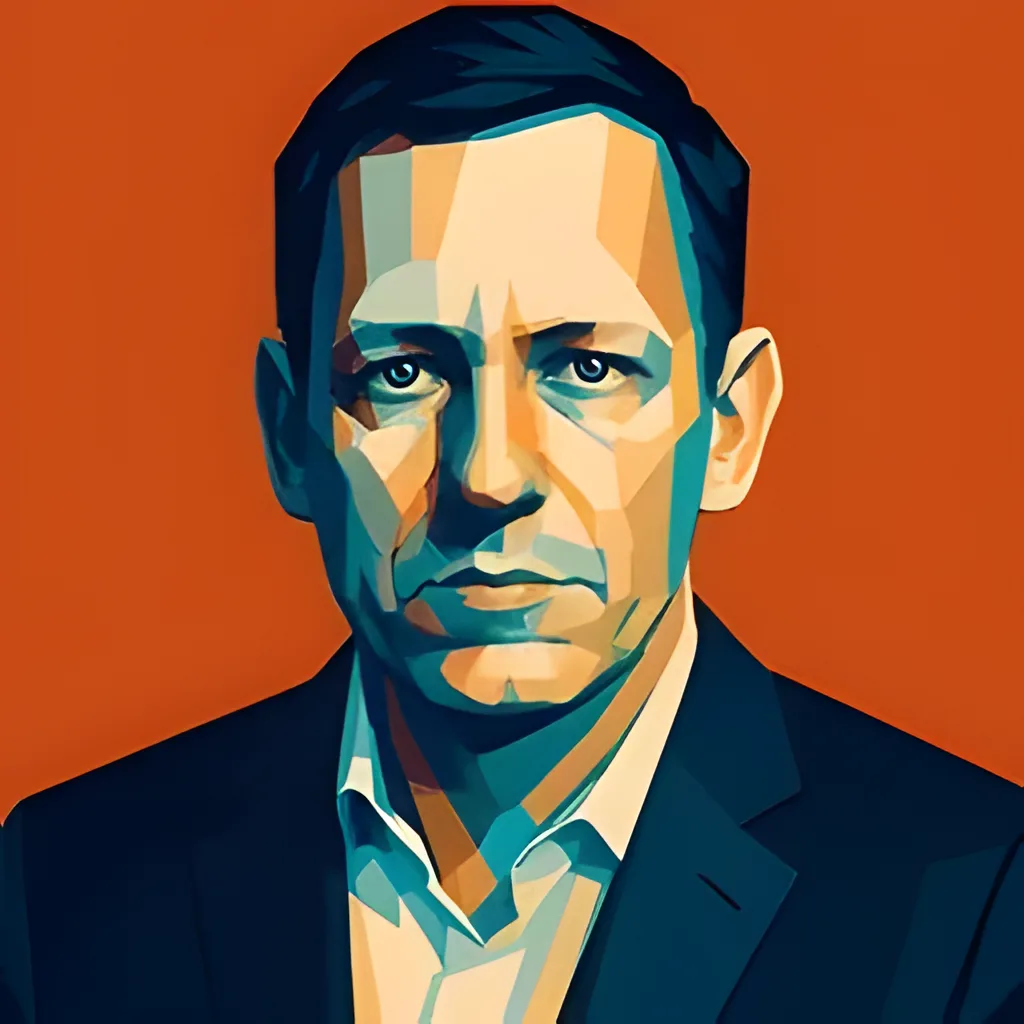
A life in brief
Peter Thiel: life and timeline.
He lasted seven months at a New York law firm. Peter Thiel had done everything right — Stanford philosophy, Stanford Law, a federal clerkship, Sullivan & Cromwell — and found the conformity unbearable. He co-founded PayPal instead, was handed the CEO's chair by the board while Elon Musk was travelling, and wrote a $500,000 cheque to a Harvard undergraduate named Mark Zuckerberg. He argues competition is destructive and monopoly pays for invention. Silicon Valley has never quite decided what to do with him.
- 1967
Born in Frankfurt
Born 11 October in West Germany to Klaus and Susanne Thiel. His father's work as a chemical engineer for mining companies moved the family often; they emigrated to the United States when he was one and settled in Foster City, California.
- 1987
The Stanford Review
While studying philosophy he co-founds a conservative student paper set against the university's dominant liberal culture. He also encounters René Girard, whose theory that people want things because others want them shapes everything he later says about competition.
- 1992
A law degree, and out
He takes his JD from Stanford Law, edits the Stanford Law Review, clerks for Judge James Larry Edmondson on the Eleventh Circuit, and joins Sullivan & Cromwell in New York. He leaves after seven months.
- 1998
Confinity
With Max Levchin and Luke Nosek he starts a company building security software for handheld devices. It pivots to digital payments, and the product is PayPal — money sent by email address, without a bank in the middle.
- 2000
The X.com merger
Confinity merges with Elon Musk's online bank in March, keeping the PayPal name. The two men clash over direction. In October, while Musk is travelling, the board replaces him as CEO with Thiel.
- 2002
eBay buys PayPal
The July sale for $1.5 billion in stock nets Thiel roughly $55 million. It also scatters the 'PayPal Mafia' — the alumni who go on to found and fund much of Silicon Valley.
- 2003
Palantir
Co-founded with Alex Karp, Joe Lonsdale, Stephen Cohen and Nathan Gettings, and named for the seeing stones in Tolkien. It builds data analysis software for government; clients come to include the CIA, the FBI and the military. He has chaired it since.
- 2004
The Facebook cheque
He puts $500,000 into a Harvard student's startup for roughly a 10 percent stake and a board seat — the first outside money into Facebook, and eventually worth billions.
- 2005
Founders Fund
His venture firm, built to back fundamentally new technology rather than incremental improvement. The portfolio comes to include SpaceX, Airbnb and Stripe.
- 2011
The Thiel Fellowship
He starts paying people under twenty-three $100,000 over two years to skip university and build companies instead — an argument with higher education, made with money.
- 2014
Zero to One
His book, drawn from Stanford lectures, argues that competition is destructive and that entrepreneurs should build monopolies, because monopoly profits are what pay for long-term invention. It becomes a bestseller.
- 2016
The Republican Convention
He speaks in support of Donald Trump, startling an industry that leans Democratic and drawing sharp criticism from colleagues and partners.
Major achievements
Peter Thiel: major achievements.
- 01
PayPal
Co-founded as Confinity in 1998 and led as CEO from 2000. It became the default way to pay on eBay, was processing billions a year by 2002, and sold to eBay for $1.5 billion — while seeding the network of founders who built much of the next two decades of Silicon Valley.
- 02
Palantir
Co-founded in 2003 and chaired ever since. Its software finds patterns in enormous data sets for governments and corporations, which has made it both one of the Valley's most valuable companies and one of its most contested.
- 03
The first cheque into Facebook
$500,000 in 2004 for around 10 percent and a board seat, at a moment when a college social network was not an obvious bet. He was much older than the founders and politically nothing like them, and backed it anyway.
- 04
Founders Fund
Established in 2005, it has invested in hundreds of companies — SpaceX, Airbnb, Stripe among them — on the thesis that the returns are in new technology, not in improving what exists.
- 05
Zero to One
The 2014 book that gave a generation of founders their argument: create a new market rather than fight for share of an old one. Contrarian by design, and widely adopted.
Turning points
Peter Thiel: defining moments.
- After 1992
Seven months
He had assembled the perfect credential stack — Stanford, Stanford Law, the Law Review, a federal clerkship, a white-shoe firm in New York — and discovered that the hierarchy and conformity of it were intolerable. Walking out of the thing he had spent a decade qualifying for is the pattern the rest of the career repeats.
- 1998–2002
PayPal
A pivot from handheld security software to sending money by email built the company, and a boardroom coup while his co-founder's rival was out of the country handed him the top job. It ended in a $1.5 billion sale and about $55 million for him — the stake that funded everything after.
- 2004
Betting on a Harvard undergraduate
$500,000 to Mark Zuckerberg made him Facebook's first outside investor and, eventually, a billionaire. It also demonstrated his actual method: the returns are in the thing nobody else is willing to take seriously yet.
- 2016
Breaking with his industry
Endorsing Trump at the Republican Convention cost him standing across a liberal industry, and drew particular criticism given his own position as a gay man. He answered that diversity of thought matters more than demographic diversity, and that the Valley's orthodoxy was making it less innovative.
What you’ll take away
Lessons from Peter Thiel’s life.
- 01
Competition is a copy of someone else's want
Girard taught him that people desire things because other people desire them. Follow that and you end up fighting over a crowded market. His whole method is refusing the thing everyone is already chasing.
- 02
Quit the prize once you've won it
The federal clerkship and the New York firm were the reward for a decade of correct decisions. He gave them seven months. Sunk credentials are still sunk costs.
- 03
Conviction has a price and a bill
The contrarianism that found Facebook also produced the Gawker campaign and an industry that distrusts him. The same trait rarely sorts itself into the parts you admire and the parts you don't.
Did you know
Facts about Peter Thiel.
- 01
Did you know that billionaire venture capitalist Peter Thiel was a nationally ranked chess master in his youth and still plays competitively on occasion?
- 02
Did you know that Thiel was the first outside investor in Facebook, acquiring a 10.2% stake in the company for just $500,000 in 2004?
- 03
Did you know that Thiel founded the Thiel Fellowship, which famously pays young students $100,000 to drop out of college and start their own companies instead?
If you liked Peter Thiel…
Browse all → AI Executive16 min
Sam Altman
Silicon Valley's AI Pioneer
 Entrepreneur & Investor16 min
David Sacks
The Strategist Behind the Startups
 Founder22 min
Elizabeth Holmes
The Rise and Fall of Silicon Valley's Youngest Billionaire
 Economist17 min
Adam Smith
The Father of Modern Economics Who Shaped How We Think About Wealth and Society
FAQ
Frequently asked questions about Peter Thiel.
How did Peter Thiel make his money?
Through a few very early bets. He made about $55 million when eBay bought PayPal in 2002, then put $500,000 into Facebook in 2004 for roughly a tenth of the company — a stake he later sold for more than a billion dollars. He also co-founded the data-analytics company Palantir in 2003 and the venture firm Founders Fund in 2005.
What did Peter Thiel do before PayPal?
Law and finance. After Stanford Law School he clerked for a federal appeals judge, lasted seven months as a securities lawyer at Sullivan & Cromwell in New York, and traded derivatives at Credit Suisse before starting his own fund, Thiel Capital Management, in 1996. Two years later he co-founded Confinity, which became PayPal.
Where did Peter Thiel grow up?
All over. Born in Frankfurt, he moved to Cleveland as a baby, then spent part of his childhood in South Africa and South West Africa — today's Namibia — where his father worked in mining. He changed elementary schools seven times before the family settled in Foster City, California, in 1977.
What does Zero to One argue?
That competition is destructive and entrepreneurs should aim to build monopolies through innovation. Thiel's case is that competitive markets force companies into short-term survival, while monopoly profits are what fund breakthrough technology. The book came out of lectures he gave at Stanford and became a bestseller.
How much did Peter Thiel make from PayPal?
Roughly $55 million when eBay bought the company for $1.5 billion in stock in July 2002. Elon Musk, the largest individual shareholder, received significantly more. The sale also created the 'PayPal Mafia', the alumni network that went on to found or fund many of Silicon Valley's biggest companies.
How did Thiel end up as Facebook's first investor?
In 2004 he put $500,000 into Mark Zuckerberg's startup, then called The Facebook, taking roughly a 10 percent stake and a board seat. It was contentious from the start — he was much older than the founders and his politics were sharply at odds with the Valley's — but it eventually proved worth billions.
What was Thiel's role in the Gawker case?
He secretly funded Hulk Hogan's lawsuit against Gawker Media, which ended in the site's bankruptcy. It provoked a lasting argument about whether a wealthy individual should be able to fund litigation that destroys a publication, and about press freedom and accountability.
Published by Lyfestori, from Duck Pond Ventures Oy. About us and how to report a correction.
15 min · one sitting